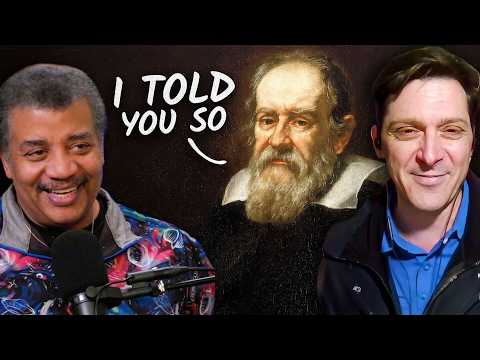
Scientists Who Got In Trouble for Being Right, with Matt Kaplan
Audio Summary
AI Summary
This discussion explores the contentious relationship between science and other societal forces throughout history, highlighting instances where groundbreaking scientific discoveries faced ridicule, exile, or suppression. Matt Kaplan, a science correspondent and author, shares anecdotes from his book, "Told You So: Scientists Who Were Ridiculed, Exiled, and Imprisoned for Being Right," emphasizing that science is not a purely objective enterprise but is heavily influenced by culture, politics, and human nature.
The conversation begins by tracing the origins of science's separation from religious institutions, particularly in the 15th and 16th centuries. Galileo Galilei is presented as a pivotal figure who, through his observations with the newly invented telescope, challenged the geocentric model championed by the Church. Galileo's work, particularly his book *Il Saggiatore*, is credited with establishing the scientific method: asking questions, exploring them, and drawing conclusions based on findings. Despite facing accusations of heresy, Galileo's diplomatic skills and powerful connections protected him from the severe fates of others who challenged established dogma. Unlike the popular narrative, Galileo was not tortured but rather lived comfortably during his house arrest, thanks to his influential friends.
The discussion then delves into the state of medicine, which for centuries was riddled with ineffective, and often harmful, practices rooted in ancient Greek notions like the "humors." The practice of bloodletting, for example, persisted for a long time because while it might lower a fever, it often led to death from blood loss. It took hundreds of years for the scientific method to be applied to medicine. Pierre Charles Alexandre Louis, a French physician in the early 19th century, is highlighted as one of the first to rigorously question the efficacy of practices like leeching. Through his experiments, he demonstrated that early application of leeches in pneumonia patients led to higher mortality rates, a finding that challenged established medical beliefs. However, his work was largely ignored due to the entrenched interests of the "leech lobby," a significant industry at the time.
A particularly poignant story is that of Ignaz Semmelweis, a Hungarian obstetrician working in Vienna in the 1840s. Semmelweis observed alarmingly high death rates (around 20%) from puerperal fever (childbed fever) in a hospital ward attended by doctors, compared to a much lower rate in a ward attended by nurses. He meticulously investigated various potential causes, from diet to the presence of a priest, but found no correlation. It was only after a colleague died from an infection similar to puerperal fever, contracted during a post-mortem dissection, that Semmelweis made the critical connection. He realized that doctors, who frequently moved between dissecting cadavers and delivering babies, were inadvertently transmitting "particles of death" (unknown to be bacteria at the time) to their patients.
Semmelweis's solution was to mandate handwashing with chlorinated lime solution for all doctors before examining patients. This intervention dramatically reduced the mortality rate from 21% to zero in the doctors' ward. However, despite the undeniable success, Semmelweis faced intense opposition from his peers and superiors. His lack of diplomacy, his open criticism of established medical authorities, and his political affiliations in support of Hungarian rebels against the Austrian Empire led to his dismissal and eventual exile. Tragically, he was later committed to an asylum by his own peers, where he died.
In stark contrast to Semmelweis's fate, the conversation introduces Louis Pasteur, whom Kaplan describes as brilliant, tenacious, and devious. Pasteur was a master of self-promotion and understood the importance of political connections and public demonstrations. While celebrated as a national hero for his anthrax and rabies vaccines, later examination of his personal journals revealed significant fraud. Pasteur had publicly denounced the methods of veterinarian Henry Toussaint, who advocated killing microbes to create vaccines, while secretly adopting Toussaint's method for his own successful anthrax vaccine. He also effectively stole the rabies vaccine mechanism from another veterinarian, Pierre Galtier, and suppressed evidence of patient deaths during his trials. Pasteur's career was a testament to how charisma, political savvy, and even unethical behavior could lead to fame and funding, while others, like Toussaint and Galtier, died in obscurity.
The discussion then shifts to more contemporary examples, highlighting the story of Katalin Karikó, a Hungarian biochemist who worked on messenger RNA (mRNA) in the 1990s. Despite its immense potential for developing new medicines and vaccines, mRNA research was considered a "dead end" by the academic community. Karikó struggled to secure grants, was demoted, and eventually fired from her university, facing threats of deportation. Her perseverance, however, led her to BioNTech, where her work with immunologist Drew Weissman (who identified the immune system's rejection of injected mRNA) ultimately paved the way for the incredibly successful COVID-19 mRNA vaccines, earning her a Nobel Prize. Karikó's story echoes Semmelweis's in that both were brilliant scientists whose groundbreaking ideas were initially dismissed and whose careers suffered due to institutional biases and a lack of social or political influence.
The overarching theme is that science, while aiming for objectivity, is deeply human. Factors like ego, economic interests, political pressures, and the power of established narratives can significantly impede progress and harm individual scientists. The "conservatism of science," while necessary for filtering out "batshit crazy ideas," can also lead to the unjust rejection of truly innovative concepts. The speakers emphasize that while skepticism and debate are crucial to the scientific process, character assassination, imprisonment, or exile are unacceptable.
The conversation concludes with a call for greater transparency and improved communication about how science actually works. The public often perceives science as an "answer machine," leading to cynicism when scientific understanding evolves or debates arise, as was evident during the COVID-19 pandemic. To counter anti-science sentiments and foster a more informed public, scientists and journalists have a responsibility to explain the process of scientific inquiry—including its debates, uncertainties, and occasional errors—rather than just presenting final discoveries. Furthermore, systemic changes, such as democratizing research funding through lotteries for well-vetted proposals and establishing stricter penalties for scientific fraud, could help mitigate the negative influences of bias and pressure, ensuring that brilliant ideas, regardless of their proponents' social skills or political connections, receive the attention they deserve.