Ferrari's Head Designer Agreed To REDESIGN Our F12.. Then This Happened
Audio Summary
AI Summary
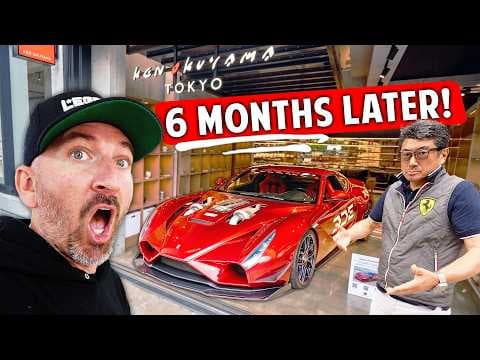
The video opens with the narrator reflecting on a supercar purchase made 2,348 days ago – a Ferrari F12, powered by one of the best-sounding V12s ever built. The initial goal was to create the world's first top-mounted twin-turbo Ferrari, a project that saw multiple failures before they successfully built it themselves. However, the car still looked stock, despite its insane performance, leading to the decision to pursue a more radical aesthetic. This quest brought the narrator to Tokyo, Japan, to meet Ken Okuyama, the original designer of the F12 and a designer of iconic one-off cars.
Ken Okuyama welcomes the narrator and his companion, Steve, to his design studio, which Steve describes as a "theme park of design." Okuyama reveals a secret project he's working on, exciting the visitors. They are first shown a car that Okuyama designed and built, which, despite having some internal components from a Ferrari 599, is largely bespoke. The chassis is from a 599, utilizing its VIN for street legality, but it has been widened by four inches. The engine is the same, but the car features a custom windshield and a lowered bulkhead, contributing to its significantly lower and wider appearance.
Okuyama points out design elements, noting a "projection in the front" that evokes the Enzo Ferrari. He explains that the design incorporates aerodynamic features, such as radiators that take air from the center and vent it through the front fenders to prevent front lift. He shares that the car’s design was inspired by the 1957 Ferrari Testa Rossa's pontoon fenders, aiming to modernize that concept. The vehicle, referred to as "Code 57," features bespoke LED lights and milled aluminum components, with everything digitized for 3D printing and carbon fiber construction.
The narrator expresses admiration for the car's cohesive design, stating it's hard to find words for it. Okuyama reveals they made five of these cars and are working on a sixth. He emphasizes his philosophy of creating a "nice meal" where all the details blend into one strong theme, a quality he feels is often missing in modern car design. He criticizes the trend of excessive screens in cars, which quickly dates them, and praises the analog gauges in his design, advocating for a driving experience where the human, not the computer, is in control.
Okuyama explains his design process, which begins with asking clients about their dream car and its intended use (track, daily driving, or static enjoyment). This personalized approach allows him to pull ideas from the client's brain and develop a truly bespoke creation. He mentions that the car they are currently viewing is a right-hand drive, semi-automatic version, making it truly one-of-one, as the other five were left-hand drive manual transmissions.
He demonstrates the "bonsai doors," which open upwards, revealing heavy-duty billet hinges. The narrator jokes about driving with the doors up. Okuyama clarifies that while they are a third party, they showed their designs to Ferrari in Maranello before public display. Ferrari appreciated the gesture, and although they couldn't grant permission to use their name or logo, the car belongs to its owner and is registered as a modified 599.
Okuyama shares the impressive value appreciation of his creations. Code 57, car number one, initially sold for $1 million domestically. It was later resold to a collector in Germany for $8 million, demonstrating the demand and appreciation for these unique vehicles. He contrasts this with Van Gogh's paintings, which only appreciated after his death, jokingly noting his good fortune. He reveals that from the initial conversation with a client over wine to deciding on the design takes about a year, but building the car itself takes only six months in his factory in Yamagata.
The narrator then discusses his own project: a twin-turbo F12 race car. He explains that he and his business partner, Damon, spent six years and over a million dollars to build it, blowing the motor once before bringing the fabrication in-house. The car now has 1,200 horsepower to the wheels and a full tube chassis, but it still has a stock F12 body. The narrator hopes Okuyama might consider designing a body for it, mentioning Damon's dream of creating a supercar "Gymkhana" video, inspired by Ken Block. He notes that Ken Block's daughter even raced their F12, embarrassing Damon. The narrator states his fundamental philosophy is to build things that last in history for the right price, emphasizing the incredible value of a $1 million bespoke car built in six months.
Okuyama shows them the interior, noting the use of dry carbon fiber and in-house fabricated leather seats and billet pieces. He explains that the car's 599 VIN allows it to be street legal without extensive crash testing. He then reveals that he was the design director for the original 599 and the F12, and also worked on the California. He shares insights into the design challenges of the 599, like the large windshield needed for airbag clearance, and how these issues were resolved in the F12, making the cabin more compact. He also mentions design tricks used in the 458 to make it look sleeker and lower despite having similar dimensions to the 360.
They move upstairs to the second floor, which is dedicated to automotive design. Okuyama shows them a concept car based on a Lotus, displayed at the 2008 Geneva Motor Show, and points out the influence of the Corvette C2, a car that inspired him to become a designer. He then reveals a top-secret project for Pebble Beach: a car with an aluminum chassis, a V12 in the back, and a manual transmission. This car uses Ferrari F430 components, which he notes are a "good deal" compared to the 599. The design is inspired by the Ferrari 288 GTO, a car he loves but believes could have been improved in terms of chassis rigidity and turbo lag. He aims to modernize the GTO's look and correct its flaws on an F430 chassis.
Okuyama then gives a sneak peek at a hydrogen-powered version of his CO 61, featuring a classic V12 that burns hydrogen instead of gasoline by simply changing the injector. He plays a video of the hydrogen V12, which sounds "really good," noting that it loses some horsepower but still rips up to 7,000 RPM. He explains that it uses hydrogen gas, which can be easily refueled at stations in Tokyo, and drives just like a gasoline car. He emphasizes the importance of keeping the sound and feeling of engines alive, offering hydrogen as an alternative to EVs. He also shows a hybrid version that can switch between gasoline and hydrogen, and another V12 car with an aluminum chassis and 430 components, inspired by the 1989 Pininfarina Mythos concept car.
The narrator expresses immense gratitude to Ken Okuyama and his team for the "crazy experience," especially for discussing redesigning the F12 with its original designer. He and Steve discuss the potential of having Okuyama design the body for their twin-turbo F12, acknowledging it would be expensive but would create an incredibly valuable one-of-one car.
The video then shifts to a private tour of Bingo Sports, a dealership in Akasaka, Tokyo, specializing in hypercars. They showcase a one-of-one Miura SVR, converted by Lamborghini in period, with a unique wing and wide tires. The narrator highlights Lamborghini's brand history, noting how many of its initial designs were driven by spite towards Ferrari. They also see a modern Countach, a Koenigsegg Jesko (which broke a lap record at Laguna Seca), and a Regera. The narrator praises Christian von Koenigsegg's engineering knowledge. They also see an Apollo IE, number nine of ten, called the "Samurai Dragon," with a unique blue carbon fiber finish and fixed mirrors, making it challenging to maneuver. The narrator is struck by its wild design, wide stance, and active aero.
Finally, they ride the bullet train from Tokyo to Nagoya. In Nagoya, they meet Mr. Ksuchia, the legendary "Drift King." The narrator introduces him as a global legend, known for his appearances in Fast and Furious. He asks about Ksuchia's inspiration for drifting, and Ksuchia explains that he started in 1971 after watching Grand Prix races in the rain, where cars like the Hakosuka and Mazda RX3 slid around the track. He was particularly inspired by Kunimitsu Takahashi's sliding technique. Ksuchia chose the underpowered AE86 for drifting as a challenge, aiming to keep up with Ferraris and Porsches by mastering the 5,000-7,000 RPM range.
Ksuchia admits that drifting was dangerous on mountain roads ("toge") and that he wrecked five cars. He explains that drifting gained popularity in Japan around 1980 and became recognized globally as a legitimate sport around 2000. He shares his experience filming a cameo for "Tokyo Drift" in Tokyo Bay, describing it as a fun experience. The narrator shows Ksuchia a video of Damon driving the F12, and Ksuchia provides feedback, advising Damon to work on his accelerator pedal. The narrator hopes Ksuchia might offer Damon some pointers in person.