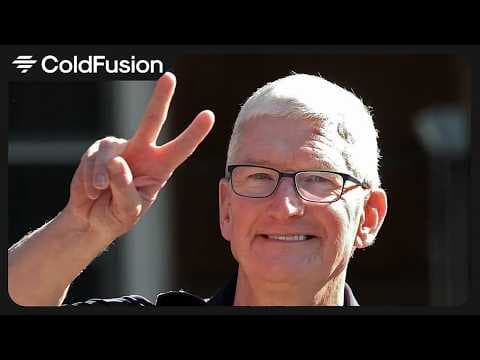
Apple CEO Resigns, What Now?
Audio Summary
AI Summary
On August 24th, 2011, Tim Cook was named CEO of Apple, succeeding Steve Jobs. Initially, Cook was an unknown, but he quickly proved his financial acumen. Under his leadership, Apple's valuation soared from $350 billion to $4 trillion, despite antitrust lawsuits and accusations of stifling competition. Cook's tenure marked a period of immense financial growth and stability for the company.
However, a significant change is on the horizon. On April 21st, 2026, Apple confirmed that Tim Cook will step down as CEO on August 31st. This departure signifies the end of an era, as Cook's leadership was characterized by a focus on supply chains, scaling, refining, and generating revenue from software services.
His successor will be John Turners, a mechanical engineer from Pennsylvania, who is already a familiar face at Apple keynotes. Turners is set to become the most powerful product executive globally, having significantly influenced almost every Apple device released during his time at the company. The central question now is: who is John Turners, and what will Apple look like under his direction? Will his engineering background lead to a new wave of innovation and product categories, or will it mark a slow decline for Apple?
Turners' influence at Apple extends far beyond his public appearances. He graduated from the University of Pennsylvania with a mechanical engineering degree, and his final university project involved building a robotic feeding arm for quadriplegic patients, controlled by head movements. This detail offers insight into his problem-solving approach as an engineer. He joined Apple in 2001, initially working on displays, including the high-resolution Cinema Display from 2002, which was a marvel of design and display quality for its time.
Later, Turners played a crucial role in the development of the iPad, advocating for iPad OS to become its own operating system, believing the iPhone software was hindering the hardware's potential. He also oversaw the AirPods and was instrumental in the transition to Apple silicon, specifically the M series chips. More recently, he announced the MacBook Neo, a $599 laptop that has received widespread acclaim for its quality at that price point.
Interestingly, Turners was reportedly skeptical of the Vision Pro, drawing on his early 1990s experience with Virtual Research Systems, where he worked on a "terrible" VR headset. He also expressed concerns about Apple's self-driving car project, fearing it would distract the company, drain profits, and divert engineers from core products. In both instances, his skepticism proved accurate, as the car project was canceled, and the Vision Pro, despite being a good product, has been a commercial flop.
However, Turners' record is not flawless. He was associated with the Touch Bar and the butterfly keyboard fiasco, which resulted in a $50 million class-action settlement. Despite these missteps, he has consistently demonstrated a keen understanding of what truly matters to users. Eventually, Turners oversaw both hardware and software design teams, bridging these critical components of Apple products. Insiders describe him as "highly technical" and a "real engineer" who delves into every product detail, a stark contrast to Tim Cook's focus on supply chains and lack of direct involvement in product development.
Mark German, a trusted source for Apple news, had previously predicted Turners as the ideal successor, highlighting his expertise in hardware, which accounts for the vast majority of Apple's revenue. Despite a slight dip in stock prices upon the announcement, the general consensus among analysts remains positive. Tim Cook will remain as executive chairman of the board, continuing to engage with policymakers globally, particularly important given the current geopolitical climate.
A significant challenge for Apple, especially for shareholders, is navigating the AI landscape. The company's previous attempt with the Siri revamp, which involved abandoning Google's technology, was largely seen as a failure. However, Apple appears to be pursuing a different AI strategy: local hardware. Their Mac and MacBook Pro lines offer substantial unified memory, enabling larger language models to run locally on devices without an internet connection. This approach has made Macs popular among local AI hobbyists.
Apple envisions a future where AI operates seamlessly in the background, unnoticed by users, rather than being forcefully integrated. Achieving this requires a deep understanding of both hardware and software design, and the integration of software and silicon—a unique strength of Turners within the executive team. While Apple has developed the interface software layer with MLX, the actual model intelligence still needs improvement.
The timing of Cook's departure is not a sign of crisis but rather a strategic decision. Cook cited a record-breaking holiday quarter, the strongest product roadmap ever, and Turners' readiness as reasons for the transition. He wanted to leave Apple on a high note, with everything aligned. Cook's genius lay in building robust company systems, supply chains, manufacturing deals, and diplomatic relationships, transforming Apple into an incredibly efficient and profitable global machine. During his tenure, Apple's stock rose nearly 2,000%, and it became the first US company to surpass $1 trillion and then $5 trillion in value.
The future under Turners could be characterized as the "hardware era," following Jobs' "innovation era" and Cook's "expansion era." Apple has been restructuring for the past two years, with new leadership in finance and legal, and Johnny Suji elevated to chief hardware officer, all positioning Turners at the center of the next phase.
Whispers of a foldable iPhone are circulating, potentially Turners' first keynote announcement as CEO. This device has been in development for years, with the thin iPhone Air serving as an experiment for its foldable components. Success in the foldable market, where competitors like Samsung have seen limited sales, would be a significant achievement for Turners. He has also been experimenting with a 20-inch foldable iPad, blurring the lines between tablets and laptops, and exploring new AI-powered home devices, wearables with cameras, smart glasses, and even a pendant with computer vision.
Turners has already begun reorganizing Apple's hardware engineering division to be more AI-integrated, using data and AI to enhance product development. Early signs suggest a shift in philosophy under Turners: premium products for professionals and enthusiasts, but also genuinely great products at affordable prices, as exemplified by the MacBook Neo. This contrasts with Cook's era, where Apple products, while excellent, were often expensive.
Tim Cook achieved the seemingly impossible by taking over from Steve Jobs and building an even larger company, though he faced criticism for being too cautious and focused on revenue extraction rather than groundbreaking innovation. John Turners, by all accounts, is not Steve Jobs, nor is he Tim Cook. He is described as deeply non-confrontational and genuinely nice, qualities that are uncommon in Silicon Valley. However, he is a "real engineer" who understands the intricacies of product functionality, as demonstrated by his correct predictions regarding the Apple car and the iPad's independent operating system.
The Turners era at Apple may not be marked by flamboyant announcements, but if his track record holds, the products will be better, more thoughtful, more integrated, and potentially genuinely surprising. While Steve Jobs was the thinker and Tim Cook the operator, John Turners is poised to be the builder, and the industry awaits to see what he constructs.