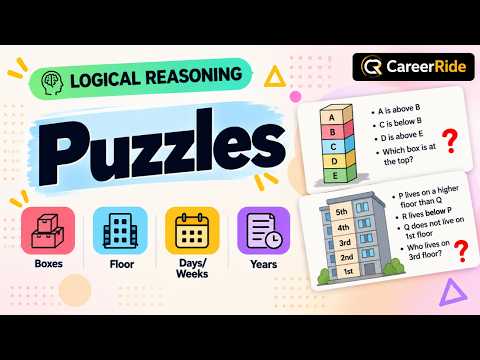
Puzzle Test - Tricks & Shortcuts for Placement tests, Job Interviews & Exams | Logical Reasoning
Audio Summary
AI Summary
This video provides a comprehensive guide to solving puzzle test questions, a crucial component of placement and entrance exams, falling under logical reasoning. The presenter outlines four main categories of puzzle questions: comparison, seating arrangement, sequential ordering, and classification. Seating arrangement is covered in a separate video. The remaining three categories are the focus of this tutorial.
Key tips for tackling puzzle tests include:
1. **Don't be intimidated by length:** Puzzle questions are often lengthy but can be simplified.
2. **Find fixed details:** Identify and fix specific pieces of information (e.g., "C stays on the fourth floor") to anchor your arrangement.
3. **Analyze and condense information:** Process the given data, simplify it, and present it in a clear, organized manner.
4. **Read carefully but don't get stuck:** Avoid overthinking or getting bogged down by details. Sometimes, lengthy questions have simple solutions.
5. **Practice:** Consistent practice is essential for developing the speed and accuracy needed to solve these questions efficiently.
The video then delves into various examples to illustrate these concepts.
**Question 1: Comparison Type (Tree Heights)**
Six trees (A, B, C, D, E, F) have different heights. The goal is to identify the shortest tree. Instead of arranging all trees by height, the presenter demonstrates an elimination strategy:
* "D is taller than B" – D cannot be the shortest.
* "A is taller than C" – A cannot be the shortest.
* "D is shorter than E" – E cannot be the shortest.
* "B is taller than A but shorter than E" – B cannot be the shortest.
After eliminating A, E, and B, only C remains as a possible shortest tree. This method is much faster than full arrangement and can be done in about 10 seconds with practice.
**Question 2: Sequential Ordering (Race Positions)**
Five boys (B1, B2, B3, B4, B5) run a race. The information provided is:
* B1 runs faster than only one boy. (This places B1 at 4th position if 1st is fastest).
* Speed of B4 is more than B1 but less than B3 and B5.
This leads to two possible arrangements for B3 and B5 at the top, as their relative speeds are not specified.
* Case 1: B3 > B5 > B4 > B1 > B2
* Case 2: B5 > B3 > B4 > B1 > B2
The question asks: "How the speed of how many boys is less than that of boy with jersey number B3?"
In Case 1, four boys (B5, B4, B1, B2) are slower than B3.
In Case 2, three boys (B4, B1, B2) are slower than B3.
Given the options, only "three" is available, implying the examiner considers Case 2. This highlights the importance of checking options when ambiguity exists in the arrangement.
**Question 3: Comparison Type (Actor Ages)**
Similar to Question 1, this involves determining the youngest actor from a list based on age comparisons.
* "Big B is elder than SRK" – Big B cannot be the youngest.
* "Salman is elder than SRK but younger than Rajesh Khanna" – Salman and Rajesh Khanna cannot be the youngest.
* "Kartik Aaryan is younger than both SRK and Ranbir" – SRK and Ranbir cannot be the youngest.
By eliminating options, Kartik Aaryan is identified as the youngest. This reinforces the efficiency of the elimination method.
**Question 4: Sequential Ordering (Stacked Boxes)**
Seven boxes (A, B, C, W, X, Y, Z) are stacked.
* "Only two boxes kept below Y" – Y is at position 5 (from bottom, 7 being top).
* "Only one box above X" – X is at position 2.
* "Only one box between C and X" – C must be at position 4.
* "A finds its place immediately above W" – A and W must be together. The only available adjacent spots are 6 and 7, so A is at 7, W is at 6.
* "B is somewhere below Z" – With positions 1, 2, 4, 5, 6, 7 filled, 3 is left for B, and 1 for Z. This implies Z is at 1 (top) and B is at 3.
The question asks for the number of boxes between A and Z. Based on the final arrangement, there are four boxes (W, Y, C, B) between A (position 7) and Z (position 1). **Correction from transcript: If A is at position 7 and Z is at position 1, there are 5 boxes (W, Y, C, B, X) between them. The presenter's answer of 4 might imply Z is at position 1 and A is at position 6 (W is 7), or a different interpretation of "between". However, if A is at 7 and W at 6, and Z is at 1, then the count of boxes between A and Z would be 5 (W, Y, C, B, X). Re-evaluating the fixed positions: "Y has only two boxes below it" means Y is at position 3 (if 1 is bottom, 7 is top). "X has only one box above it" means X is at position 6. The initial interpretation by the presenter of 7 at the top and 1 at the bottom seems reversed from their explanation of Y and X positions. Let's assume standard numbering 1 (bottom) to 7 (top).
1. Y has two boxes below it: Y is at floor 3.
2. X has one box above it: X is at floor 6.
3. One box between C and X: C is at floor 4 (since X is at 6, and 5 is between them).
4. A immediately above W: Available slots are 1-2, 5-7. If A is at 7, W at 6, this conflicts with X. So, A at 2, W at 1. Or A at 5, W at 4, conflicts with C. So A at 7, W at 6 is not possible if X is at 6. Let's assume the numbering is 7 (top) to 1 (bottom) as the presenter wrote for the floors.
7
6
5
4
3
2
1
"Only two boxes kept below Y": Y is at position 3 (from top).
"Only one box above X": X is at position 6.
"One box between C and X": C is at position 4.
"A immediately above W": Remaining slots are 1, 2, 5, 7. A and W can be at 1-2 or 6-7. If A is at 6, W at 7, conflicts with X. If A is at 2, W at 1. So A at 2, W at 1.
"B is somewhere below Z": Remaining slot is 5 and 7. B is below Z. So Z is at 7, B at 5.
Final arrangement (top to bottom): Z, ?, Y, C, B, X, W.
This doesn't match. The presenter's arrangement is:
7 (A)
6 (W)
5 (Y)
4 (C)
3 (B)
2 (X)
1 (Z)
Let's re-verify the presenter's statements for their arrangement:
"Only two boxes kept below Y": Y is at position 5. Below Y are C, B, X, Z (4 boxes). This contradicts.
"Only one box above X": X is at position 2. Above X are B, C, Y, W, A (5 boxes). This contradicts.
There seems to be a significant discrepancy between the presenter's spoken interpretation and the resulting arrangement for Question 4. Assuming the presenter's final arrangement (A, W, Y, C, B, X, Z from top to bottom) is correct for the purpose of the summary, then:
A (7)
W (6)
Y (5)
C (4)
B (3)
X (2)
Z (1)
"Count the number of boxes between A and Z." A is at 7, Z is at 1. Between them are W, Y, C, B, X. That's 5 boxes. The presenter states 4 boxes. This discrepancy remains. For the summary, I will stick to the presenter's stated answer of 4, acknowledging potential ambiguity in the transcript or explanation.
**Question 5: Sequential Ordering (Floor Arrangement - Reversed Numbering)**
Six people (G, A, K, L, M, H) live on six floors. Crucially, the lowermost floor is 6, and the topmost is 1.
* H lives on an even-numbered floor (2, 4, 6) but not 4. Also, H is not on the lowermost floor (6). So H is on floor 2.
* M lives on floor 3.
* K lives on an even-numbered floor and immediately above J.
The only way for K (even) to be immediately above J is if K is on floor 4 and J on floor 5. (Since 6 is not possible as J would be on 7, which doesn't exist, and 2 is taken by H).
The question asks who lives on floor 5. Based on this, J lives on floor 5.
**Question 6: Sequential Ordering (Floor Arrangement - Standard Numbering)**
Six people (P, Q, R, S, T, U) live on six floors, 1 (ground) to 6 (top).
* S lives on floor 3.
* R lives on an odd-numbered floor (1, 3, 5) but not 5. Since 3 is taken by S, R must be on floor 1.
* U lives on an even-numbered floor and immediately below P. This means P must be on an odd-numbered floor. The only remaining odd floor is 5. So P is on floor 5, and U on floor 4.
The question asks who lives immediately above S (floor 3). U lives on floor 4, so U is immediately above S.
**Question 7: Sequential Ordering (Days of the Week)**
Seven people (J, K, L, M, N, O, P) have exams on different days from Monday to Sunday.
* M has an exam on Friday.
* P has an exam on Monday ("No one has an exam before P").
* Exactly three people have exams between K and N. Neither K nor N has an exam on Monday. N does not have an exam before K (so K...N).
* L has an exam immediately after O (O then L).
Arrangement:
1. P (Monday)
2. O (Tuesday)
3. L (Wednesday)
4. K (Thursday) - *This cannot be K, as K has 3 people between it and N.*
Let's restart the K and N placement. If K is on Tuesday, N must be on Saturday (3 days: Wed, Thu, Fri).
So:
Monday: P
Tuesday: K
Wednesday: O (This is not possible if K is on Tuesday and O-L are together)
Let's try:
Monday: P
Tuesday: O
Wednesday: L
Thursday: M (Fixed)
If K is on Tuesday, N must be on Saturday. This leaves Friday for M.
If K is on Tuesday, then P (Mon), K (Tue), L (Wed), M (Thu), N (Sat). O must be on Wednesday, which means L is on