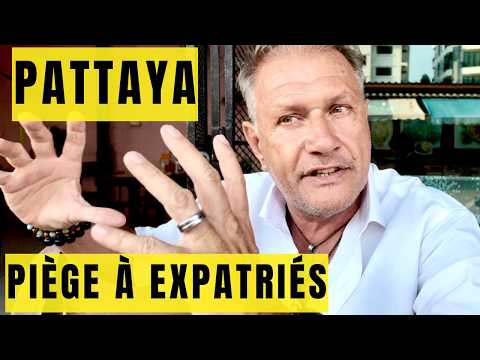
Retraite en Thaïlande, le piège de Pattaya
Audio Summary
AI Summary
Fabrice, an expatriate living in Thailand for over 20 years and a real estate agent for 15, shares his experiences and insights about life in Pattaya and Jomtien. He emphasizes that while many people have found success and happiness there, others have lost significant fortunes, highlighting the importance of having a "normal brain" and a sensible approach to life in Thailand.
Fabrice has explored all regions of Thailand, including the north, south, east, west, and various islands, but considers Pattaya the best compromise. Its strategic location, just 1.5 to 1.75 hours from the international airport and 1.75 to 2 hours from downtown Bangkok, makes it highly accessible. The city also boasts proximity to the beach, islands, and a comprehensive range of amenities, making it a convenient and desirable place to live.
He recalls living in Jomtien with his Thai girlfriend for four years, but now prefers a single life due to his demanding work schedule. His typical day involves sport, work, meals with friends or clients, more work in the afternoon, and relaxation in the evening. This busy lifestyle leaves little time for a relationship, leading him to choose a celibate life.
Pattaya, once known for its "sulfurous" alleys in the 90s, has transformed into a normal seaside resort, similar to Phuket or Hua Hin. Since the passing of King Rama IX, many wealthy Thais from Bangkok, who previously frequented Hua Hin, now prefer Pattaya for their weekends. This shift is partly due to Pattaya being an hour closer by car, and its extensive offerings. The city has everything one could desire, available at any hour, including 24-hour supermarkets and massage parlors. Fabrice notes that the "sulfurous" aspects of Pattaya are now a minority, and the city offers a wide array of activities, from golf to fishing, making it the second-largest city in Thailand by population.
Fabrice expresses a deep love for Pattaya, not for its nightlife or "girl bars," which he visits infrequently (about three times a month, with one major outing). At 58, he leads a more settled life compared to his 40s. He enjoys a normal social life with French friends who share similar rhythms, engaging in activities that don't always revolve around bars. He points out that Pattaya has excellent infrastructure, beautiful golf courses, and nearby islands like Koh Samet (1 hour by car) and Koh Larn (20 minutes by speedboat). The areas of Naklua (north of Pattaya) and Jomtien (south) offer beautiful beaches and increasingly popular private beach clubs, similar to Saint-Tropez.
Regarding the tourist demographics, Fabrice explains that different nationalities tend to congregate in specific areas. Indians are found at the beginning of Second Road, while Russians are primarily in Jomtien. Despite a diverse population comprising over a hundred nationalities, Pattaya is remarkably safe, with no significant issues of violence or insecurity. He contrasts this with the behavior of English hooligans, who might drink excessively but do not engage in fights in Pattaya. He recounts a single physical altercation in 20 years, caused by a misunderstanding with a drunken man whose girlfriend he knew from Bangkok.
Fabrice lives in the Pratamnak district, which he considers the best area after experiencing others. Pratamnak is popular among francophones, located just five minutes from the beach and city center, and offers all necessary amenities like gyms, restaurants, massages, and convenience stores. It is considered the chic district of Pattaya, situated on a hill, providing pleasant breezes. Jomtien, on the other hand, is popular with Thais from Bangkok for weekend getaways. While Pratamnak has a large French community, Jomtien also has a significant number of French residents. Those preferring villas often live behind Sukhumvit Road (the "dark side"), about 15-20 minutes from Pattaya, a choice favored by families, retirees, and Franco-Thai couples. Fabrice personally prefers living in a condo for convenience, especially when traveling.
Addressing the rising cost of living, Fabrice acknowledges that while Thailand was very inexpensive 20 years ago, prices have naturally increased. However, he maintains that it remains very affordable. He gives an example of a meal for two, including grilled chicken with black pepper, rice, a fried egg, a Perrier, and ice cream, costing only 260 baht (about 7 euros). Pattaya is one of the cheapest cities in Thailand, especially compared to Bangkok and Phuket, where hotels, restaurants, and nightlife are more expensive. Hua Hin is comparable to Pattaya in terms of cost.
Regarding real estate, a decent apartment in Pattaya with a separate bedroom (around 40 square meters) costs between 40,000 and 50,000 euros. Such an apartment can be rented for an average of 350 euros per month.
Fabrice has witnessed many success stories and failures. He knows people who arrived with 2-3 million euros and left penniless, having made "abracadabra" investments or been swindled. The primary pitfalls are women and bad investments. He cautions against seeking partners in bars, recommending dating sites like ThaiFriendly or Tinder, where one can find many normal Thai women. He emphasizes that some Thai women are "very, very strong" in financial manipulation, leading to significant losses for many men. Secondly, bad investments, such as buying unsuitable hotels, restaurants, or land for retirement homes, have also caused financial ruin. These ventures might work in Europe but are not compatible with the Thai context.
Another grim reality is the frequent suicides, about one per month, often attributed to heartbreak or financial ruin. Fabrice stresses the need for a "normal brain" and a strong mind to navigate these challenges. He notes that while cannabis has been legalized, it has attracted less desirable individuals, changing the clientele somewhat. However, for retirees who maintain a normal, healthy lifestyle, Pattaya remains an excellent place to live.
Fabrice confirms that many French couples, particularly those over 50, successfully settle in Pattaya and maintain their relationships. He believes it's important to break clichés without denying realities, acknowledging both the positive and potentially negative aspects.
He describes himself as a social person, known by many Thais and foreigners alike, thanks to his work and friendly demeanor. He emphasizes the kindness and constant smiles of the Thai people, refuting negative stereotypes about them. He has never had a conflict with a Thai person, except for a single incident with a taxi driver in Bangkok over 20 years.
Despite his admiration for Thais, Fabrice admits that he doesn't have "true" Thai friends due to cultural, educational, and linguistic differences. His closest friends are French, as they share the same language, mindset, and worldview. However, he has many Thai acquaintances, especially from his past involvement in pétanque, a sport in which Thais excel.
Fabrice concludes by reiterating his deep affection for Pattaya, stating that it suits him 100% and offers everything one could wish for.