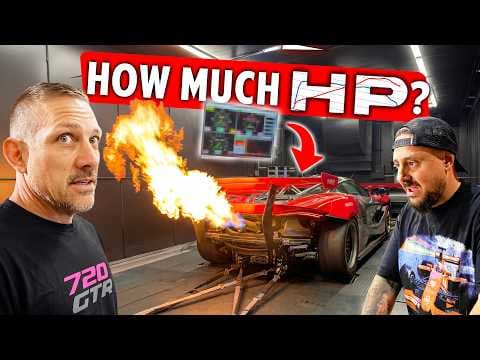
My McLaren 720 GTR Made HOW MUCH HP?!
Audio Summary
AI Summary
The McLaren 720 GT-R, after a two-year struggle to recover from being wrecked, is finally back on the road and undergoing its ultimate test: a dyno run. The owner expresses excitement and hope that the car will perform reliably and powerfully, anticipating flames and a smooth road test without entering limp mode. The car is strapped onto the dyno, and the owner is eager to see its performance.
Initial checks reveal the car is performing well. A quick street pull confirms it "rips," with tires smoking in second gear around 5,000 RPM. The car is also producing impressive flames, even more so than on previous occasions. The owner notes that the flames were so intense during a morning drive that they were coming into the cabin, causing concern about the car catching fire.
Before the dyno session, there's a moment of humor and camaraderie as the owner jokes with the mechanic about the car's dirty state, preferring it that way. A minor issue arises when the mechanic realizes there's no tow hook attached, leading to a makeshift solution involving a Sawzall, much to the owner's amusement and slight apprehension about modifying the car. The sound of the car is praised, particularly the loud blow-off valve, which is described as a unique and satisfying "JDM noise" not often found in exotic cars.
During the dyno run, a spark is observed, possibly from the dyno equipment making contact. The owner humorously references a past incident where a car allegedly caught fire on a dyno. The dyno session is paused due to a sponsorship read for "RhinoShield," highlighting their phone cases and a discount code.
The focus then shifts back to the car's performance. The owner expresses the emotional significance of seeing the car back on the dyno, evoking memories of its past glory. However, the excitement is short-lived as the car begins to cut out during the dyno pulls. Alex, the mechanic, identifies an ECU issue, suspecting a problem with the pins. He plans to pull the ECU for further inspection.
The problem then evolves to a fuel pressure issue, with the car leaning out significantly. This indicates a potential fuel pump problem. It's confirmed that the car has two fuel pumps, and it's suspected that one is not engaging correctly. This is particularly frustrating as the car was running perfectly just that morning. The owner laments the irony that after all the rebuilding, a fueling issue is proving problematic. The car's extensive mileage, over 1300 miles, is noted, with the owner humorously suggesting they'll have to walk to Canada if the car isn't ready.
Further complications arise with a blown fuse for the car's cluster, which had happened previously. The mechanics are determined to find a simple solution. They attempt to test the secondary fuel pump by hot-wiring it, but this requires removing the car from the dyno and putting it on a lift, a process made difficult by the mid-engine layout. The frustration mounts as the car was running so well, and the issue seems to have appeared on the dyno.
The team decides to smoke test the car to identify potential vacuum leaks. Despite the smoke test, no clear leak is found, but a vibrator clamp near the blow-off valve is suspected. The car continues to exhibit issues, sounding like it's hitting the rev limiter or going into limp mode when boost is applied. The mechanics decide to replace the coil packs and fuses within them, hoping this will resolve the problem.
After swapping the coil packs, the car is taken for another test drive. The owner is tasked with holding the camera steady. During this drive, the car sputters above 5,000 RPM. Alex confirms a bad coil is the likely culprit, but without a diagnostic code, it's difficult to pinpoint which specific coil is failing. The team decides to swap the coil packs again, this time using stock coils instead of the previous upgraded ones used for higher horsepower applications.
The next step is to inspect the spark plugs, which were recently replaced. Upon inspection, a bent spark plug is discovered. It appears to have been damaged during installation or possibly due to the stress of the hard pulls. The spark plug is replaced, along with the coil packs, and another test drive is conducted.
This time, the car performs exceptionally well. The owner is elated, declaring the problem solved. The car is running strong, producing 24 PSI of boost without issue. The owner expresses joy and relief, recalling the two years of headaches and uncertainty. The car's performance on 91 octane is impressive, and the owner fondly remembers its even more potent performance on ethanol, capable of over 400 extra horsepower. The experience of driving with the engine cover removed, allowing all the sounds to be heard, is described as akin to an open-top sports car.
With the 720 GT-R now seemingly fixed, the owner reveals an ambitious plan: to drive the car from Alex's shop to Canada as a shakedown, covering 1361 miles over two days. If the car survives this journey, it will be entered into the 2026 Gumball 3000, a 3,000-mile rally from Miami to Mexico City. The owner emphasizes the importance of this shakedown, stating that any failures need to happen now, before the high-stakes rally where support will be minimal. The journey to Mexico will involve intense heat, long distances, and demanding conditions, serving as the ultimate test of the car's resilience. The owner expresses gratitude to the Gintani team for their hard work and dedication in bringing the 720 GT-R back to life. The focus now shifts to preparing the car for the road trip, including reattaching the engine cover and detailing it. The success of the car in the upcoming Gumball 3000 remains the ultimate question.