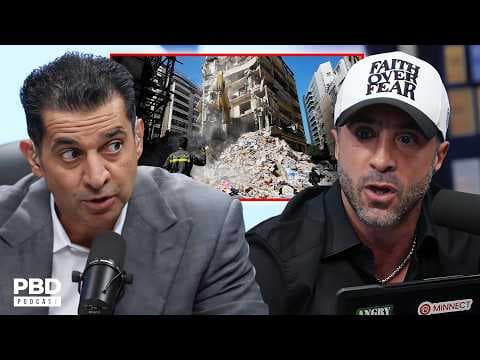
“At War For 78 Years” - Israel-Lebanon Ceasefire Marks Trump’s 10th MAJOR Win
Audio Summary
AI Summary
The discussion begins with an update on oil prices, which have dropped to $83, down from $119 just a few days prior and an initial $65-$67 in late January. This decline is interpreted as a sign of confidence and stability returning to the oil markets, a positive development. Concurrently, the overall markets are up, with the S&P 500 reaching an all-time high of $71.40 in pre-market trading. This economic improvement is noted to be challenging for some media outlets and commentators who may have anticipated a negative economic outlook, possibly to reflect poorly on the current president.
The conversation then shifts to a significant geopolitical development: a 10-day ceasefire between Lebanon and Israel, which began after Israel agreed to a U.S.-backed deal. President Trump announced the agreement, which came into effect on Thursday evening, with Pakistani mediators working to extend the U.S.-Iran ceasefire and facilitate new talks. The ceasefire was confirmed by Israeli Prime Minister Netanyahu, who stated that Israel had an opportunity for a historic peace agreement with Lebanon. However, he also affirmed that Israeli forces would maintain a reinforced security buffer zone within Lebanese territory. Notably, Hezbollah, the group targeted by Israel, was not involved in the negotiations and issued ambiguous statements regarding the ceasefire. Hezbollah demanded a comprehensive halt to attacks across all Lebanese territory, no freedom of movement for Israeli forces, and a return to the situation before March 2nd, when the current conflict round began. Despite Trump's announcement, the Israeli military reported at least 40 strikes from Lebanon, and Lebanese state media reported heavy air strikes in regional areas, indicating ongoing hostilities.
The significance of this ceasefire is explored, emphasizing that most countries desire peace and prosperity. The question is raised whether designated terrorist groups like ISIS, Al-Qaeda, Hezbollah, and Hamas share these aspirations, concluding that their ideologies do not align with peace. A key difference in the current situation is the weakened state of Iran, which is seen as controlling Lebanon through the IRGC. For the first time, high-level peace talks are occurring between Netanyahu and the Israeli government with Lebanese President Joseph Aoun, marking the first such discussions in decades. Hezbollah is notably absent from these talks, suggesting that the parties involved are seeking peace without the group's interference. It is asserted that 80% of the Lebanese population, much like 80% of Iranians, desire peace, prosperity, and the removal of Hezbollah (and the Ayatollah/IRGC in Iran). The central question remains whether peace can be negotiated or if Hezbollah will obstruct the process.
The speaker expresses a personal hope for a ceasefire in Lebanon, particularly for the Lebanese Christians and people in rural areas who are caught in the middle of ongoing rocket attacks. The difficulty of achieving a "win" against terrorist groups is discussed, highlighting the U.S. policy of not negotiating with terrorists. It's argued that a "war on terror" is an unrealistic win because any nation can always claim the presence of terrorists, creating a perpetual justification for conflict. The inherent challenge of achieving permanent victory against groups with fundamentally opposing beliefs is acknowledged, suggesting that life and business often involve finding ways to make progress rather than achieving absolute peace.
President Trump's optimistic view on the ceasefire is shared, where he expressed excitement about meeting with Netanyahu and the Lebanese President, believing it could be his tenth peace agreement. A clip shows Trump responding to a question about Iran reportedly executing four protesters, including a woman, by saying, "Well, tell that to the Pope," implying the Pope's stance against war.
Finally, a new product, a "Faith Over Fear" hat, is introduced. The hat, black on white with a cross and Hebrews 11:1 on the back, is presented as more than just merchandise; it's a statement of faith in Jesus Christ and a rejection of fear. This is tied to a recent Gallup poll indicating a significant shift, with 42% of men aged 18-29 saying religion is very important in their lives, an increase of 28%. The hat is promoted as a way to represent this growing faith and to initiate conversations.