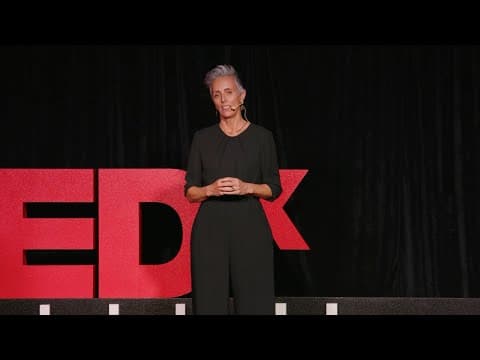
The Human Hum | Jen Buchanan | TEDxBurleigh Heads ED
Audio Summary
AI Summary
Every individual experiences a remarkable phenomenon: we all hum with energy at frequencies we can't hear but can feel. Our planet also hums at 7.83 cycles per second, known as the Schumann resonance, or Earth's heartbeat. Since the Big Bang, everything, from stars to cells, has been evolving, expanding, and humming with energy, and we are all unknowingly tuned into this hum. The question is whether we are truly listening.
Having worked in education for nearly three decades, the speaker initially believed it was about delivering content and preparing students for exams. However, a profound experience in July 2016 during a school trip to Peru reshaped this understanding. Hiking the Inca Trail with 15 students, conversations became more open and honest over the days. On the third day, they encountered an elderly woman living in a small wooden house on a mountainside. She invited them in, sharing stories of her life in the Andes. The students and staff were captivated by her narrative. Before they left, she offered a final piece of wisdom: in the Andes, one doesn't just hike; one learns to slow down, pay respects to the mountain spirits (Apus) and Mother Earth (Pachamama). She emphasized that they weren't just passing through but were part of something much bigger.
The next morning, before sunrise, the group hiked to the Sungate, the ancient stone entrance to Machu Picchu. After climbing a challenging 50-step stone staircase known as the "gringo killer," they reached the top as the sky lightened. Machu Picchu emerged from the mist, first as shadows, then terraces, and finally the entire ancient city, revealing itself in the morning sun. In that moment, the speaker felt a deep sense of awe, humming with the land and feeling part of something much bigger. This experience led to the realization that "this is school," questioning what if education felt like this for every young person. Learning, it became clear, is not just about understanding the world but about finding our place within it. We are not separate from the world; we are stardust with sound waves, frequencies in human form, recycled and reborn elements from ancient stars. Our language reflects this innate understanding, with phrases like "I'm in tune" or "I like the vibe." While we may not always have the science to explain it, we feel this connection, whether through music, stories, or moments of collective silence. This feeling is our "human hum."
However, the world we hum in is shifting rapidly, undergoing profound transformations in how we live, work, and learn. Algorithms and automation accelerate our lives, making it difficult to keep pace. The speaker recounted a student's dilemma about using AI for writing, where she struggled to discern her original thoughts from the AI's output, posing the deeper question: "How do I know what's me?" This question may define our era, as machines can simulate logic and mimic emotion but cannot experience relationships, grieve, fall in love, or offer a glance that conveys "I see you." In our busy lives of processing, producing, and optimizing, we often forget to create time to feel the frequency of being human and simply be in awe of the world.
The speaker then invited reflection on the last time one felt a deep sense of awe—a feeling that stops time, makes one feel small yet connected, and only arises when fully engaged in the moment. Research suggests that awe makes us more generous, collaborative, and less self-focused. What if schools prioritized awe, making it the curriculum, where learning is a rhythm, a hum, rather than a race? This shift would transform the question from "what do you know?" to "who are you becoming?"
Acknowledging the practical challenges faced by teachers with limited time and large classes, the speaker proposed a simple yet powerful solution: slowing down for just one minute. When a student is disengaged, disconnected, or disregulated, even the best lesson plan is ineffective. The invitation is to take one minute before delivering content or taking attendance to create a space of compassion and connection. Students can be asked to notice their feet on the ground, listen to sounds, and take one collective breath. This "one minute of arrival" before learning begins can be applied beyond the classroom to meetings or family dinners. For school leaders, the suggestion is to protect one hour each week for space, connection, and awe, guarding it fiercely. In a world that constantly pushes for speed and more, slowing down to feel the frequency of being human might be our most courageous act.
While this approach won't solve everything, every meaningful human action began with someone choosing to move differently. The Earth's frequency is 7.83 cycles per second, and as our world accelerates, the frequencies only humans can feel—the hum of life itself—will always matter most. The goal is to create schools that don't mute this hum but instead help every young person find their voice, leading to different ways of teaching and listening. When humans are truly heard, the world responds, and that is the "human hum."