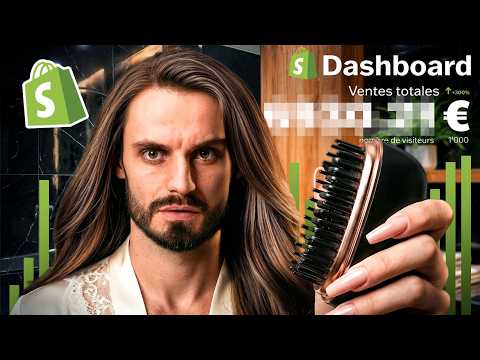
J'ai Essayé de Vendre un Produit au Hasard pendant 24 heures (+100€)
AI Summary
This video chronicles a 24-hour dropshipping challenge, aiming to launch a product chosen by chance with a €30 budget and demonstrate the entire process. The presenter, an experienced e-commerce entrepreneur, emphasizes the importance of following a clear, step-by-step method for success, even for beginners. The goal is to show that anyone can start an online business with minimal risk and budget if they put in the work.
The first step is product research. Theoretically, a good product solves a problem, has an "X-factor" making it easy to demonstrate and attention-grabbing, and is validated in another market, typically the US market, which is often ahead of the French market. This involves checking if the product already exists, has demand, and if competitors are making money with it. However, for this challenge, the presenter decides to randomize the product selection to prove that any product can be sold with the right strategy.
A roulette wheel, populated with 15 generic product ideas from ChatGPT, is spun. The chosen product is a "pocket heated hair straightening brush." The presenter quickly researches it on AliExpress, confirming it's a portable hairbrush with an integrated straightener, designed for on-the-go touch-ups. Despite the random selection, the challenge is accepted, reiterating the video's core message: any product can be sold with the right methodology.
The journey begins with creating a Shopify account. The presenter recommends Shopify as the best e-commerce platform, highlighting its current offer of three free days and then only $1 per month for the first three months, making it a low-risk option. After signing up and selecting the basic plan, the first crucial step is to disable the default password protection on the store, making it public.
Next, the focus shifts to building the website structure, heavily leveraging artificial intelligence for speed. Before diving in, the presenter advises spying on competitors to understand their marketing angles, arguments, and visuals. For the chosen product, a portable straightening brush, the main advantage is its portability and convenience for women to straighten their hair anywhere. An Amazon listing for a similar product is found, and its URL is used with an AI tool called Productly.
Productly.app is used to generate a complete product page. By pasting the Amazon URL, the AI retrieves data, images, and descriptions, creating a comprehensive product listing, including a FAQ section, in just two minutes. This generated content is then imported directly into Shopify.
An important detail is to establish a professional brand name and domain. Using Namelix, a free AI tool, the presenter generates brand name suggestions based on keywords. The chosen name is "Louisy," which is short, memorable, and generic enough to be used for various products in the future. The availability of the .fr and .com domains is checked on OVHcloud.com, and Louisy.fr is available and purchased directly through Shopify for $16 per year. The shop's name is then updated in Shopify's settings.
The next step involves configuring the store's language and markets. The default language is set to French, and "France" is confirmed as an active market. Shipping settings are then adjusted to offer free standard delivery from the first euro, as unexpected shipping costs are a major reason for cart abandonment.
With the basic store configured, the process moves to order fulfillment. Since dropshipping involves no stock, an application called AutoDS is introduced. AutoDS allows sourcing products from AliExpress, automating order fulfillment by notifying the supplier directly when a sale occurs on Shopify, and providing alerts for changes in delivery times or prices. The presenter guides on setting up AutoDS, selecting the "Import 200" monthly plan for $1 for the first 30 days.
The chosen straightening brush is found on AliExpress, and its URL is imported into AutoDS. Stock monitoring is enabled to receive alerts if supplier stock levels become critical. The product details are quickly edited in AutoDS, and then imported to Shopify, connecting the product directly.
Back in Shopify, the product is linked to the AI-generated "productly" theme template for optimized conversion. The most critical part, the product page, is then refined. The presenter emphasizes that 95% of traffic lands here, and its quality directly impacts the conversion rate. AI tools like Gemini or ChatGPT are used to generate compelling texts and descriptions for the product page. Images, initially from AliExpress and some in English, are enhanced using Gemini for style and Canva for text translation and branding, including placing the Louisy logo on the product visuals.
A crucial "before and after" section is added, allowing customers to visualize the product's benefits, especially for problem-solving items. Shopify's theme provides a pre-built section for this. Minor tweaks are made to colors, fonts, and sections to finalize the site's aesthetic and functionality.
Variant names (e.g., "pink" to "rose") are translated, and corresponding images are assigned to each color variant for a dynamic user experience. Bundles are initially removed to keep the product page simple and avoid friction, a key principle for maximizing conversion rates in the early stages. The strategy is to start simple, test, and then gradually add features based on data.
Before launching, it's verified that the product is published across all sales channels, including the online store, point of sale, and TikTok. Finally, payment processing is activated through Shopify Payments, ensuring the store can receive orders.
The next phase is marketing, focusing on driving traffic to the site. The presenter highlights that marketing is paramount, even more so than a perfect website. The strategy is to leverage successful competitor content. A TikTok account named "Glam Brush," selling similar products with millions of views, is identified as inspiration. The presenter had already arranged for their team to order the product and recreate these viral videos in French, focusing on the most liked and commented sequences. The goal is to have three videos ready for testing.
TikTok Ads is chosen as the advertising platform due to the product's suitability for a younger, female-centric audience. The process of connecting TikTok to Shopify is demonstrated, including setting up a TikTok for Business account and a TikTok Ads Manager. Data sharing is set to "maximum" to allow TikTok's algorithm to optimize ad targeting effectively.
A new ad campaign is created in TikTok Ads Manager, with the objective set to "Sales," targeting website conversions. Specific placements are selected, excluding "Pangle." The targeting is set to France, for women, and age ranges are narrowed to exclude older demographics. Interests like "hairdryers" and "straighteners" are chosen, emphasizing precise targeting over broad categories to maximize budget efficiency.
A daily budget of €30 is allocated for the campaign, starting the next day at 6 AM and running until 11 PM to target active users. Before finalizing the ad setup, the TikTok profile is quickly optimized with a profile picture and a short description, as potential customers often check the profile after seeing an ad. The three recreated videos are then published organically on the TikTok profile, making it appear more established.
Finally, these organic TikTok videos are selected for the ad creative, and a simplified product name, "mini lisseur portable," is used for the ad. The campaign is launched, awaiting TikTok's validation.
The presenter then explains key metrics for analyzing ad performance: CTR (Click-Through Rate), CPC (Cost Per Click), and Conversion Rate. A CTR below 1% indicates a poor creative, while a good CTR with no sales points to issues with the product page.
After 24 hours, the results are revealed: three sales were made with the €30 ad budget, totaling €75 in revenue, with an estimated profit of €15-€17. The presenter acknowledges this is a strong start for a new pixel and algorithm, and emphasizes that not getting sales on day one is normal and requires further optimization.
The video concludes by offering two free resources: a comprehensive dropshipping guide and a product research checklist. These resources are designed to provide a solid foundation for anyone looking to start their own e-commerce business.