Thoughts in the Aftermath of My Trip to China
Audio Summary
AI Summary
The speaker, an American attorney based in Bangkok, recently visited mainland China on a school exchange trip with his child. While he maintains his strong dislike for communist ideology, he acknowledges that, much like Vietnam, he has to grudgingly accept certain aspects of China's current reality. Despite the visible communist symbolism, he observed that the everyday focus of the people is on doing business.
He noted certain policies in China that he personally disagrees with, such as the social credit system and the prevalence of cashless transactions. While he acknowledges that using a phone for everything might make daily life easier for residents, he emphasizes that it's not his country, and if the Chinese people are content with these policies, then it's their prerogative. He also mentioned the significant challenge of communication due to what he refers to as "the great Chinese firewall," which limited his ability to connect with the outside world.
A key takeaway from his trip was how much more ridiculous the concept of a "trade war" seemed to him after witnessing China firsthand. He views "trade war" as an oxymoron, arguing that one either trades or wars, but not both simultaneously. His primary observation was the immense scale of industrialization in China.
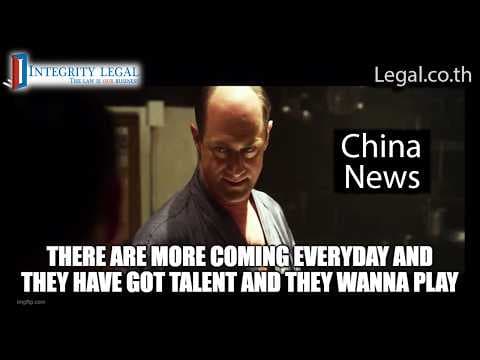
To illustrate his point, he draws a parallel to a scene from the movie "42," about Jackie Robinson, the first black man to play in Major League Baseball. In this scene, the team manager confronts players who are petitioning against Robinson due to his race. The manager forcefully tells them that Robinson is coming to play because he can help the team win, and if they don't like it, the team ownership will make other arrangements for them. The manager's prescient quote, "There's more coming and they're talented and they want to play," resonated deeply with the speaker's observations of China.
He interprets this quote in the context of China's industrialization, noting that just as more talented black players followed Jackie Robinson, there are "more coming" from China who are eager to build, innovate, and participate in market economics. He observed cranes and bridges being built everywhere, at an even greater scale than what he sees in rapidly industrializing Thailand. He emphasizes that China is a larger place with more people, and their industrialization and desire to engage are palpable.
He spent time at a school and was struck by the dedication of the students to their studies. He believes this indicates a civilization focused on practical achievements, such as building bridges, boats, and technological innovations, rather than philosophical musings.
His core message to the West is to heed this reality. He believes that the notion of a "trade war" or any conflict with China is an unsound strategy for maintaining Western standards of living. Instead, he urges the West to think less about war and more about trade, focusing on how best to trade, do business, and facilitate mutual innovations with China. He warns that if the West does not get on board with the "East rising," it will be overtaken, much like the baseball player in "42" who was relegated to Pittsburgh after failing to adapt. He concludes that China's rise is inevitable, like a freight train, and the West needs to either adapt and engage or get out of the way.