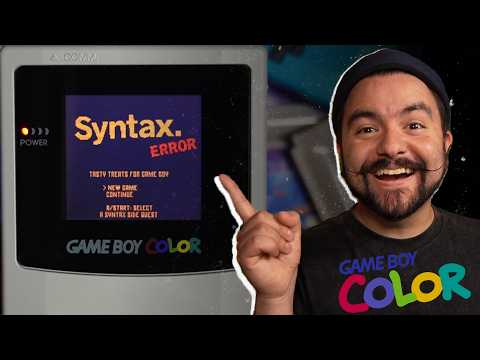
I made a custom Game Boy game
AI Summary
In 2026, a Game Boy game called "Syntax Error" was built in four days for Sentry's Hackw Week. The game is a platformer with puzzles, themed around syntax, featuring characters Scott, Wes, and CJ. The creator also modded a Game Boy Color with a custom shell and a backlight screen. AI was crucial for development, including playing the game, and Tiled was used for level layout. Pixel art was created from scratch. The physical game, with packaging and a manual, will be released in the Syntax shop.
The first step was planning, consuming half of the first day. The game's story involves Scott, Wes, and CJ being sucked into a computer to fix code and battle a boss. The core mechanic is a platformer, similar to Mario, where characters defeat enemies and interact with terminals to solve puzzles. Puzzles are inspired by Dr. Mario, Bust a Bug, and Sooan, with increasing difficulty per level. This blends nostalgic Game Boy elements with a syntax theme.
Building a Game Boy game in the modern era offers options. GB Studio provides an interactive editor, similar to Unity, for quick development. However, the creator opted for low-level code using GBDK 2020, an SDK for writing C code to create retro games, supporting Game Boy, Analog Pocket, Sega Master System, Mega Duck, or NES. The creator had prior experience building a Sega game with a low-level SDK.
Given the four-day limit, shortcuts were necessary. Initial research focused on open-source GBDK 2020 games for reusable code and assets. GBDK 2020 examples included a platformer for character control and projects with moving enemies. Day one's goal was to run a GBDK 2020 build on a physical cartridge. AI analyzed examples, selected relevant ones, and generated an example ROM.
Development utilized a flash card, available for $30-40, which accepts an SD card and can load ROMs for testing on a physical device. For AI to test the ROM, Pi Boy, a Python project, was used to control the Game Boy. AI's test scripts would build the C code with GBDK 2020, then use Pi Boy to simulate button presses, take screenshots, and inspect them for functionality. For human testing, the tested ROM could be loaded into an emulator like SameBoy, an open-source, cross-platform option.
Game Boy Color ROMs have different formats (e.g., GBC 4, GBC 5). AI created a debug ROM to determine the supported format and verify saving functionality on the physical cartridge before proceeding with game development.
While AI built level one and initial menus, the creator modded the Game Boy. The original Game Boy Color screen requires good lighting. A solderless kit was used to install a backlight screen that also allowed color palette changes. The process took about an hour, requiring a special screwdriver and tweezers.
By the end of day one, custom games could be built, the Game Boy was modded, and an AI-driven toolchain for ROM building and testing was established. Day two focused on pixel art. AI continued building with placeholder art while the creator designed characters and tiles in Pixelorama, an open-source program similar to Aseprite.
Game Boy graphics have limitations. The screen is 160x144 pixels. All displayed elements must be broken into 8x8 pixel tiles. While the Game Boy Color supports 32,768 colors, only about 56 can be on screen at once, and each tile can have a maximum of four colors. This limitation encourages creative design. Graphics are layered: a scrollable background layer for levels and a window layer for the heads-up display and static text. Text requires creating a font from 8x8 tiles; a compact, free font was modified for the game. To achieve more character detail, hero characters (CJ, Scott, Wes) were designed as three tiles high (24 pixels) and two tiles wide (16 pixels), allowing for features like a mustache. By the end of day two, a functional but visually unpolished platformer existed.
Day three involved scoping down the ambitious plan. Instead of multiple levels with varying puzzle difficulties and a boss, the plan was streamlined to one hallway leading to the "Syntax Doctor" puzzle, another to "Bust a Bug," and a final hallway to the "Sooan" puzzle and boss battle. Day three also involved extensive bug fixing, particularly memory management issues causing color glitches and incorrect sprite rendering, all handled by AI through high-level prompts. The game's story, involving the podcast hosts getting sucked into a computer, was integrated with title sequences similar to Pokémon, allowing players to fast-forward text. A character select screen was also built, detailing character power-ups: Wes throws hot tips, TJ throws his seedling, and Scott throws his hat. By the end of day three, a working main menu, save functionality, initial title sequence, level one with "Syntax Doctor," and level two with "Bust a Bug" were complete.
Day four focused on polish, cleanup, integrating remaining assets, and building simple versions of the final level, puzzle, and boss. Music and sound effects were not included in the initial four-day demo but are being developed for the final game using the UG format, which GBDK 2020 ingests. Game Boy Color hardware uses noise generators and a sequencer to create up to four simultaneous sounds. Free songs from it.io are being modified, with plans for unique music for each level, puzzle, and menu.
A "track mode" was also built, displaying pre-coded gameplay before the main menu, simulating a player's interaction with the game. This feature is common in many games to provide a preview. The final game will allow players to press 'A' to access the main menu from track mode. This was one of the last features built to generate B-roll footage for a commercial.
In four days, a working game and a demo video were created, and the Game Boy was modded. Post-Hackw Week, the game is being polished to meet the original plan: multiple puzzle difficulties, doubled level sizes, playtesting, and bug fixing. Physical game production is underway. Initial AI-generated box art prototypes were refined and will be replaced with human-created art for the final product, as the creator is actively commissioning artists. The finished game is expected to be available in the Syntax store.