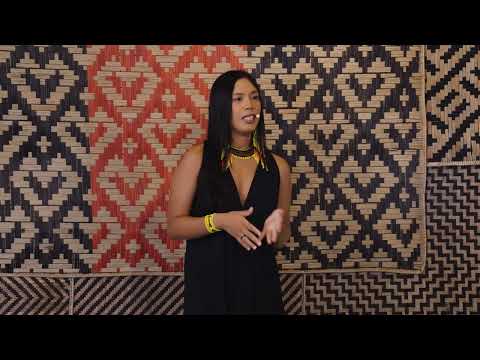
Minha câmera é minha flecha: o cinema por nós mesmos | Natália Tupi | TEDxAmazônia Salon
Audio Summary
AI Summary
Natalia Tupi, originally from Parintins, Amazonas, on Ilha Tupinambarana, a territory historically belonging to the Tupinambá people, shares her journey. Her parents, Carlos Lopes and Neide Lopes, were artists at the Parintins Festival, and their talent led Natalia to São Paulo at the age of nine. This move presented a stark contrast to her upbringing surrounded by nature and the Amazon River. In São Paulo, she encountered a polluted urban environment and experienced discrimination for her indigenous appearance, being called "india" before even speaking. Her first year of school was difficult, with classmates perpetuating stereotypes about indigenous people being savage, dirty, and greedy, even going so far as to put chewing gum in her hair.
This experience deeply affected her, and she expressed to her parents a desire to change her appearance and avoid such treatment. Her parents offered profound advice: "My daughter, you can't be ashamed of who you are. And whenever someone talks about you, about your story, about us, indigenous people, don't read it with violence or with violence, but read it with information. Construes the knowledge points." This advice became a guiding principle. The next day at school, when faced with jokes, she calmly explained that many indigenous people, like her family, lived in cities but did not abandon their identity.
Returning to Parintins was a rare occurrence due to the cost of travel for her family of five. It wasn't until 2009 that her parents could afford to buy tickets. The anticipation for this trip was immense, filled with excitement for family, familiar places, and traditional food like "pão com tucumã" and "tambaqui com farinha." Her parents bought a simple camera, and Natalia, instructed on its use, quickly learned to photograph her family upon arriving in Parintins.
The family then visited Waikurapah, an ancestral territory three hours by boat from Parintins, where part of her family was born and raised. It was here that Natalia realized the camera's power extended beyond capturing fleeting moments; it was a repository of memories. She documented family activities like fishing, collecting Brazil nuts, preparing cashew dishes, and navigating the river.
Upon returning from Waikurapah, Natalia felt a clear sense of purpose. Despite lacking formal photography courses, she self-taught by exploring online content. Later, she pursued a journalism degree. During her studies, an invitation led her to Roraima, to the Roraima Health Society, to learn about the Yanomami situation. She heard firsthand accounts of the violence of illegal mining (garimpo), invasions by loggers (madeireiros) and miners (garimpeiros), and mercury contamination of rivers, as well as the abuse faced by women and children. Her photographs of Yanomami children, showcasing their resilience and curiosity, were particularly impactful.
This experience solidified her understanding of the camera as not just a memory keeper but a powerful "flash" capable of reaching many minds and hearts. This led her to create her project, "Ancestralização Visual," aiming to showcase the ancestry and resistance of indigenous peoples through audiovisual means.
In 2023, she applied to the International Cinema Academy of Sciences in São Paulo. During the selection process, which included a one-minute video submission, she emphasized the crucial need for indigenous representation in such spaces. She argued for reclaiming these platforms, transforming the narrative from being objects of documentation to becoming storytellers of their own experiences, using their own eyes and narratives. This opportunity proved transformative, leading to the creation of two significant films, "Minha Câmera, Minha Flecha" and "Os Sonhos Guiam," which continue to travel globally, sharing indigenous culture.
Natalia concludes by reflecting on her journey, recalling the advice to fight with information and knowledge, a principle she has embraced since she was young. She reiterates the importance of remembering one's origins and identity, believing that indigenous people can achieve their rightful places in all necessary spaces, guided by their dreams and empowered by their cameras as their "flash."