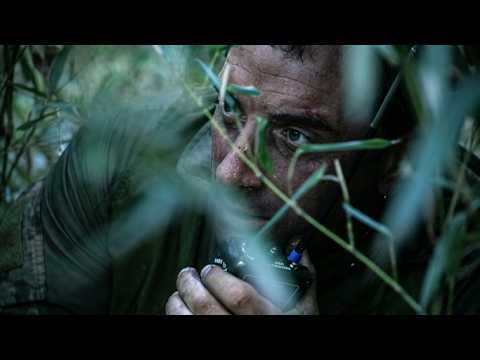
Navy SEALs: Vietnam | Behind Enemy Lines
Audio Summary
AI Summary
This video recounts the dramatic story of a U.S. Navy SEAL's mission to rescue downed American airmen behind enemy lines during the Vietnam War. The narrative begins in April 1972, when an unarmed U.S. Air Force EB-66 electronic warfare plane, call sign BAT-21, was shot down over the demilitarized zone. The aircraft was on a mission to detect enemy missile batteries threatening a squadron of B-52 bombers. Despite evasive maneuvers, BAT-21 was hit by a surface-to-air missile, resulting in the deaths of five crew members. Only Lieutenant Colonel Gene Hambleton, the 53-year-old navigator, managed to eject.
Hambleton landed deep within enemy territory, two miles inside North Vietnamese lines, and was immediately spotted by an enemy patrol. As an expert in U.S. missile strategy with top-secret clearance, his capture would have been a significant intelligence coup for the North Vietnamese Army (NVA). Hambleton used his survival radio to call for help, but the situation was dire, with 30,000 NVA troops descending upon South Vietnam as part of a massive invasion.
Colonel Cecil Newerhead, commander of the U.S. Joint Search and Rescue Center at Da Nang Air Base, initiated an air rescue operation. However, the initial attempts were fraught with tragedy. Two helicopters dispatched to rescue Hambleton flew directly into an NVA anti-aircraft battery. One chopper crash-landed, and its crew survived, but the aircraft was lost. The other Huey was heavily damaged, killing three of its four crew members and taking one prisoner. In a single effort, Newerhead lost four men and two helicopters. Rescue missions were suspended for the night, and Hambleton was instructed to lay low.
Meanwhile, an NVA listening post intercepted Hambleton's transmission, alerting Colonel Tran, a battalion commander. Recognizing the pilot's potential value, Tran saw an opportunity to use him as bait to lure U.S. aircraft into an ambush. At dawn, two forward air controllers, Lieutenant Mark Clark and Lieutenant Bruce Walker, were deployed to locate Hambleton. While flying low over the jungle, they spotted him but were then attacked by a surface-to-air missile. Both men ejected. NVA troops converged on the area, and Clark narrowly avoided capture, hiding just feet from enemy soldiers, while Walker was about 100 yards away.
Colonel Newerhead now faced the daunting task of rescuing not one, but three downed airmen. Despite ordering precision airstrikes to neutralize heavy air defenses, rescue choppers continued to be pummeled by anti-aircraft fire, resulting in the deaths of six more Americans. Hambleton, witnessing the escalating casualties, was devastated, realizing nine lives had already been lost in attempts to save him. The intensity of the rescue efforts also tipped off Colonel Tran, who suspected the airmen were important assets. The Air Force, due to the heavy losses, shut down the rescue operation.
However, Colonel Newerhead refused to abandon the men. He contacted Lieutenant Colonel Andy Anderson, head of the Joint Personnel Recovery Center, who specialized in ground-based rescue operations. Anderson assembled a team of elite South Vietnamese Sea Commandos. Lieutenant Tom Norris, a U.S. Navy SEAL, volunteered to lead this perilous mission, which had already cost nine American lives and several aircraft. Norris and his team were tasked with rescuing Hambleton, Walker, and Clark, who were all trapped deep within enemy territory.
The airmen had been evading capture for over a week, starving and dehydrated. Lieutenant Walker was found by the NVA, and his subsequent death was confirmed by Anderson, hardening Norris's resolve. The rescue plan shifted to a ground operation, with the Kamlo River identified as a potential escape route. However, the team could only extract one man at a time. Circumstances dictated they prioritize Lieutenant Mark Clark, who was closer to the river, while hoping Lieutenant Colonel Hambleton, in worse condition, could survive another night.
The mission was coordinated from the air by Captain Harold Icke, a forward air controller, who used coded language based on pilot-specific references to relay instructions, as the NVA was monitoring their communications. Clark, recognizing the coded message referencing the Olympic swimmer Esther Williams and a river, understood he was to travel east by river. Norris and his commando team inserted into the jungle south of Clark's position, navigating through enemy patrols.
Meanwhile, Hambleton, advised that Clark would be rescued first, continued to endure. Norris and his team faced numerous enemy patrols, narrowly avoiding engagement to maintain the mission's secrecy. Colonel Tran, suspecting a ground rescue, deployed hunter-killer teams. Hambleton, exhausted and without food or weapons, used his radio to call in airstrikes on the enemy's position, disrupting their movements and allowing Clark to reach the river.
Norris and his men reached their rendezvous point on the Kamlo River, requesting illumination flares. They spotted Clark, but an NVA patrol intercepted them. Norris watched helplessly as Clark was carried downstream toward the enemy. Through Anderson, Clark was instructed to hold his position. Norris, deciding the fastest way to reach Clark was alone, entered the river without backup. In the pre-dawn hours of April 10th, 1972, Norris pulled Lieutenant Mark Clark from the Kamlo River. Clark was medevaced to Da Nang for treatment.
The focus then shifted to rescuing Hambleton, whose condition was critical. Captain Icke provided Hambleton with directions to the river using golf-themed code, referencing Pebble Beach. Hambleton, despite his exhaustion, attempted to reach the river. However, the NVA, monitoring communications, located the forward command outpost and launched a mortar attack, severely damaging the outpost and injuring Lieutenant Colonel Anderson and several South Vietnamese commandos.
With no time to assemble another team, Navy SEAL Tom Norris and Petty Officer Nguyen Van Keet, the only uninjured members, decided to proceed alone to rescue Hambleton. They found a sandpan in a bombed-out fishing village and disguised themselves as fishermen. They pushed off towards Hambleton's last reported position. Captain Icke, unable to get a survival kit to Hambleton without exposing his location, airdropped it, but an NVA patrol reached it first.
Norris and Keet continued up the Kamlo River, encountering sleeping NVA guards at a gun emplacement. They landed near Hambleton's location and found him barely alive, collapsed near a large NVA encampment. They hid him in the sandpan and set out. As dawn approached, their cover was blown, and they came under heavy enemy gunfire. Norris provided cover fire as Keat raced for shore. The NVA ordered all soldiers to stop the sandpan, and the three men were trapped. Norris called for airstrikes directly on their position. A squadron of A6s responded, decimating the enemy troops but also damaging the outpost.
As the sun rose, leaving them without cover, they were surrounded by converging NVA soldiers. An A1 Sandy dropped smoke bombs, obscuring the river and allowing the sandpan to emerge from the mist. Norris and Keet had achieved the impossible, rescuing BAT-21 Bravo and concluding one of the costliest search and rescue operations in U.S. military history. Lieutenant Colonel Gene Hambleton, at 53, had survived 11 days behind enemy lines. Petty Officer Nguyen Van Keet received the Navy Cross, and Lieutenant Tom Norris was awarded the Medal of Honor for his heroic duty.