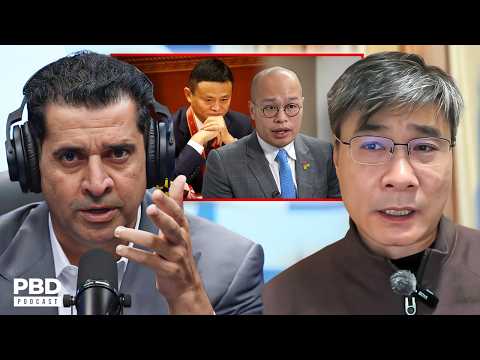
“Cannot Challenge The CCP” - Why Jack Ma & Jimmy Lai VANISHED
Audio Summary
AI Summary
The transcript discusses the disappearances and fates of prominent figures in China, particularly Jack Ma and Jimmy Lai, and contrasts their situations with the potential for democracy in China.
Jack Ma, a well-known entrepreneur, seemingly vanished after making comments that were not well-received by the Chinese Communist Party (CCP). The speaker suggests this was part of a broader crackdown by Chinese regulators aimed at curbing economic overheating, corruption, fraud, and speculation, especially in the real estate market. Many entrepreneurs were reportedly engaged in financial Ponzi schemes, and Ma's pushback against central authority was seen as unacceptable in China, where questioning the government is not permitted. Despite his immense wealth and popularity, Ma discovered he could not change the system.
Jimmy Lai, a Hong Kong-based publisher and critic of the Communist Party, is presented as another example of an individual who crossed "red lines." Hong Kong is described as a quasi-sovereign part of China, similar to Puerto Rico in America. Lai's outspoken pro-democracy stance and his involvement in Hong Kong protests, particularly after the implementation of a new national security law in 2020, led to his arrest and a 20-year prison sentence. He owned the Apple Daily newspaper, which played a role in significant protest movements. The speaker struggles to find an American equivalent for Lai but draws a parallel to Russian billionaires who fell out with the Putin regime and faced imprisonment or death. The core issue highlighted is the defiance of the government's ultimate authority.
The discussion then shifts to the interest in democracy within China. The speaker, having lived in China for 25 years, states there is almost no interest in democracy. This is attributed to the system's focus on bureaucracy, where the ultimate aspiration for Chinese people is to become a bureaucrat, mirroring historical imperial structures. Survival in such a system depends on becoming a civil servant, which explains the intense academic focus on passing civil service examinations to gain status and provide security for one's family. The speaker suggests that for democracy to thrive, there would need to be a greater respect for human rights, individual liberty, empathy, and the rule of law, which are not prioritized within the current Chinese system.
Finally, the transcript includes a call to action for viewers to subscribe to the podcast channel, emphasizing that subscriptions help the channel grow, hire more employees, conduct bigger interviews, and deliver a better product.