French Story for Intermediate B2 | Improve Listening & Speaking | DELF B2 French Practice
AI Summary
Learning a language goes beyond grammar and vocabulary; understanding idioms is crucial for speaking like a true French speaker. These seemingly strange phrases don't always mean what they appear to, yet the French use them daily in their work and school lives, adding color and spontaneity to the language. Idioms allow for more vivid and engaging expressions of emotions or situations. They hold a special place in work and study environments where students and professionals often experience stress, effort, and frustration. Instead of simple statements, they use expressions that reflect their feelings, making their speech more natural and closer to everyday conversation.
Idioms also help build social connections by creating an impression of shared culture. When a colleague uses an expression like "c'est la fin des haricots" to describe a disastrous situation, others instantly understand and may even add humor to a tense atmosphere. Similarly, students use these phrases to express exhaustion before exams or to joke with friends. Furthermore, learning idioms significantly improves listening comprehension, as they are frequently used in French series, films, and movies. Recognizing these idioms helps learners better understand natural conversations, and knowing how to use them boosts confidence and makes expressions more vivid. In essence, idioms used at work and in school are crucial for enriching one's French, making one sound more natural, and better understanding the daily lives of French speakers.
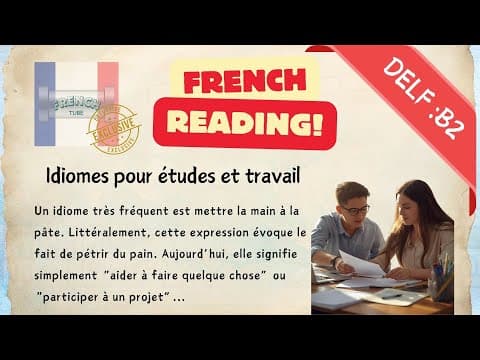
When discussing work or studying in French, many idioms express effort or participation. These are useful for describing common situations like starting work, helping others, or embarking on a difficult task. "Mettre la main à la pâte" literally means "to put your hands on the dough," but it signifies "helping with something" or "getting involved in a project." For example, a teacher might use it to encourage student participation in organizing a party, or a team leader might use it to ask for a colleague's help. Another common expression is "se mettre au travail," a more vivid way of saying "get to work," often heard in schools to signal the need to focus. Friends might also use it humorously when faced with a task like tidying up after a party. "Donner un coup de main" (to give a hand) is similar to "mettre la main à la pâte" but is primarily used for casual assistance, such as helping move boxes. These idioms show that French often uses imagery related to hands to describe work and effort, making requests sound more compassionate and less authoritarian. Learning these expressions helps in understanding everyday conversations and participating comfortably in group situations at school, university, or the office.
In daily life, whether at school or work, feeling overwhelmed with too many tasks is common. French offers several idioms to express this feeling of "être débordé" (being overwhelmed), conveying stress, fatigue, and frustration. "Avoir trop de boulot" (to have too much work) uses "boulot," a colloquial term for work. Students might say it when they have a lot of homework, and adults use it in the workplace to explain why they can't go out. This simple and direct idiom perfectly captures the reality of many people's situations. "C'est la fin des haricots" (it's the end of the lentils) is a peculiar idiom meaning a catastrophic situation with no hope or solution, often used with humor to exaggerate a problem's severity. For instance, students whose computers crash and files disappear before a presentation might exclaim this. Finally, "courir dans tous les sens" (rushing around) figuratively describes a very busy person juggling many tasks simultaneously. A teacher might use it to describe a hectic day of preparing papers, organizing meetings, and answering emails, or it can be used in personal life before a party. These expressions allow for more vivid and humorous discussions about stress and workload, adding personality to speech and enabling the expression of emotions with imagination and color.
Staying focused and achieving success at work and in school can be challenging. French offers idioms to express mistakes, clumsiness, or, conversely, motivation and perseverance, enriching everyday language and enlivening conversations. "Être à côté de la plaque" literally means "to be off the mark" but figuratively means "to make a mistake" or "to not understand something." A student might use it after failing an exercise, or a colleague might use it after misunderstanding a meeting time. This informal idiom allows for expressing a mistake without sounding harsh. To maintain motivation, "ne pas lâcher" (to not let go) is common, meaning "to keep trying" or "to not give up." A student preparing for an exam might tell herself not to give up, and a manager might encourage her team with this phrase. Another idiom, "tenir bon" (to hold on), means to persevere despite difficulty or pressure, useful in challenging projects. Using these idioms in daily life allows for sharing experiences and emotions naturally, demonstrating an understanding of French culture and the ability to speak like a native. These idioms for avoiding mistakes and staying motivated help learners express difficulties and efforts uniquely, enriching the language, promoting understanding, and enabling humorous, positive, and precise communication in academic and professional settings.