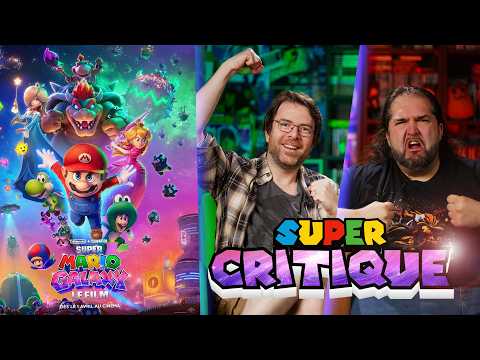
CRITIQUE: SUPER MARIO GALAXY
Audio Summary
AI Summary
The video reviews the Mario Galaxy movie, released about 15 days prior to the recording. The movie has garnered significant marketing attention, including collaborations and merchandise, some of which, like a Yoshi popcorn container, were scalped and resold for exorbitant prices online. The discussion is divided into spoiler and non-spoiler sections, beginning with the latter.
The movie's plot, as described without major spoilers, centers on Harmony (Rosalina in French) and her Luma companions on a space station. Bowser Jr. attempts to capture Harmony, leading one of the Lumas to escape and seek help from Peach, Mario, and Luigi, as Harmony had read stories about them. Notably, Mario is not the central figure at the beginning, with Harmony initiating the call for help. Mario later arrives to assist, taking on a more supportive role.
The film has generated divided opinions, with some critics giving it a zero rating, which the reviewers find disproportionate, suggesting it's an extreme reaction to a film that, while perhaps not groundbreaking, doesn't warrant such harsh judgment. They contrast this with other films, like the Minecraft movie, which they personally found to be of poor quality but didn't receive the same level of vitriol. The reviewers suggest that the strong reactions, both positive and negative, stem from the iconic status of the Mario franchise.
The reviewers express their personal enjoyment of the film, finding it better than the first one. They appreciate that it deviates less into generic pop culture references (like overused 80s songs) and focuses more on original compositions by Brian Tyler, who remixed classic Mario game music. The film is described as more "nervous" and action-packed than its predecessor, with a faster pace that some critics have negatively labeled as "TikTok generation" filmmaking. The reviewers, however, see this as a positive, contributing to a dynamic and engaging experience.
A key point of discussion is the film's perceived lack of deep reflection or complex themes, unlike Pixar films that often appeal to both children and adults on different levels. The Mario movie, in contrast, offers a straightforward, pure entertainment experience. This simplicity is attributed to Nintendo's strict control over their intellectual property, particularly Mario, who is a global icon appealing to all ages. The Japanese creators would likely prevent any deviation from Mario's established persona, such as exploring complex relationships or dark themes. The movie adheres to a "perfect, nickel image of the mark," avoiding anything that could be considered bizarre or controversial.
The film's focus on family is noted, with three pairs of characters representing familial bonds. However, the execution of these themes is criticized as being underdeveloped and sometimes "bizarre." For instance, Bowser's redemption arc is described as short-lived and inconsistent with the film's broader message about family loyalty.
Moving into the spoiler section, Harmony sends a Luma to find Peach, who then joins Harmony. Meanwhile, Mario and Luigi are left to manage the Royal Champignons, which Bowser Jr. later attacks and removes the castle. Mario and Luigi then embark on their own journey to find a way out, encountering Bowser in his normal form, who reconnects with his son, Bowser Jr. This creates a duality between Harmony and Peach's storyline, where Peach's unknown parentage is a subtle theme, and Mario/Luigi and Bowser/Bowser Jr.'s family dynamics. The resolution of Bowser's arc is particularly criticized as being "really bad" and artificial, with his brief attempt at redemption quickly reversed.
The character of Yoshi is mentioned as a teaser in the first credit scene, appearing in a brief flashback sequence set in New York with a Notorious B.I.G. song playing. While cute and providing comic relief, Yoshi is largely gadget-like and doesn't significantly impact the main story. The reviewers discuss the three family arcs: Harmony and Peach, Bowser and Bowser Jr., and Mario, Luigi, and Yoshi. The Bowser storyline is deemed the most interesting due to Bowser Jr.'s desire to live up to his father's formidable legacy, though this arc is ultimately aborted.
The film's ending is described as abrupt, with the generic starting quickly after the climax, leaving many plot points unresolved, particularly the reunion of Harmony and Peach. The lack of a concluding discussion between the sisters after their reunion is highlighted as a missed opportunity. There are two post-credit scenes: one featuring Fox McCloud returning home, and another showing Bowser and Bowser Jr. in prison, with a depressed Luma. A second, widely spoiled post-credit scene features the appearance of Daisy, teasing future installments.
The reviewers speculate that the inclusion of characters like Fox McCloud and Daisy, along with the disappearance of Donkey Kong from the main story, might be a cynical marketing strategy by Nintendo to promote upcoming games or introduce new character designs. Despite these criticisms, the film's technical aspects, animation, and music are highly praised. The animation is considered "magnificent," surpassing the first film in beauty and visual dynamism, with well-executed action sequences and seamless transitions between scenes. The French studio's contribution to the animation is particularly lauded.
The overall consensus is that while the Mario Galaxy movie is not a profound cinematic masterpiece, it serves its purpose as pure entertainment. It offers a fun, fast-paced experience that appeals to fans of the franchise, incorporating numerous nostalgic nods to various Mario games. The reviewers find it a successful contract fulfillment for a strong IP, providing a pleasurable viewing experience without necessarily evoking deep emotional reflection. They acknowledge that while some plot points are left unfinished, it doesn't detract significantly from the overall enjoyment. The film's runtime of 1.5 hours is deemed appropriate for its content.