Autism: A Century of Discovery and Development
AI Summary
The World Autism Organization advocates for the rights of autistic individuals, focusing on self-advocacy, independent living, accessible education, housing, and support services, as well as freedom from abuse. The organization works to inform people about autism and assist in establishing autism services globally, addressing common challenges like lack of access and assessment due to long waiting lists. The prevalence of autism has significantly increased, from an estimated 4-15 per 10,000 in the past to as high as 1 in 56 in some countries today, partly due to increased awareness and more adults being diagnosed. The organization relies on a network of volunteer members and holds congresses every four years, with the next one scheduled for 2026. They also host regular webinars and maintain a YouTube channel to provide support and information.
Dr. Stephen Edelson, with over 45 years in the autism field, has witnessed many milestones. He began his studies under Ivar Lovaas at UCLA and later worked closely with Bernard Rimland for about 30 years. Edelson also has a long-standing relationship with Temple Grandin, having known her since their graduate student days in the early 1980s.
The Autism Research Institute (ARI) has established a National History of Autism Museum in San Diego, which offers a journey through nearly 100 years of autism history. The museum, curated by Dr. Edelson, presents a chronological account, beginning with a 1925 study by Ukrainian researcher Grunya Sukhareva in Russia, extending to the Netherlands in the 1930s, and the United States in the 1940s. It commemorates Dr. Leo Kanner's pivotal 1943 work, who is widely recognized as the father of child psychiatry. His detailed description of 11 cases of autism, initially referred to as "Kanner syndrome," remains highly cited.
The museum also highlights Dr. Bernard Rimland's work, which, starting in 1964, challenged the prevailing belief that autism was caused by parental neglect. Rimland emphasized the biological origins of autism, proposing connections to genetics, neurology (specifically the reticular formation in the brainstem), and environmental factors, suggesting an epigenetic model involving genetic susceptibility and environmental exposure. He founded the Autism Research Institute in 1967 to encourage research into understanding and helping autistic individuals.
Other key exhibits include Temple Grandin's contributions, showcased by a galley proof of her book "Thinking in Pictures," and the portrayal of autism in cinema, with notable attention to the film "Rain Man," in which ARI played an instrumental role. The museum also features the introduction of Julia, a Muppet on "Sesame Street" designed to raise autism awareness, and an exhibit on the evolving logos used to represent autism since the 1960s, moving away from the controversial puzzle piece. Savant abilities, observed in about 10% of the autistic population, are also explored, with videos featuring Dr. Rimland's son, Mark, who demonstrates calendar memory. Artifacts include a 1964 Life magazine issue discussing electric shock therapy at a UCLA clinic and foundational scientific texts. The museum aims to foster understanding and awareness, promoting acceptance and societal support for those on the autism spectrum. ARI plans to expand these displays to libraries and airports globally.
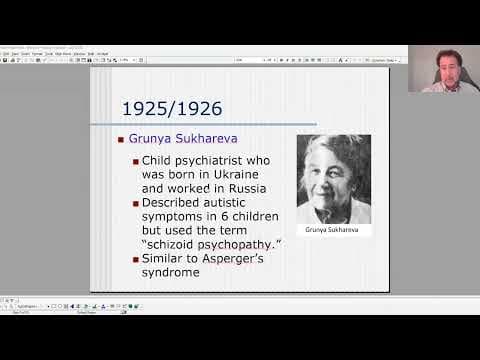
The first scholarly articles on autism were by Grunya Sukhareva in 1925 and 1926, describing six children with "schizoid psychopathy," similar to what is now known as Asperger syndrome. In 1944, Hans Asperger, an Austrian pediatrician, described four cases, though his work gained wider recognition only after Lorna Wing's paper in 1981.
In the late 1950s, Bruno Bettelheim popularized the theory that autism was caused by parental emotional neglect, leading to interventions like marriage counseling for parents and play therapy for children, despite a lack of evidence. Rimland's 1964 book, "Infantile Autism," was instrumental in shifting the focus back to a biological understanding.
The 1960s saw significant developments:
- Edward Ritvo and colleagues at UCLA's Neuropsychiatric Institute began studying the medical aspects of autism and powerful medications.
- Ivar Lovaas pioneered behavior therapy, initially focusing on challenging behaviors and later expanding to communication, education, and social interaction.
- Ruth Sullivan, with Dr. Rimland's help, established the National Society for Autistic Children (later the Autism Society of America) to create a parent network for support and resource sharing.
- Eleanor M. Creak organized the British Working Group, which developed a nine-point diagnostic criteria for autism in 1961.
- Helen Allison established the National Society for Autistic Children in the UK in 1962.
- Neil O'Connor and Betty Hermelin began studying cognition, attention, and sensory processing in autism in 1963.
- Victor Lotter conducted the first prevalence survey in 1966, estimating autism at 4.5 per 10,000, a statistic widely cited for many years.
- Uta Frith developed the central coherence theory, suggesting autistic individuals have difficulty integrating information into a coherent whole, focusing instead on details.
- Lorna Wing proposed the "Triad of Impairment" (social interaction, communication, repetitive behaviors), which influenced later diagnostic criteria.
The 1970s brought further advancements:
- Susan Folstein and Michael Rutter published research in 1977 on identical and fraternal twins, providing early data for a genetic component to autism.
- Jean Ayres pioneered sensory integration therapy at the University of Southern California.
- Rimland published early work on nutritional supplements, particularly vitamin B6 and magnesium, after receiving anecdotal reports from parents, leading to studies that showed benefits for a subgroup.
The 1980s saw changes in diagnostic criteria and increased research:
- The DSM-III in 1980 gave autism a separate category, "infantile autism," with criteria similar to Wing's Triad, requiring onset before 30 months. A revised version in 1987 offered a broader definition.
- Margaret Bauman and Thomas Kemper documented the first evidence of neurological differences in a 29-year-old man, showing fewer neural cells in specific brain areas.
- Ivar Lovaas published a detailed manual for behavior therapy, often called the "Me Book," and a study on the long-term effects of behavior therapy, reporting recovery in nearly half of the participants.
- Temple Grandin published her first book, "Emergence: Labeled Autistic," in 1986, edited by Rimland.
- The movie "Rain Man" (1988) significantly raised autism awareness, with Rimland serving as a consultant and suggesting the character be autistic with savant abilities.
The 1990s focused on establishing major advocacy and research groups:
- ARI established the "Defeat Autism Now!" program, focusing on medical conditions, particularly immune and gastrointestinal systems.
- Cure Autism Now was founded, focusing on the biology of autism, biological interventions, prevention, and a cure, eventually merging with Autism Speaks.
- "Families for Early Autism Treatment" (FEAT) was established, inspired by Lovaas's work, to advocate for behavior therapy and work with government officials, insurance companies, and schools.
- Lenny Schaefer oversaw the FEAT e-newsletter, one of the first major online newsletters on autism.
- The Behavior Analyst Certification Board was established to certify professionals offering ABA therapy, addressing concerns about varying levels of experience and understanding.
From 2000 to the present, research continues to emphasize:
- Genetics, DNA, exome sequencing, and epigenetics, with strong evidence connecting genetic susceptibility to environmental toxins and pollution.
- Neurology, including brain tissue research, brain wave imaging, and specific neurotransmitters.
- Medical conditions such as gastrointestinal, immune, metabolic issues, anxiety, depression, and sleep disturbances.
- Behavioral interventions like the Early Start Denver Model, functional communication training, and pivotal response treatment.
- Increased attention to adults and seniors on the autism spectrum, addressing housing, employment, recreation, and ongoing medical issues. Discussions include the need for nursing homes and group homes for seniors with staff trained in autism awareness.
Dr. Edelson believes it's important to understand autism as having different types, as a more nuanced understanding can lead to more effective interventions. He advocates for the re-evaluation of Asperger syndrome as a diagnostic category, noting that its removal from the DSM was partly due to funding considerations. He also prefers the term "condition" over "disorder" for autism, believing that labels, when properly understood, can help in providing appropriate support. He suggests that medical students and other professionals should have coursework on autism due to its high prevalence and the unique insights it can provide into helping a wide range of individuals.