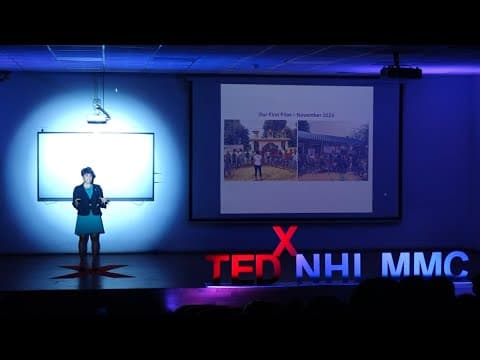
My training saga & how Ek beti, Ek cycle is contributing to the society | Pragnya Mohan | TEDxNHLMMC
Audio Summary
AI Summary
The speaker begins by inviting the audience to recall the first time they felt in control of their destination, free, and independent, often associated with riding a bicycle. They share a personal anecdote about their first new bicycle, a purple "lady bird" with a basket, which became a companion for adventures and a tool for significant achievements. This bike facilitated a rigorous daily routine during school, involving a 10 km cycle to swimming practice at 4:30 AM, 5 km of swimming, and another 10 km cycle back home before school. This dedication, enabled by cycling, led them to become the best swimmer in the state for four consecutive years.
The speaker's cycling journey continued in 2013 when they decided to participate in their first cycling competition in Ahmedabad. Lacking a racing bicycle, they found a rusty, broken-down one in a friend's basement. With a mere 100 rupees, a mechanic transformed it with new brakes, oiled parts, and new tires. They trained for the race, which was flagged off by then Chief Minister Narendra Modi, and won the 50 km race, earning a prize of 1 lakh rupees. This victory marked the beginning of their triathlon career, eventually leading them to become an internationally ranked triathlete and represent India at the Commonwealth Games.
Beyond personal achievements, the speaker recognized the bicycle's potential as a "mode of opportunity" and a means to give back to the community. In 2023, selected as a young leader for the International Olympic Committee, they identified a significant problem in rural India: a nearly 20% higher dropout rate for girls in education compared to boys. This issue stemmed from the structure of schooling, where primary schools are within villages (a few hundred meters away), but high schools (9th and 10th standard) are located in clusters of five to seven villages, requiring girls to travel five to ten kilometers. This distance, combined with social barriers, often forced girls to drop out.
Inspired by their own experience of acquiring a bicycle when needed, the speaker devised a solution: providing bicycles to these girls. In November 2023, they launched a pilot project with family and friends, going door-to-door to collect unused bicycles. These bikes were repaired by partner mechanics. They then collaborated with a rural high school near their home to identify girls who would benefit. They collected 22 bicycles and conducted a six-day training camp. Many 13-year-old girls touched a bicycle for the first time during this camp. They were taught how to cycle on roads, navigate obstacles like animals and potholes, and even cycle non-stop for five to ten kilometers. The training also included basic bicycle maintenance, such as repairing punctures, adjusting brakes, and seat height. Finally, the girls were given the bicycles to independently commute to school and continue their education.
Following the successful pilot, the project scaled up in 2024. The main challenge identified was a consistent supply of bicycles. To overcome this, they approached schools in the city, asking students to donate unused bicycles. They also targeted apartment buildings, where hundreds of bicycles often lie in basements, and partnered with corporates and businesses to encourage employee donations. This strategy yielded a strong response, allowing them to expand the project with the help of volunteers.
Their current standard operating procedure involves collecting donated bicycles from city school students' doorsteps, repairing them with partner mechanics, and then providing them to identified girls in rural high schools. A three to five-day training period covers cycling and basic maintenance. The bicycles are handed over with a formal ownership transfer: from the donor to their foundation, then to the rural high school, which in turn lends them to the girls as long as they remain in education. This system ensures accountability and sustainability, as girls return the bikes upon leaving school. Furthermore, participating girls are encouraged to become mentors for future projects.
The project has generated heartwarming stories. One girl, Priyanshi, started noting her daily learnings and dreams for the bicycle from the second day of the camp, highlighting the girls' bright minds and lack of opportunities. The project also broadened the girls' horizons, as many had never visited neighboring villages before. Teachers have reported positive impacts, including a stronger Kho Kho team composed of daily cyclists and increased confidence and classroom participation among the girls.
The initiative addresses nine out of the 17 United Nations Sustainable Development Goals, promoting gender equality, sustainable communities, and climate-friendly transport. By providing bicycles, the project aims to reduce the dropout rate for girls and offer them equal opportunities. Corporate and bank partnerships are growing, with plans to roll out another thousand bicycles around Ahmedabad and Gandhinagar next year, and to expand to new cities like Pune, where a pilot was conducted last December. The speaker concludes by inviting everyone to join this movement, emphasizing that sometimes, all it takes to change a life is "two wheels and a little bit."