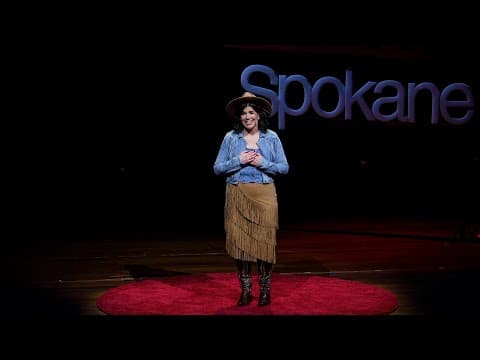
How horses promote connection | Cat Caldwell Myers | TEDxSpokane
Audio Summary
AI Summary
A hundred years ago, humanity lost something vital when daily connections with horses ceased. This loss and its significance are explored, beginning with the riddle: "What has no life but can die?" The answer is machines, highlighting the unique way we describe inanimate objects as "dead" without having "lived."
The speaker, a certified horse adventure coach, author, and podcaster, shares a personal experience of learning to drive a horse, which paralleled how children historically learned to drive carts alongside parents before riding. This experience led to teaching her own children and students with a pony named Chester, who came with his own cart and harness. The phrase "putting the cart before the horse" is re-examined. While commonly understood as doing things in the wrong order, the driving community revealed its deeper meaning: people prioritized keeping their cart when needing a new horse, thus de-prioritizing the crucial human-horse connection. This reflects a broader societal tendency to value material possessions over living connections.
The speaker believes horses offer a powerful antidote to machine-induced disconnection. Less than a century ago, daily life revolved around horses, once called "living machines." The 9-to-5 workday standard, for instance, originated from the amount of time a horse could work at 3 miles per hour before fatigue. Both horses and humans are not meant to work like machines.
A conversation with her grandmother, born in 1931, revealed the impact of the transition from horsepower to machine power. Her great-great-grandfather, a farmer, found farming unfulfilling without horses, emphasizing the team aspect. Some still practice traditional horse-powered work, like a neighbor plowing a potato field with a four-horse team, a family tradition spanning seven generations.
The grandmother also taught the speaker about being a "team" through "grandmother's week" on the family farm. A photo from the late 1900s shows the grandmother using her voice, hands, and seat to guide her horse, energetically setting the tone for her horse, grandchildren, and the herd. She only handed over the reins when each grandchild demonstrated the ability to control and co-regulate their horses.
Co-regulation, a mutual exchange of calm, is observed between people, horses, and horses and people. Horses, as prey animals with mobile ears and side-set eyes, co-regulate with humans, who are predators with front-facing eyes. This interspecies co-regulation has existed for over 5,000 years and is considered another sense—"horse sense." Dolly Parton's quote highlights the practical value of horse sense over theoretical knowledge.
The speaker questions our reliance on AI for answers, suggesting "horse intelligence" (HI) as an alternative. The shift at the turn of the century saw horses replaced by cars, leading to a dramatic decline in horse populations and carriage makers. The Bureau of the Census even cited this transition as a contributing factor to the Great Depression. While not the sole cause, losing horses can lead to a "depression" in a personal sense.
Horses are presented as a portal to face-to-face communication, demanding mutual seeing, touching, and sensing. Unlike machines, which are programmed and designed to meet whims, working with horses taps into something deeper. As equestrian Ray Hunt said, there's an inexplicable "other thing that makes it all work," a connection that matters and can always be rediscovered.