New York's Orthodox Jews: a City Within a City
Audio Summary
AI Summary
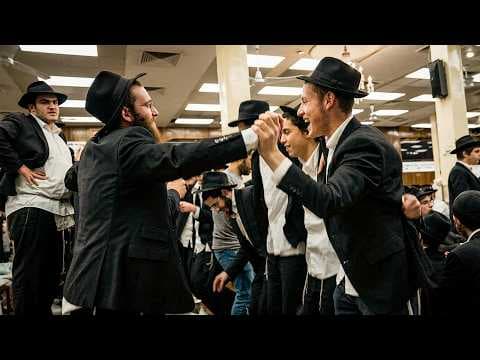
In New York's Brooklyn neighborhood, the majority of American ultra-Orthodox Jews, known as Hasidic Jews, reside. The Chabad Lubavitch, one of many Hasidic branches, are a prominent group, with approximately 15,000 members in New York. The Katz family, for instance, belongs to this community. Each Hasidic group has distinct customs and symbols; for the Chabad Lubavitch, the image of their last leader, Rabbi Schneerson, who died in 1994, is ubiquitous. His birthday is a significant celebration, with hundreds of men dancing to traditional music in the synagogue at 770 Eastern Parkway, the Chabad Lubavitch headquarters. Women celebrate separately on the first floor. Many attendees are yeshiva students, some traveling from as far as Paris for the two-day event.
Hasidic Jews, numbering 200,000 in the United States, constitute less than 3% of American Jews, predominantly living in New York's Williamsburg, Borough Park, and Crown Heights. Their religious practices, largely unchanged since the 18th century, include strict dress codes and the use of Yiddish. Children learn Hebrew before English, as Hebrew letters are considered connected to their soul. They live in insular communities, marry within their faith, and often have large families; one couple mentioned having 14 children. While they have prospered in the U.S. due to religious freedom, their expansion into areas like Monroe, a small country town, has met resistance. Leaving the community carries a significant personal cost.
The life of Hasidic Jews is governed by rigorous religious adherence. Men, like Yoni Katz, wear black trousers, white shirts, a hat, and a kippah from age three. They pray three times daily, using a prayer shawl and tefillin, which symbolize aligning emotions and mind with God. Women's primary role is marriage and childbearing, with no compulsory prayer but strict modesty rules. They wear long skirts or dresses and sleeves covering their elbows, and married women must cover their heads with a wig or scarf. Rivki Katz, a Chabad Lubavitch woman, wears a wig over her natural hair, which is styled to be undetectable, emphasizing personal identity and preserving "sexual energy" within.
Married women also practice monthly immersion in a mikvah, a ritual bath, after their menstrual cycle, before resuming intimacy with their husbands. Physical contact between men and women outside the immediate family is forbidden.
A central figure in the Hasidic world is the Rebbe, revered by the community. Many travel to Rabbi Schneerson's tomb at Montefiore cemetery to pray, give "good news," and seek inspiration. Rabbi Schneerson, who led the movement for 43 years, revolutionized it after fleeing Europe during WWII. He aimed to rebuild the lost world of Eastern European Jewish villages (shtetls) in New York, and the community has since grown, including families like the Katzes from Germany and Hungary.
The Chabad Lubavitch movement globalized in the 1970s, with Rabbi Schneerson's messages broadcast live via a unique telephone system to emissaries worldwide, a precursor to the internet. Today, there are about 5,500 emissaries.
Preparations for Pesach (Passover) involve extensive chores. Families immerse new utensils in a rainwater pool and meticulously clean their homes to remove all leavened products. Dietary laws, such as kosher meat, no pork or shellfish, and the separation of milk and meat, are observed year-round. Contraception is generally only allowed under exceptional circumstances with a rabbi's permission, leading to large families. Bracha, Rivki's mother, is one of 15 children and now has 31 grandchildren. The Passover Seder begins with a ritual search for hidden pieces of bread, which are then burned the next morning, symbolizing a victory over history for many.
In Borough Park, another Brooklyn neighborhood, 70% of residents are Hasidic, with some communities even stricter than Chabad Lubavitch. Rachel Freier, a Hasidic judge on the New York Supreme Court, lives here. She belongs to the Bobov Hasidic movement, where boys grow side locks (piot) from age three, and married men wear a shtraiml (fur hat) on holidays. English and Yiddish are spoken, with Gavriel, Rachel's son-in-law, only learning English at age eight. Men typically study religion, while women often work to support their families. Rachel, for example, supported her husband's religious studies and now pays for her three sons-in-law to study full-time.
Marriages are arranged by a matchmaker (Shadchem), with families vetting each other before the couple meets. Leah and Gavriel met twice for an hour and a half before getting engaged. Wedding ceremonies are segregated, with men and women celebrating separately. Leah, along with her mother, runs an association of volunteer female ambulance drivers, providing care for Hasidic women who might be uncomfortable with male healthcare workers. This initiative, initially met with resistance, gained legitimacy with the support of rabbis, who make all major community decisions.
Rabbis also influence technology use. In 2012, many Hasidic leaders banned followers from using the internet except for work or with rabbinic permission, an announcement made to 60,000 men (women watched outside). In Chabad Lubavitch, a rabbi (mashpia) acts as a marriage advisor and personal coach, and consulting them is common for significant life decisions.
Many Hasidic Jews have moved to Florida, a state with liberal religious laws, to provide an education aligned with their beliefs. The Chabad Lubavitch school in Boca Raton, which opened in 2020 with 30 pupils and now has almost 300, emphasizes religious education in Hebrew and Yiddish, with boys and girls separated from first grade. While English, math, and some science are taught, creationism is favored over evolution. These schools benefit from state aid as long as children pass basic skills tests.
Coexistence is not always peaceful. In Monroe, New York, the Satmar branch of Hasidic Jews grew from 15 families in the 1970s to 35,000, outnumbering other residents. This led to cultural clashes and territorial disputes, particularly when Hasidic Jews sought to expand housing. In 2019, Kiryas Joel, the Hasidic area, became an independent town to alleviate tensions, though wary residents like Mike still observe further Hasidic settlement with concern.
Leaving an isolated community like Kiryas Joel can lead to profound loss, including family ties and unpreparedness for the outside world. Shifra and Yohanan, who left the extreme Kiryas Tosh community in Canada 15 years ago, describe it as a "prison" where modernity and English were forbidden. They secretly sought outside knowledge, leading to their isolation and eventual departure. While they found it challenging to adapt, they raised their children freely. Their daughter Esther, now studying film, credits her parents with saving her from a predetermined life of early marriage and many children. Despite a dismissed lawsuit against the Canadian government for inadequate basic education, they have found balance and happiness.