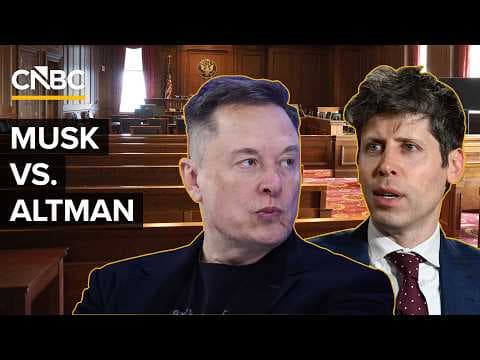
Battle Of The Billionaires: Elon Musk And Sam Altman Go To Court
Audio Summary
AI Summary
Elon Musk's lawsuit against OpenAI, CEO Sam Altman, and President Greg Brockman begins with jury selection on April 27th in California. Musk, a co-founder of OpenAI in 2015, alleges he was deceived into donating approximately $38 million to the startup under the promise it would remain a nonprofit. The trial will have two phases: a liability phase to determine wrongdoing and a remedy phase to decide the outcome. The jury's verdict in the first phase is advisory, with Judge Yvonne Gonzalez Rogers making the final decision on both liability and remedies.
OpenAI's original mission was to advance digital intelligence for humanity's benefit, unconstrained by financial returns. Musk left OpenAI's board in 2018 after disagreements, including his inability to merge the company with Tesla. Following his departure, OpenAI created a for-profit subsidiary in 2019 and, after considering a full conversion to a for-profit company, restructured in 2025 to solidify its nonprofit status with a controlling stake in its for-profit business. Microsoft emerged as a major stakeholder, holding about 27% of OpenAI's for-profit entity. Musk, meanwhile, founded a competing for-profit AI startup, xAI, in 2023, which has since merged with SpaceX.
The first phase of the trial is expected to last until mid-May, with major tech executives potentially testifying in the second phase, set to begin May 18th. Musk seeks remedies including the removal of Altman and Brockman from their respective roles and for OpenAI to revert to a fully nonprofit structure. He has also sought significant financial damages, reportedly up to $134 billion from OpenAI and Microsoft. OpenAI has consistently dismissed Musk's suit as baseless. The case could ultimately define control and direction within the rapidly expanding AI industry, determining whether it is guided by public mission or private profit.