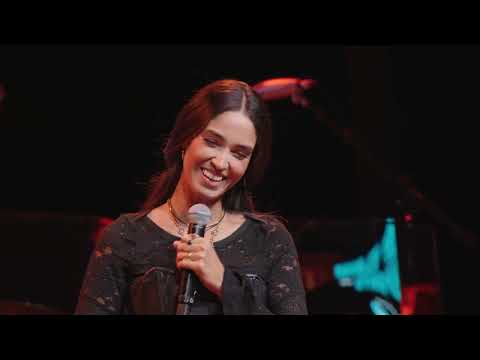
How to decode others without writing them off | MŌRIAH | TEDxNashvilleWomen
Audio Summary
AI Summary
At 17, newly arrived in Nashville from Southern California, the speaker faced an immediate cultural shock, epitomized by a local host's comment on her lack of warm clothing in January. This experience initiated her "crash course in cultural translating," a skill she found essential for navigating a new environment filled with unfamiliar social cues and veiled meanings. She encountered a world of competitive casserole Sundays, executive boardrooms, spiritual marketing, and Southern belles whose "bless your heart" could simultaneously offer a blessing and undermine self-esteem.
Living with strangers and working with people twice her age, the speaker, a musician, realized that success depended on understanding the "kind, confusing people whose words didn't always mean what I thought that they meant." She recognized the universal applicability of this "decoding tool," noting that many people often smile and nod without truly understanding what is being said, often with a lingering sense that whatever it is, it's probably not good. This led her to the principle: "decode or die," emphasizing that decoding with compassion transforms judgment into clear intention.
The first crucial question in this process is: "Am I decoding with kindness or criticism?" The speaker highlights that encoded language is pervasive, evident in polite deflections and professional euphemisms. She provides examples of common phrases and their underlying meanings: "I'm just really busy right now. I'm so sorry," often means "I don't have the emotional capacity to deal with this relationship." "It's not you, it's me" typically signifies "it's you. It's definitely you." In the music industry, "you've got a unique look" can translate to "you don't look like the last person who sold well for us." She argues that these discrepancies suggest a need for better communication skills, asserting that while communicators don't always succeed, listeners possess an "infinite ability to decode." She asks for grace from her audience to foster a meaningful connection.
Decoding, she explains, requires maturity and "the confidence to give someone else the benefit of the doubt," as advised by her 71-year-old mentor, Valencia. She humorously recounts past experiences receiving disappointing news about her first album, illustrating how different "executives" conveyed the same message of limited success through various coded languages, from "spiritual Sammy Mariah" to "quarterzip golf dad exec" and the "bless your heart bell." She reflects that a better understanding of decoding at that time might have prompted clarifying questions instead of her "fear of getting curious" leading her to "write them off," which she equates to "decode or kill your connections."
The second question is: "Am I decoding correctly?" The speaker points out that misinterpretation can arise not only from personal dictionaries but also from tone and long-term processing. Citing a study, she notes that women with higher voices are often perceived as more attractive, while those with lower voices are seen as more demanding. She demonstrates how a neutral observation like "You are tall" can be perceived differently based on vocal pitch, potentially turning into a "lethal weapon" without awareness of incorrect decoding. She then performs a song with two friends, inviting the audience to pay attention to how each unique vocal timbre resonates with their inner child. The song, "Superwoman," explores themes of self-criticism, lost dreams, and the fear of vulnerability, contrasting a childhood belief in being a hero with an adult reality of self-doubt.
Finally, the third question for self-reflection is: "How do I decode me?" The speaker emphasizes the importance of delivering truth to oneself before receiving it from others. She describes "decoding Mariah" as a personal act of defiance against her tendency to interpret what feels right for the room rather than what she genuinely feels. She shares a transformative experience in a studio with a producer who, over six hours, repeatedly asked her questions until there was a "seamless and shameless connection between what I felt and what I said." This "painful process," likened to carving a new neural pathway with a machete, involved confronting painful memories and resisting the urge to distract herself with superficial lyricism. They spent days, weeks, and months in the studio, not writing a single song, but "decoding my heart."
In closing, she encourages the audience to use these same tools and questions to avoid making excuses for feeling let down or fed up. She passionately asserts that "friends decode or die with our beautiful tangled stories locked up in our casket," reminding them that their ancestors have been decoding for centuries, and this ability is a birthright. She envisions her grandmother, who spoke Spanish and decoded English, cheering her on as she learns new dialects, always connected to her "God-given birthright" of her "one original voice."