Pourquoi Chenla a échoué et l'Empire Khmer a triomphé
Audio Summary
AI Summary
This video introduces a three-part series on the Khmer civilization, described as one of the greatest yet most overlooked in human history. While civilizations like Egypt, Rome, Greece, and China are commonly recognized, the Khmer people, during Europe's Middle Ages, built the world's largest city, its grandest religious monument, and an intricate hydraulic network so complex that its function was only understood with satellite imagery 800 years later. Their story begins in Cambodia. This first part will delve into their origins, predating the Angkorian period, focusing on maritime trade, a legendary love story, and the rise of a king who declared himself a god.
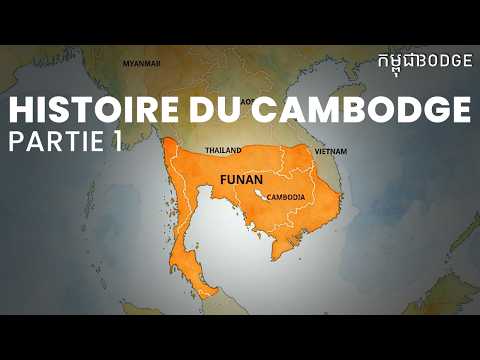
The narrative starts in the 1st century CE, a time when Rome was building the Colosseum and China's Han Dynasty was at its peak. Between these two powers lay the Indian Ocean, a bustling trade route traversed by hundreds of ships annually, laden with silk, spices, gold, and precious stones. To navigate from India to China by sea, ships followed the coast of Southeast Asia. Midway, they encountered the vast delta of the Mekong River, where the first great kingdom of Cambodia, known to the Chinese as Funan, emerged. The original name its inhabitants used has been lost to time.
Funan's capital was at Ancorboreil, in present-day Too province, with its port city, Oc Eo, strategically located on the India-China trade route. This perfect position and timing allowed Funan to thrive. Ships would stop, merchants would trade, and Funan would collect its commission, becoming a central intermediary in Asian trade and accumulating significant wealth. However, more important than gold and spices, the merchant ships brought new gods and ideas. Indian merchants introduced Hinduism, its deities, a sophisticated political system, and a new worldview to Cambodia. This cultural adoption was gradual, driven by prestige rather than military conquest. The kings of Funan observed Indian elaborate rituals, sophisticated Sanskrit writing, and the concept of divine kingship, choosing to adopt these elements. They took Sanskrit titles, calling themselves Raja, built temples to Shiva and Vishnu, and engraved inscriptions in Sanskrit. This was a unique form of "soft power," where Indian culture permeated Southeast Asia without a single soldier or invasion. Even the name Cambodia derives from the Sanskrit "Campudja."
A beautiful legend illustrates this cultural fusion: an Indian prince arriving by sea meets Soma, a local princess and daughter of the Naga king (divine serpents in Hindu mythology). They fall in love, and as a wedding gift, the Naga king swallows the water covering the land, revealing a new kingdom for the couple. This myth, while symbolic, conveys a profound truth: the Khmer civilization was born from the marriage of Indian culture, brought by sea, and the indigenous peoples rooted in the Mekong lands. This blend of foreign influence and local ingenuity forms the core identity of Cambodia, making its civilization unique. Funan prospered for five centuries under this model of commerce, temple building, and wealth, but by the 6th century, its fortunes began to change.
The video then shifts to the rise of the kingdom of Chenla, which would eventually replace Funan. To understand Chenla, it's necessary to trace the origins of the Khmer people. The Khmer belong to a larger group called the Mon-Khmer, who originated in southern China. Around 4,000 years ago, they began migrating south along major rivers like the Mekong, Irrawaddy, and Salween. This migration led to two main groups: one settling in modern-day Myanmar, Laos, and North Vietnam, which would give rise to Chenla; and another settling further south in present-day Thailand, Cambodia, and South Vietnam, in the plains around the Tonlé Sap and along the Mekong, forming the kingdom of Funan. These Mon-Khmer peoples were distinct from Indians or Chinese, possessing their own traditions, animist beliefs (worship of spirits, earth, and water), and a Mon-Khmer language belonging to the Austroasiatic family.
This cultural melting pot was crucial. From India, merchants brought Hinduism, Sanskrit, and divine kingship, influencing spirituality and politics. From China, officials, diplomats, and traders arrived, but not gods. Chinese envoys mapped the region, documented customs, and established trade relations from the 3rd century onwards. Chinese chronicles are, in fact, the primary source of information about Funan and Chenla. Amidst these external influences, the Mon-Khmer people maintained their deep animism and a mystical connection to the Tonlé Sap and Mekong. The Khmer civilization was not a mere copy of India or a satellite of China; it was a unique synthesis forged over centuries of local tradition, Indian spirituality, and Chinese commercial and diplomatic ties.
Returning to the 6th century, maritime trade routes shifted south towards the Strait of Malacca, diminishing Funan's geographical advantage and weakening the kingdom. This allowed the inland kingdom of Chenla to rise. Chenla was distinct from Funan; while Funan focused on the sea and international trade, Chenla looked to its hinterland and rivers. Its people were farmers, elephant breeders, and brick temple builders. They venerated Shiva, a testament to Indian influence, but also maintained their animist cults and water-related fertility rituals. Around 612 CE, King Iśānavarman I of Chenla conquered the remnants of Funan, establishing his capital at Ishanapura, near modern-day Kompong Thom. The ruins of Sambor Prei Kuk, magnificent brick temples predating Angkor by centuries, still stand today.
For a few decades, Chenla flourished. Iśānavarman I's great-grandson, Śrīdharavarman I, expanded the territory. However, after his death around 681 CE, Chenla fragmented. Chinese chronicles mention "Land Chenla" in the north, relatively stable, and "Water Chenla" in the south, plunged into chaos with warring princes and short-lived dynasties. To compound matters, Chenla fell under the domination of the Shailendra Empire, based in present-day Indonesia. Kings became puppets, and the country was fractured and humiliated. At this point, no one could have imagined that from this chaos, one of the world's greatest empires would emerge.
This brings us to Jayavarman II, arguably the most important figure in Cambodian history. Little is known of his early life, but stone inscriptions written centuries after his death indicate he spent time in Java, possibly as a hostage, exiled prince, or student. What he witnessed there profoundly impacted him: the power of a centralized, monumental empire, sophisticated rituals, and the concept of a king as the incarnation of a god on Earth. He returned to Cambodia around 800 CE with a plan. Starting in the east, at Indrapura, he began the arduous task of unifying the fragmented Khmer principalities. Through negotiation and battle, he patiently pieced together the kingdom over years.
In 802 CE, Jayavarman II made a pivotal move. He gathered his warriors, priests, and allies and ascended Phnom Kulen, a sacred mountain 30 km north of what would become Siem Reap. There, a Brahmin priest performed a solemn ritual, and before all witnesses, Jayavarman II proclaimed himself "Chakravartin" (universal sovereign) and "Devaraja" (god-king). This was the foundational moment, the "big bang" of the empire, and the birth certificate of a civilization. The concept of Devaraja was a stroke of political and religious genius: the king was not just a leader or a successful warrior but the embodiment of Shiva on Earth. Disobeying him was not merely defying a man but challenging the cosmic order itself. This divine authority was a powerful argument in a fragmented land, providing a legitimacy stronger than any army. Simultaneously, he declared independence from Java, liberating Cambodia and establishing an emperor.
After the ceremony, Jayavarman II descended the mountain and established his capital at Hariharalaya, near present-day Roluos, 15 km southeast of what would become Angkor. Hariharalaya served as the prototype, featuring the first stone temples, initial water reservoirs, and early urban planning centered around a temple-mountain. Jayavarman II died in 835 CE. His temples were modest, even described as rushed by some archaeologists, but his true legacy was far greater: he built the idea of a unified, divine, and sovereign Khmer Empire, an idea that would endure for centuries.
Jayavarman II's successors inherited this grand idea, tasked with transforming it into reality. His son, Jayavarman III, reigned without leaving significant traces. However, in 877 CE, Indravarman I, a king of a different caliber, ascended the throne. Indravarman was an engineer at heart who grasped a fundamental truth: the key to the empire was water. Cambodia faced an existential challenge with six months of monsoon rains causing floods, followed by six months of severe drought. To feed a growing empire and achieve multiple rice harvests annually, it was essential to capture and store water. Indravarman I constructed the Indratataka, a vast artificial reservoir, and built Bakong, the first true temple-mountain entirely in stone. This five-tiered sandstone pyramid, surrounded by moats and topped with a sanctuary, became the architectural model for subsequent kings. Remarkably, his reign was peaceful, with wealth derived from rice cultivation rather than conquest.
His son, Yasovarman I, pushed this logic further. In 889 CE, he made the bold decision to move the capital northwest, founding a new city called Yasodharapura, the first name for Angkor. He conceived on an unprecedented scale, ordering the excavation of the Eastern Baray, an artificial lake 7 km long and 2 km wide – longer than a significant stretch of the Seine River and larger than some natural European lakes. This reservoir held millions of cubic meters of water, sufficient to irrigate thousands of hectares and feed hundreds of thousands of people. This marked the beginning of the most sophisticated pre-industrial hydraulic system in the world, a network so vast and complex that its full extent was only understood through 21st-century satellite imagery. Yasovarman I also built Phnom Bakheng, a temple atop a natural hill, from where the king could survey his monumental work: endless rice fields, the shimmering baray, and the nascent temple towers piercing the canopy. The "machine" was in motion, the stage was set, and Angkor Wat's story had just begun.
This rich history is not merely ancient; it profoundly shapes modern Cambodia. Absara dancers, Khmer words like "Raja" and "Deva," and royal rituals are direct legacies of Funan and Chenla, and the Indian merchants who arrived over 2,000 years ago. The Cambodian celebration of Bon Om Touk (Water Festival) and their fascination with the Tonlé Sap's annual reversal of flow reflect the deep-seated belief, ingrained for centuries, that mastering water is mastering life. The Cambodian flag itself features Angkor Wat at its center, symbolizing the nation's core identity: to build something grand. This pride is intensified by the devastating periods that followed—centuries of decline, colonization, wars, and the Khmer Rouge. The history of Angkor is both Cambodia's greatest pride and its deepest wound, constantly posing the question: how could a people who built such wonders lose so much? This question will be explored in subsequent videos.
This first part has covered 800 years of history, from the wealthy, cosmopolitan port of Funan to the dark period of Chenla's fragmentation and foreign domination. It culminates with Jayavarman II, a prince returning from Java with a unifying vision, who ascended a mountain in 802 CE and declared himself a god, transforming the world. The next video will delve into the golden age of Angkor Wat, wars against the Cham, and the incredible account of a Chinese diplomat in 1296, who described a city grander and richer than any European capital of its time.