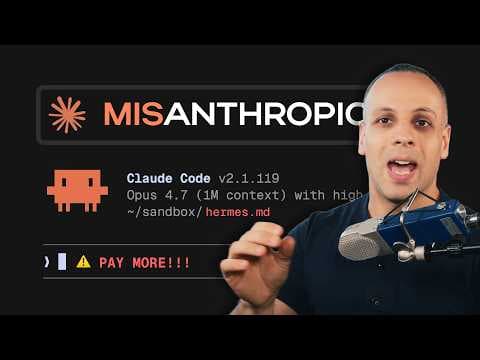
Anthropic deserves mass chargebacks for predatory billing policies
Audio Summary
AI Summary
In this episode, Lewis Rossman discusses a problematic billing strategy implemented by Anthropic, the creators of Claude AI. Many users favor Claude AI, particularly for its "Claude code" harness, which is known for its effectiveness in producing functional code. While other AI models like Gemini may offer more information on specific topics such as Google SEO, Claude code excels in agentic workflows. Rossman suggests that Anthropic has recognized this market advantage and is exploiting it through what he describes as "sloppy and underhanded" practices.
To illustrate the issue, Rossman uses an analogy involving an internet service provider. Imagine your ISP charges $100 per month for 100 gigabytes of data, with a $10 per gigabyte overage fee. If you've only used 70 gigabytes but start using BitTorrent, the ISP begins charging you $10 per gigabyte, even though you haven't exceeded your initial quota. This happens without explicit notification, simply because BitTorrent is associated with piracy, even if you're using it for legitimate purposes like downloading a Linux ISO.
Rossman explains that Claude AI is employing a similar tactic. Users who prefer to integrate their Claude account with other frameworks, such as OpenClaude, might have specific files in their directories. For example, if a user has a file named "Hermes.md" (written with a capital 'H' and '.md' extension) in their directory, Anthropic's system will start billing them for "extra usage" even if they still have a significant portion of their regular plan's usage remaining.
For users with a Claude Max plan, which costs $200 per month and includes substantial usage, the normal procedure is for the service to stop working once the usage limit is reached, with the option to opt into "extra usage" at an additional rate to continue projects. However, Rossman's example shows that the presence of "Hermes.md" triggers extra usage billing prematurely, even when the user is only 70% or 80% through their allotted usage. While users can consent to extra usage, this consent is typically given with the understanding that penalty rates only apply after the initial usage is exhausted.
Rossman believes this practice is a deliberate attempt to push users towards API billing, which is significantly more expensive. API billing charges users based on tokens used per query, rather than a flat monthly rate. He argues that if Anthropic wanted users to switch to API billing, they should be transparent about it. Instead, they are silently overcharging customers.
Anthropic's response to billing inquiries regarding these "technical errors" has been dismissive. They state, "I need to let you know that we are unable to issue compensation for degraded service or technical errors that result in incorrect billing routing." Rossman views this as fraud.
As a solution, Rossman advises users to file a chargeback with their credit card company *before* submitting a technical support ticket to Anthropic. He explains that chargebacks create significant friction for businesses. Unlike canned responses to support tickets, chargebacks require a manual response from the company, often handled by underpaid customer support employees who may be more sympathetic to the consumer than the large corporation.
Furthermore, a high rate of chargebacks can lead merchant services providers to drop a company, as processing chargebacks is costly for them. Businesses are highly motivated to avoid chargebacks and will often change their policies to prevent them. Rossman acknowledges that the chargeback process can be cumbersome, especially with certain banks, but he stresses that collective action through mass chargebacks will force Anthropic to change its unethical billing practices. He highlights that these "bugs" consistently result in users paying more, particularly if they are perceived to be using the service outside of Anthropic's preferred ecosystem. He concludes by urging users to band together and file chargebacks to combat what he considers "sneaky" and "fraudulent" behavior.