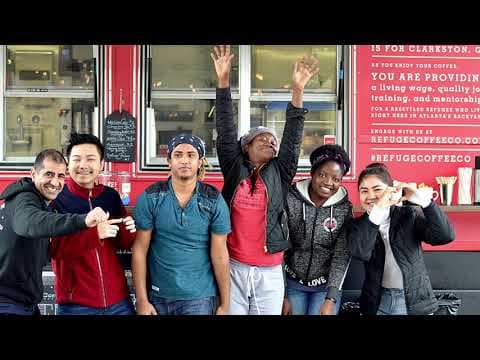
Massive World/Microscopic Me | Kitti Murray | TEDxEmory
Audio Summary
AI Summary
Kitty Murray shares her unexpected journey into entrepreneurship, sparked by a move to Clarkston, Georgia, a suburb recognized by Time magazine as the most diverse square mile in the country. Clarkston is a global hub, with residents representing approximately 40 countries and speaking around 60 languages. Many of these foreign-born residents arrived as refugees, fleeing war, persecution, and violence, and upon arrival, they face additional crises such as food, housing, education, and job insecurity, often carrying the scars of trauma.
Murray describes her initial reaction to encountering the refugee crisis as a "shock to the system," but this soon evolved into a deep affection for her new neighbors, whom she admired for their heroism, resilience, and hospitality. Her first encounter was with a refugee named Elena, who, due to the sensitive nature of her story, asked that her real name and country of origin remain anonymous. Elena's harrowing experience, which included witnessing the murder of her husband and children, left Murray feeling a profound sense of despair and helplessness.
Murray identifies her immediate responses to Elena's story as textbook reactions to trauma. The first was a "functional freeze," an evolutionary survival mechanism that caused her to become overwhelmed by her emotions. She realized that dwelling on her own feelings rendered her ineffective. The second, equally common reaction, she terms the "white knight syndrome," an arrogance born from a belief that she could fix everything with her own resources, education, and network. This realization that she couldn't simply "fix" the situation was a humbling experience.
The dynamic shifted when Elena, demonstrating remarkable agency, called Murray to the Department of Labor for assistance. Murray, initially hesitant and unsure of her ability to navigate such a situation, was met with Elena's calm suggestion to "Google it." This moment was a turning point, making Murray realize that there was no pre-written script for how to help, and that Elena herself was capable of writing it.
About a year later, Murray conceived of an idea that she couldn't shake: a nonprofit coffee shop in Clarkston. Her vision was to create a space that would bridge the gap between her world and that of her refugee and immigrant neighbors, providing jobs and future training opportunities. She aspired to share a more accurate and nuanced refugee story with the world. Her initial idealism was boundless, envisioning details like serving eggs from a hypothetical chicken coop at the coffee shop, though this specific detail never materialized.
Despite her enthusiasm, Murray was acutely aware of her limitations. Having been a pastor's wife and a soccer mom with a modest writing career, she lacked the business acumen required to launch such an ambitious venture. She and her husband humorously acknowledged their combined business skills would amount to a negative number. The sheer scale of the global and local refugee crises seemed overwhelming, and her idea felt microscopic in comparison.
A pivotal moment occurred at a writer's conference where she met Mike Rush, a young man who encouraged her to pursue her idea. He introduced her to a simple graph that helped her visualize her place within the vastness of the world and its challenges. This graph presented a continuum based on two dimensions: being "near" or "far" from people, and being "loud" or "quiet." Murray explained that "far" doesn't imply aloofness but the ability to gain perspective, while "near" signifies the capacity to connect deeply. She offered examples of how these traits combine: loud and far might be an activist (like John Lewis), far and quiet a supporter (like Melinda Gates), loud and near an implementer (like Mother Teresa), and quiet and near a mentor. She emphasized the importance of exploring all quadrants, especially for younger individuals discovering their identity.
Murray then connected this framework to the reality of people like Elena, stating that the world is "rounded out" by the presence of real people. She recounted taking Elena to a comfortable coffee shop, where Elena observed that there would never be anything like it in Clarkston. Elena's statement, delivered in one of her nine languages, wasn't a complaint but a poignant observation that refugees were not perceived as worthy of investment in spaces that could make them feel welcomed and valued. This was Murray's "tipping point."
Recognizing her limitations but also her strengths as an "implementer" who leans in and enjoys engaging conversations, Murray decided to take ownership of making the coffee shop happen. A year later, they obtained their 501c3 status, secured funding, purchased a coffee truck, hired their first refugee barista, and launched their job training program. The success of this endeavor, Murray believes, stems from individuals finding their "dot on the map" and inviting others to join them.
She highlights the crucial role of "asking others to join us." Early on, a mentor advised her to find a "number one volunteer." She approached a friend and neighbor, who agreed to help despite Murray admitting she had no idea what the role entailed. Murray's core belief is that the most effective way to address the immense global refugee crisis is not to try and "fix" it or be paralyzed by it, but to "befriend the people most impacted by it."
Eleven years later, their venture has grown to four locations in Atlanta, with a fifth opening soon. They have trained and employed refugees and immigrants from over 17 countries and have served approximately four million cups of coffee. Murray concludes by reiterating that this initiative began with a few people finding their individual place and then allowing the overwhelming world to come close enough to be seen as humanity. She acknowledges that the scale of the world's suffering can be terrifying, but encourages listeners not to let fear or even false confidence stop them. Her advice is to find that "microscopic dot," gather a few more people, and in doing so, discover "massive amounts of hope."