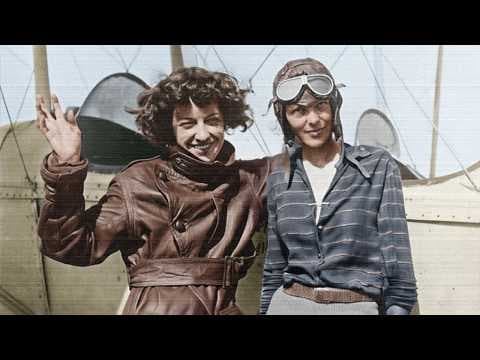
Amelia and Muriel Earhart | A Tale of Two Sisters
Audio Summary
AI Summary
Amelia Earhart became one of the most recognizable aviators of her time, embodying female aviation endeavor and inspiring future generations. Born in Atchison, Kansas, in 1897, Amelia and her younger sister Muriel shared an adventurous childhood, fostered by a love of reading. Their stable upbringing ended due to their grandfather's alcoholism, leading to a move to Los Angeles and financial struggles. Both sisters excelled in their studies, with Amelia initially pursuing pre-med before realizing it wasn't for her.
Amelia’s life changed when she moved to California and attended an air show, igniting her obsession with flying. She began lessons with Netta Snook, one of the few women pilots at the time. With financial help from Muriel, Amelia bought her first aircraft, a Kinner Airstar, in 1921. Her career truly took off in 1928 when she was selected to be the first woman to fly across the Atlantic as a passenger, an opportunity that arose after Mrs. Guest's family objected to her undertaking the flight. This journey, facilitated by publisher G.P. Putnam, made Amelia an international sensation.
The transatlantic flight, though Amelia was only a passenger, transformed her life. She toured Europe and returned to ticker-tape parades in the US, recognizing the opportunity to build a career in aviation. Putnam became her publicist and manager, instrumental in promoting her fame and arranging lecture tours, which were essential for funding her expensive flying pursuits. Amelia and Putnam developed a deep bond, marrying in 1931. Unconventionally, she retained her maiden name, Amelia Earhart, reflecting her determination to maintain her independence and career, and she was not interested in having children, advocating for birth control.
Despite her fame, many in the aviation industry doubted Amelia’s piloting abilities, believing she was better at making headlines than landings. Amelia herself felt she didn't deserve the accolades from her first transatlantic flight and vowed to make her own solo crossing to earn respect as a pilot. She went on to break numerous speed and distance records, proving that being a woman was not a hindrance.
On May 20, 1932, five years after Lindbergh's famous flight, Amelia successfully flew solo across the Atlantic from Newfoundland to Londonderry, Northern Ireland, battling mechanical difficulties, strong winds, and icy conditions. This achievement solidified her reputation as a serious pilot, earning her widespread recognition and a hero's welcome. She continued to conquer more aviation feats, including the first trans-Pacific flight from Honolulu to California in 1935.
Amelia's ultimate goal was a circumnavigation of the globe along the equator, the longest route ever attempted. For this, she chose the Lockheed Electra, a powerful twin-engine plane. In March 1937, her first attempt from California to Hawaii ended in a crash on the runway, damaging the landing gear. After repairs, she set off again on May 21, 1937, heading east with navigator Fred Noonan. A month later, they had circled the world to reach Papua New Guinea, with only the 7,000-mile Pacific Ocean separating them from the finish line.
On July 2, 1937, Amelia and Noonan departed from Ley, Papua New Guinea, for Howland Island, a tiny, barren island in the middle of the Pacific. This 2,500-mile leg required precise navigation. The U.S. Coast Guard cutter Itasca was waiting at Howland Island to guide them in and refuel their plane. However, communication was flawed; the Itasca could hear Amelia, but she could not hear them. After almost 20 hours of flying, Amelia reported being in the vicinity of Howland Island but couldn't locate it and was running low on fuel. Her last confirmed radio message was received at 8:45 AM, followed by silence.
A massive sea and air search was immediately launched by the Coast Guard and Navy, but after 18 days, on July 18, 1937, the search was abandoned. The official conclusion was that her plane had run out of fuel and ditched in the ocean north of Howland Island, with no wreckage or bodies ever found.
Amelia's disappearance became one of aviation's greatest mysteries, with many theories emerging over the years. The most popular initial theory was that she simply ran out of fuel and crashed at sea. However, after World War II, stories surfaced suggesting she was forced down and captured by the Japanese, though no solid evidence ever supported this.
A third theory, championed by the organization TIGHAR (The International Group for Historic Aircraft Recovery), proposed that Amelia and Noonan survived a crash landing on Gardner Island (now Nikumaroro), hundreds of miles south of Howland Island. This theory is supported by radio distress calls heard for nights after her disappearance, with radio bearings crossing near Nikumaroro. Furthermore, in 1940, three years after her disappearance, the bones of a castaway, along with parts of women's and men's shoes and a sextant box (similar to Noonan's backup instrument), were found on the island. While no item has been conclusively linked to Earhart, Lockheed, the plane's manufacturer, believed the radio calls indicated the plane was on land and its wheels, as an engine would be needed to recharge the battery for the radio.
Despite these findings, the theory of a crash at sea remains widely held. Critics of the Nikumaroro theory argue that Amelia wouldn't have had enough fuel to reach the island. Those who believe she crashed at sea suggest that after her last broadcast, an engine likely failed, and she was too busy preparing for a sea landing to make a distress call. The exact circumstances of Amelia's disappearance remain unconfirmed.
Amelia's sister, Muriel, found the continued searches painful, believing the money could be better spent. She and G.P. Putnam worked to preserve Amelia's legacy, with Putnam financially supporting Amelia's mother and Muriel writing a book about her sister. Muriel continued to speak publicly about Amelia's life and achievements, advocating for women in aviation and encouraging them to pursue careers in fields like engineering, offering an alternative to traditional family life. The lives of Amelia and Muriel represent the societal changes of their time, where women were slowly gaining access to new industries and choices beyond traditional roles.