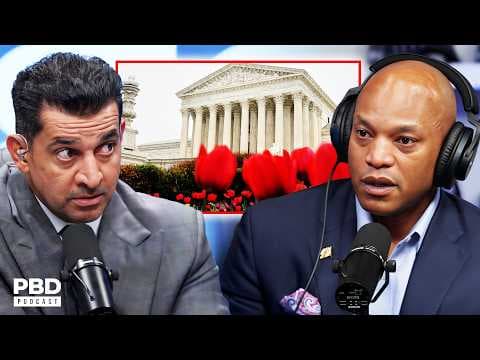
"Republicans Just Got 12 More Seats" - Wes Moore SLAMS Supreme Court's Redistricting Ruling
Audio Summary
AI Summary
The discussion revolves around a recent Supreme Court decision concerning the Voting Rights Act and its implications for gerrymandering. President Obama tweeted about the decision, stating it "effectively guts a key pillar of the Voting Rights Act," enabling state legislators to gerrymander districts, diluting the voting power of racial minorities under the guise of partisanship. He emphasized that this is another example of the court abandoning its role in ensuring equal participation and protecting minority rights. Obama stressed that citizens must mobilize and vote in record numbers to overcome such setbacks.
A New York Times article further detailed the Supreme Court's 6-3 ruling, which weakened a landmark civil rights era law by striking down a majority-black congressional district in Louisiana. This decision, according to the article, opens the door for more redistricting nationwide that could aid Republican efforts to control the House. The court's conservative majority found Louisiana's district, represented by Democrat Cleo Fields, relied too heavily on race, with Justice Samuel Alito describing it as an "unconstitutional gerrymander."
The guest on the podcast agreed with Obama's assessment, highlighting the oddity of allowing partisan gerrymandering while prohibiting other forms, especially given that over 92% of congressional maps in the country are uncompetitive. The guest advocated for national redistricting reform, arguing that politicians are currently picking their voters rather than the other way around. They also expressed concern over what they perceive as an assault on basic democratic frameworks, citing recent actions by the Trump administration regarding elections, such as attempts to nationalize elections or eliminate mail-in balloting, which they argue are unconstitutional.
The Supreme Court's decision on the Louisiana district is seen as a form of "political redlining," disenfranchising Black voters and reversing efforts made after the Civil Rights Act to ensure their enfranchisement. The guest criticized Congress for its failure to address these issues, deeming it unproductive and lacking guidance for states, leading to a "race to the bottom" in terms of fair redistricting.
The discussion then touched upon the three types of gerrymandering: partisan, racial, and bipartisan. The current case is primarily racial. The New York Times article suggests this ruling could lead to Republicans gaining 12 more seats across several states, including Tennessee, North Carolina, South Carolina, Georgia, Florida, Alabama, Mississippi, and Louisiana, where Democrats currently hold 24 seats. This decision sets a legal precedent that could encourage other states to engage in similar redistricting practices, building on earlier Supreme Court rulings that allowed partisan gerrymandering.
Gerrymandering occurs every ten years after the census. Illinois and California were cited as examples of aggressive gerrymandering, with Illinois creating a 143 to 3 advantage for Democrats in 2021 by packing Republican voters into a few districts. The guest acknowledged that gerrymandering happens on both sides, with some advocating for an end to the practice, while others engage in it if their opponents do. The core issue, they argued, is that many congressional districts are uncompetitive, meaning the primary election often determines the winner, effectively disenfranchising voters in the general election. The guest reiterated the need for Congress to act to protect the democratic process.