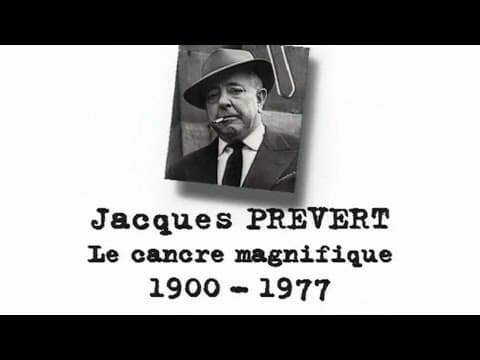
Jacques PRÉVERT – Un siècle d'écrivains : Le cancre magnifique (DOCUMENTAIRE, 1995)
AI Summary
Jacques Prévert, born in February 1900, was the second son of Suzanne and André Prévert. His older brother, Jean, died at 17 from typhoid fever, and his younger brother, Pierre, was born in 1906. His mother taught him to read, while his father, André, worked in an insurance company but harbored dreams of theatre and writing. The family moved to Toulon in 1906, hoping for a better life, but economic conditions did not improve, leading them back to Paris in 1907. They settled in the Saint-Sulpice district, frequently moving between streets like Rue de Tournon, Rue Saint-Sulpice, and Rue du Vieux Colombier.
Jacques’s relationship with his father, whom the children called "Auguste the Sever," was strained due to their differing bohemian and royalist natures. His father, a devout Catholic and director of the Central Office of the Poor of Paris, secured André a job visiting the needy to assess their eligibility for assistance, which improved the family's financial situation. Jacques would sometimes accompany his father on these visits, finding the impoverished settings reminiscent of "a sad party, without music and never ends."
In 1914, Jacques earned his certificate of studies and left school to enter the workforce, briefly working at department stores like Bon Marché and Grand Bazar. In 1920, he was incorporated into the 37th Infantry near Lunéville. During his service, he met Tanguy and later Marcel Duhamel in Istanbul. Upon returning to civilian life, Duhamel provided a house at 54th Rue du Château in the 14th arrondissement, which became a vibrant hub for surrealists. This period, from 1925 to 1929, saw Prévert deeply involved with the surrealist movement. He participated in various protests, co-created the game "cadavre exquis," and shared the group's fascination with women and love.
However, Prévert's relationship with André Breton, a leading figure in surrealism, deteriorated. Prévert found Breton’s authoritarian style and his attempt to align surrealism with Leninist revolutionary concepts problematic. The conflict culminated in March 1929 with the publication of a libel titled "Un cadavre," mocking Breton. Prévert's scathing article, "Mort d'un monsieur," further widened the rift, leading to his eventual dissociation from the surrealist group, though he remained close to the Communist Party without officially joining.
In April 1932, the Group Octobre was formed, inspired by Russian auto-active theatre (GITPROP), aiming to stage political events. Jacques Prévert was immediately sought after to write texts that would resonate with a popular audience. He became a central figure, known for his ability to translate current events into powerful, engaging theatre. For example, following Hitler's nomination as Chancellor of the Reich in 1933, Prévert wrote a show for the group titled "Hitler, Hitler, Hitler," portraying him as a "murderer, provocateur" and a "monster in freedom." He also penned a particularly virulent text during the Citroën workers' strike, using phrases like "the workers ask milk. It's not a nurse, it's a Citroën," culminating in a defiant "Merde, all the group of October." These works were designed to empower audiences and inspire change.
Prévert’s engagement extended to cinema from the 1920s. His brother Pierre Prévert filmed his first scenes, and in 1931, they collaborated on the surrealist film "L'affaire est dans le sac." In 1935, his dialogues for Jean Renoir's "Le Crime de Monsieur Lange" brought him wider popular acclaim. Prévert's cinematic style blended comic destruction, influenced by American and French comics, with fantasy, folly, and poetry, resulting in an "insolent" tone evident in films with his brother, like "Voyage Surprise," and with Paul Grimaud.
The period of the Popular Front saw Prévert creating pessimistic, suicidal, and anti-militarist films such as "Quai des Brumes" (1938) and "Le Jour se lève" (1939), often collaborating with director Marcel Carné. This partnership, known for its "poetic realism," brought together actors like Michèle Morgan and Jean Gabin, with whom Prévert developed a close, almost fraternal, bond. Prévert often worked with Alexander Trauner, who would create visual concepts and locations for his scenarios, seeing in color what would later be filmed in black and white. Prévert believed cinema was for the public, stating that "if there's no public, there's no spectacle."
His relationship with actress Arletti was significant; Prévert was fascinated by her beauty and freedom. Arletti notably starred as Garance in "Les Enfants du Paradis," a film released during the Liberation, which cemented her iconic status. While Pierre Prévert's films, like "Voyage Surprise" (1946), were creatively explosive, they often lacked commercial success compared to the more rigorous Carné-Prévert collaborations.
By the 1950s, the Carné-Prévert partnership dissolved. Prévert contributed to dialogues for films like Jean Delannoy's "Notre Dame de Paris" and continued working with Paul Grimaud and his brother Pierre. Concurrently, his poetry gained immense popularity, starting with "Paroles" in 1946. Prévert saw himself as an artisan rather than a "poet," writing for pleasure and a select few. He challenged conventional literary circles that often dismissed his work as "popular poetry."
Prévert's words transcended borders, translated into many languages and adapted into popular songs. His poetry, though sometimes aimed at children, was rooted in an "ethics of the tongue," exploring themes of love, misery, and the human condition. He was an anarchist at heart, critical of state and power, which often led to him being caricatured and denounced. He famously refused the Legion of Honor, citing his respect for an old man Prévert had depicted without such decorations.
Prévert's influence on those who read him was profound. As Juliette Gréco described, his work became "our reference, our vocabulary, our feelings, our violence, our poetry," speaking for those who suffered from "humility, silence, violence." His words offered solace and a voice to many.
Prévert's legacy endures through his ability to connect with people on a deeply emotional level, transforming perceptions and challenging societal norms. His vision of the "universe" was not abstract but rooted in the people he knew and loved, believing that "everything that is extraordinary" is simply "everything." He championed the beauty in everyday life and the honesty of human experience, leaving an indelible mark on French culture.