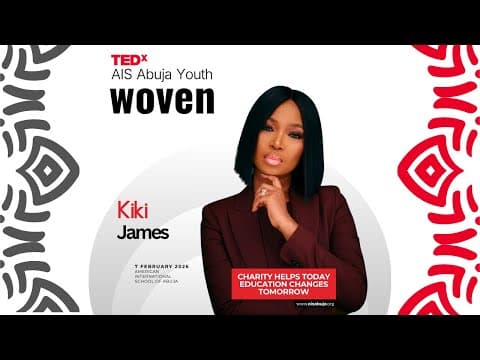
Charity Helps Today Education Changes Tomorrow | Kiki James | TEDxAIS Abuja Youth
Audio Summary
AI Summary
Kiki James shares her personal journey, beginning with a pivotal moment at age 10 when she witnessed the desperation and gratitude in a woman's eyes as she received a bowl of rice. This experience ignited a lifelong passion for helping others, leading her to volunteer her time and resources throughout her teenage years and into adulthood, providing meals and winter essentials for the homeless in the UK.
Despite these acts of kindness, Kiki felt an underlying emptiness, realizing that simply addressing immediate needs like hunger was temporary. She understood that true change required providing something more enduring, gifts that couldn't be taken away. This realization propelled her to address the educational disparities she observed, particularly in African classrooms where children lacked basic resources like books and faced overcrowded conditions.
At 28, Kiki returned to Nigeria with a clear mission: to establish a charity focused on creating a world where Africans could achieve an education beyond the basic level and participate fully in economic life. She defines education not merely as the ability to read and pass exams, but as a transformative process that shapes one's thinking, choices, and engagement with the world. It's about problem-solving and self-belief, empowering individuals to overcome limitations like illiteracy.
Her charity, ACE, founded in 2010, operates on three core pillars: education and training, economic empowerment, and research and advocacy. Kiki highlights Nigeria's current underinvestment in education, with the federal budget allocation falling significantly short of UNESCO's recommended benchmarks. She emphasizes that while governments play a role, individuals also have the power to drive change within their communities.
ACE's approach to improving education starts early, focusing on children. They have established 28 learning resource centers in partnership with government primary schools, creating safe and welcoming environments for learning. These centers provide essential curriculum-aligned books and, crucially, employ qualified staff who teach phonics, reading, confidence, leadership, and vital life skills, including financial literacy. These centers aim to make learning desirable and engaging, similar to well-resourced schools elsewhere.
The impact of these centers is significant, with over 4,000 children benefiting each term. A long-term goal of ACE is to expand educational broadcasting across Africa through radio. This initiative gained traction during the COVID-19 pandemic, which, despite its challenges, opened doors for ACE to secure radio slots. Broadcasting lessons in mathematics, English, and science across northern Nigeria, they reached an estimated 20 million people in 18 states.
Subsequently, ACE shifted its focus to out-of-school children, establishing 28 listening centers in seven states. These centers have shown remarkable results, including a 60% increase in knowledge and a 55% reenrollment rate into formal education. Kiki shares the inspiring story of Yahaya, an 11-year-old who, despite never attending formal school, possessed a deep desire to learn. Through ACE's listening center, Yahaya developed literacy, numeracy, and, most importantly, dignity, confidence, and a sense of belonging.
Yahaya's story underscores Kiki's central message: potential is universal, but opportunity is not. By providing the right learning environments and consistent support, ACE transforms learning and empowers children. Kiki argues that charity alone is insufficient; investing in education is key to enabling children not just to survive but to shape their own futures.
She reiterates that education extends beyond academic achievement, equipping individuals with transferable skills, opening doors, and fostering critical thinking, problem-solving, and leadership abilities. This, she believes, is the future every African child deserves. Quoting Nelson Mandela, Kiki emphasizes education as the most powerful weapon for global change. Her journey from a child offering a bowl of rice to an advocate for education illustrates that while charity addresses immediate needs, education provides the lasting power to transform lives and build a better tomorrow for children and nations alike.