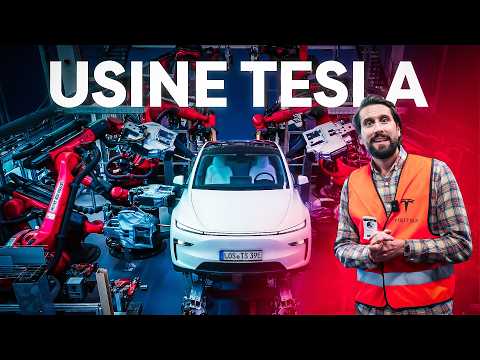
J'ai infiltré la Giga Berlin : voici les vrais SECRETS de fabrication de la Tesla Model Y
Audio Summary
AI Summary
This video takes viewers on a detailed tour of Tesla's Giga Berlin factory, aiming to explain the end-to-end electric car production process and compare it with practices in China. The presenter emphasizes a pedagogical approach, promising a clear and transparent look at automotive manufacturing.
The tour begins by highlighting Tesla's global factory strategy, with historical roots in the US, followed by Shanghai and now Berlin. This expansion is seen as a way to reduce logistics costs and utilize more favorable energy mixes, such as Germany's.
The production of an electric car, similar to a thermal car, is broken down into five key steps:
1. **Stamping and Casting:** Forming metallic parts.
2. **Body in White (BIW):** Creating the car's structural chassis, crucial for accident resistance.
3. **Painting:** Applying protective and aesthetic coatings.
4. **Battery and Electric Motor Installation:** Integrating the core electric powertrain components.
5. **Assembly Line:** The final stage where all parts are put together, culminating in final inspection.
The presenter shares initial impressions of Giga Berlin, noting the immense size of the factory floor, though perceiving it as less "polished" than facilities in China. The atmosphere is described as having a distinct smell of metal, reminiscent of older automotive plants. However, a significant contrast is drawn with past experiences in the industry. Unlike the harsh conditions of older factories, Giga Berlin is characterized by improved worker conditions, including music, the availability of an integrated supermarket, and a generally more pleasant working environment, which the presenter notes was not observed in Chinese factories.
A key observation is the perceived age of the machinery at Giga Berlin, estimated to be around four years old. This leads to a hypothesis that some production lines might be slightly worn, possibly due to a strategic decision to employ more human workers, a contrast to the highly automated Chinese industry where job displacement can be a concern.
The video delves into the first production step, **Stamping and Casting**. While the Giga Casting process itself wasn't fully visible, its significance is explained: a massive aluminum piece is melted and molded into a single component, such as the rear chassis of the Model Y. This single-piece construction replaces dozens of smaller steel parts, leading to increased solidity, reduced cost, and potentially lighter vehicles. The presenter mentions Tesla's claim of increased autonomy due to reduced weight and notes that while repairs might be more costly after a severe impact, Tesla is developing repair methods to avoid full part replacement. The process involves using elevator trolleys and ensuring the aluminum mixture is homogenous.
Moving to the **Body in White (BIW)** stage, the presenter highlights a stark difference: the significant presence of human logistics workers driving forklifts to transport pieces and tools. This is contrasted with the highly automated BIW process observed in China, where robots manage the delivery of parts. The presenter attributes this difference to the powerful influence of German unions, particularly IG Metal, which advocates for job preservation and is less inclined towards full automation. This leads to a surprising observation: Tesla's Shanghai factory, being older, is reportedly 95% automated, with more robots than humans, while Giga Berlin appears to have a higher proportion of human workers. The presenter acknowledges the debate between human labor and robotization, but clarifies that Giga Berlin still employs numerous robots, including two massive ones named "Godzilla" and "King Kong" used for heavy lifting at the end of the line. The BIW process at Berlin involves around 800 robots applying sealant and 250 workers on different shifts, producing a chassis every 60 seconds. The entire Model Y production from start to finish is estimated to take less than 10 hours.
The **Painting** stage is off-limits due to contamination risks. The process begins with dipping the car body into a corrosion-resistant tank, a crucial step for longevity. Over 200 robotic arms then apply six layers of paint, followed by a protective clear coat. The presenter notes that historically, Tesla's paint quality, particularly in the US, was not excellent, with inconsistencies. However, significant improvements have been made in Shanghai and Berlin, with the paint finishing now considered much better, though the presenter hesitates to definitively rank it against the sector's best. A notable practice at Tesla is the in-house production of plastic parts, like bumpers, which helps reduce costs and increase production speed by eliminating reliance on external suppliers. The challenge of painting plastic to match the car's body color is also mentioned.
Crucially, the **Battery and Electric Motor** are produced in parallel. While Tesla receives battery cells from suppliers like LG, Panasonic, and BYD, it assembles them into battery packs internally. The good news, the presenter states, is that Tesla will soon produce battery cells directly in Germany, which will lower costs and reduce the environmental footprint, as battery production is resource-intensive. The presenter emphasizes that even electric cars produced in China with a carbon-heavy energy mix are still more environmentally friendly than thermal cars, citing scientific consensus on this point, while acknowledging China's dominance in battery material supply.
The final stage is the **Assembly Line**. This is where the chassis is married with all other components like wheels, seats, and brakes. The presenter observes that this stage is not heavily robotized, relying on a significant number of human workers to perform numerous small tasks. This contrasts with Chinese manufacturers where similar steps are often handled by robots. The presenter attributes this to cultural and political factors, specifically the influence of unions and labor regulations in Europe, rather than a lack of technological capability. Tesla's vertical integration, including in-house production of seats and other components, is highlighted as a key factor enabling them to offer high-performance electric cars at competitive prices. A specific detail shared is that car doors are initially attached to the "body in white" but are removed after painting to allow for easier installation of internal elements and to ensure consistent paint application between the door and the car's body.
The tour concludes with the **Final Inspection** in a light tunnel, designed to reveal any defects not visible to the naked eye, such as micro-scratches or improperly fitted parts. Cars are either cleared for delivery or sent for repair. An anecdote is shared about a Chinese manufacturer where a car was tested on a simulated rough road, revealing a loose balloon that had been improperly fitted, leading to the car being rejected for repair.
The presenter then looks towards the future, referencing Tesla's "Unboxed" method, a revolutionary approach promising to halve production costs by performing many tasks in parallel, rather than in series. This involves producing major components like the front and rear chassis and the structural battery pack simultaneously and then assembling them. This method is expected to significantly reduce the need for human labor and robots, leading to a potential 50% reduction in production costs, which could translate to lower car prices. While acknowledging Elon Musk's ambitious promises, the presenter believes this method will be a game-changer. The applicability of this method to thermal cars is questioned due to their greater complexity.
The video ends with a broader philosophical discussion about the increasing role of robots in society. The presenter contrasts the highly automated, 24/7 operations in China with the more human-centric approach in Europe, questioning whether Europe is at a disadvantage by prioritizing human employment over maximum automation and cost reduction. The debate is framed as a choice between creating jobs for humans or reducing production costs through robots, allowing more people to afford cars. The presenter posits that maximum robotization may ultimately benefit humans by freeing them from repetitive tasks to focus on more creative and fulfilling work. The video encourages viewer engagement, asking for opinions on the future of automation and inviting suggestions for future factory tours, including electric vehicles produced in France.