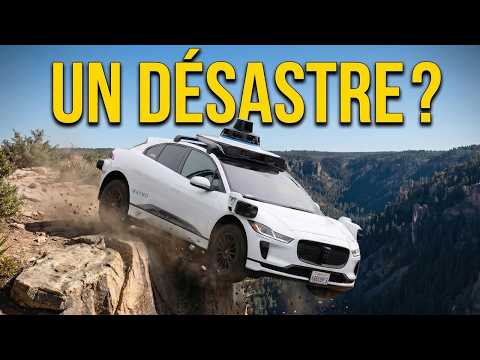
126 MILLIARDS pour un taxi SANS chauffeur?
Audio Summary
AI Summary
In the present day, self-driving cars are no longer a futuristic concept but a tangible reality, with autonomous vehicles completing millions of rides globally. These vehicles, equipped with advanced sensors capable of seeing in complete darkness and AI brains making hundreds of decisions per second, are navigating complex urban environments, obeying traffic laws, and even parking themselves. Companies like Waymo and Apollo have already conducted over 40 million commercial rides across China, the US, Dubai, South Korea, and the UK. The fleets are expanding, cities are becoming more receptive, manufacturing costs are plummeting, and the technological advancements are outpacing even their developers' expectations. This revolution in transportation is arguably as significant as the invention of the automobile itself.
While the widespread adoption of autonomous vehicles was anticipated around 2020, a promise made in 2015, France, despite being home to major automotive players like Renault and Peugeot, and Valeo – a global leader in mass-producing autonomous sensors – has lagged behind. The country's most prominent autonomous vehicle achievement is a mere 3-kilometer shuttle route at Roland Garros. This raises a critical question: how did a nation that supplies nearly 99% of the world's Level 3 autonomous car sensors become a spectator to a revolution it could have led?
To understand this, we must first grasp how the technology functions. An autonomous car essentially replicates human driving capabilities: seeing, understanding, deciding, and acting, but without human limitations like fatigue or distraction. The "seeing" aspect is achieved through a combination of cameras, radars, and crucially, Lidar (Light Detection and Ranging). Lidar utilizes hundreds of thousands of laser pulses per second, which bounce off surrounding objects and return to sensors, creating a precise 3D map of the environment up to ten times per second.
The "understanding and deciding" is handled by an artificial intelligence, an AI trained on billions of kilometers of driving data. This AI can recognize complex scenarios like a child chasing a ball, a scooter cutting into traffic, or roadwork narrowing the lane. Finally, the "acting" part involves the car accelerating, braking, and steering with the smooth precision of an experienced driver, free from stress or the urge to rush.
The levels of autonomy are categorized from 0 to 5. Level 0 is no automation, while Level 1 offers basic driver assistance like cruise control. Level 2 enhances this with lane keeping assistance but still requires driver supervision. Level 3 allows the car to handle driving in specific, limited conditions, such as highway traffic jams, with Mercedes being an early commercializer. Level 4 represents a significant leap, where the car drives itself within a defined operational domain without supervision, stopping safely if it encounters an issue. This is the level of robotaxis currently operating in cities like San Francisco and China. Level 5, complete autonomy everywhere, all the time, remains a theoretical future, with some, like Luc Julia, scientific director at Renault and co-creator of Siri, believing it to be unattainable.
Despite the challenges, progress has been rapid. Waymo, a company that began as a secret Google lab project in 2009, has been a pioneer. Initially, the concept of a self-driving car was pure science fiction. However, Google, not being a traditional car manufacturer, focused on building the "driver." Waymo became an independent subsidiary in 2016 and has since accumulated vast amounts of data and experience. After years of meticulous mapping, AI training on billions of scenarios, and continuous iteration, Waymo now operates in ten US cities, completing over 400,000 rides weekly, with plans to expand to cities like Tokyo and London. Waymo's vehicles, equipped with a comprehensive suite of sensors (Lidar, radar, cameras), are designed for high safety, contributing to a production cost of around $175,000 per vehicle. However, the company has faced scrutiny due to incidents, including a low-speed collision with a child and disruptions caused by power outages.
China's response has been swift and cost-effective. Baidu's subsidiary, Apollo, has achieved remarkable progress in just ten years, matching Waymo's ride volume but at a significantly lower production cost, around $30,000 per vehicle, with future generations expected to be even cheaper. This cost advantage is attributed to China's robust electric vehicle manufacturing ecosystem and government support. Apollo is rapidly expanding its operations within China and has secured licenses for autonomous vehicle operations in Hong Kong, opening doors to markets that drive on the left, such as the UK, Singapore, and Japan. They have also established a presence in Dubai, Abu Dhabi, and South Korea, with plans for London in 2026. A key concern regarding Apollo's expansion is data privacy, as Chinese national security laws could grant authorities access to collected data without judicial proceedings, leading to hesitations from some European regulators.
Tesla, led by Elon Musk, has taken a different approach, prioritizing a camera-centric, software-driven strategy, deeming Lidar and radar too expensive and complex. Musk's vision is to transform existing Teslas into autonomous vehicles through software updates. However, Tesla's robotaxi service in Austin, launched in June 2025, has faced performance issues, with an uptime of only about 19% and a reported incident rate significantly higher than human drivers. Despite these challenges, Tesla is pushing forward, with the production of the Cybertruck, a vehicle physically incapable of human driving, slated for April 2026. Musk's ambitious timelines for full autonomy have repeatedly been missed, with Tesla acknowledging the need for billions more kilometers of data.
Back in France, progress has been considerably slower. Level 3 autonomous driving is officially permitted but with strict limitations: only on roads with central reservations, at speeds up to 60 km/h, in good weather, and with a driver ready to take over at any moment. Several factors contribute to this lag: regulatory hurdles, with European countries still harmonizing interpretations of international conventions; an industrial strategy that has prioritized electric vehicles over autonomous driving; and a deliberate, albeit debatable, cautious approach focused on stricter legal responsibilities, data protection, and preventing foreign entities from collecting mobility data without oversight. While Valeo excels in sensor production, the complete autonomous vehicle remains largely a foreign acquisition for France.
Optimistic projections for robotaxis in France range from 2028 to 2030, with some believing it will take even longer. The broader implications of autonomous vehicles are profound: a potential reduction in road accidents caused by human error, the reshaping of urban landscapes, and significant job displacement for drivers. Furthermore, the ethical dilemmas surrounding unavoidable accidents, such as choosing between protecting passengers or pedestrians, or prioritizing certain demographics, are complex. The "Moral Machine" experiment by MIT highlighted these divisions, revealing distinct cultural preferences in accident scenarios across different regions. Ultimately, the development and adoption of autonomous vehicles present not just technological and financial challenges, but fundamental questions about societal values and choices.