If I Wanted to Make $1,000 a Day Trading, I’d Do This
AI Summary
The speaker, a successful trader for over four and a half years, explains how to aim for a profit of $1,000 a day in trading. He immediately clarifies that making $1,000 every single day is an unrealistic expectation. Instead, the goal should be to achieve $5,000 by the end of the week, which, when averaged, equates to $1,000 a day. This approach prevents overexposure to unnecessary trades, reduces stress from forcing trades daily, and encourages patience to take only proper trade setups. He illustrates this by suggesting that one single trade with a $1,000 risk and a one-to-five risk-to-reward ratio could achieve the $5,000 weekly goal, which is less stressful than attempting five to ten daily trades.
The speaker uses a baseball analogy to explain the correct mindset for trading. In baseball, a batter waits for the perfect pitch to hit a home run. Similarly, in trading, you have unlimited opportunities and are not forced to swing at every market movement. The goal is to be patient and wait for the perfect trade setup, rather than "swinging at every pitch" and striking out. Traders often fail because they try to capitalize on every perceived opportunity, believing there are endless chances, which is false. Only the correct opportunities should be pursued. Missing a few is part of the process; the focus should be on taking the right ones to achieve the "home run." This mindset emphasizes patience and strategic waiting over constant action.
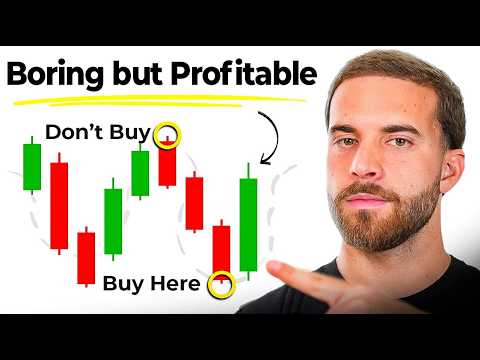
The first practical step in achieving the $1,000 daily goal through technical analysis is to avoid buying at highs and selling at lows; always wait for a retracement. When the market shows high volatility or a significant push, the move has often already happened. Entering out of hype or fear of missing out (FOMO) is a common mistake. Instead, traders should wait for a retracement, or a "discount," before entering a trade. This applies to all types of trades, from scalping to swing trades, ensuring a better entry point. An example given is Bitcoin hitting an all-time high; buying at this point is ill-advised, and waiting for a retracement is crucial. Patience is key in waiting for the "perfect ball" to enter the "pocket" before taking a swing.
The second crucial point is to avoid getting stuck to a daily bias or constantly changing it based on how one feels or the day's fundamentals. Many traders wake up deciding whether to buy or sell that day, often changing their market direction daily. This inconsistent approach, typical of many scalp traders, leads to low win rates and lack of success. Instead, traders should perform technical analysis on Sunday before the market opens to determine the overall market direction for the entire week. If the market is projected to be bearish, one should only look for selling opportunities; if bullish, only for buying opportunities. Countertrend trades or small retracements should be avoided if they deviate from the weekly plan, to prevent "feeling involved" unnecessarily. The technical analysis should always lead, and the bias should remain consistent throughout the week, regardless of daily feelings or fundamental news. The baseball analogy is revisited: a batter doesn't change their swing style daily if it doesn't immediately yield results; consistency in strategy is vital.
The third and most powerful point for achieving the $1,000 daily goal involves managing risk and accepting losses as part of the trading plan. Trading inherently involves risk, and a robust plan must account for losing trades. A typical trading plan might have a 50-60% win rate, meaning 40-50% of trades will be losses. These losses are unavoidable and must be accepted from the outset. The speaker recounts an instance with a student, Josh, who tried to find ways to avoid a loss while in a drawdown, despite having pre-calculated his risk. The speaker emphasized that one cannot enter a trade without accepting the potential loss. Pre-calculated risk management is the way to minimize losses, not by trying to avoid them mid-trade. Accepting losses is akin to accepting that one might lose a game in sports; it's part of the game, and one learns from mistakes to optimize future performance. Dragging the negativity of a loss to subsequent trades or allowing external factors to affect future decisions is detrimental.
Furthermore, traders should not expect to maximize every single trade to its full potential. The speaker highlights that traders often catch a one-to-two or one-to-three risk-to-reward but lament not achieving a one-to-five or one-to-six. The trading plan should define the minimum acceptable risk-to-reward. Using the baseball analogy again, the goal is to swing hard enough to at least reach second base, not just first. In trading, this translates to aiming for a minimum of a one-to-two risk-to-reward ratio on every trade. This positive risk-to-reward ensures profitability even with a 50% win rate (e.g., five losses of minus one and five wins of plus two result in a net gain of five). Traders should stick to this plan; if a trade is not going as anticipated, they shouldn't cut it short at a one-to-one or less, deviating from the plan. The commitment is to at least second base. If the trade reaches the one-to-two target, a decision can be made to hold for a one-to-three or one-to-four, which is the "home run." Once the "home run" (e.g., one-to-four risk-to-reward) is achieved, the trade is done, and one moves on without greedily trying to extend it further. The speaker stresses committing to the plan and moving forward without looking back, even if fear or doubt arises.
Finally, all these points coalesce into a comprehensive trading plan. It's crucial to understand market dynamics, recognizing if a market is bullish or bearish, identifying strong support/resistance or supply/demand zones, and having a clear entry signal. Without this foundational understanding, one is merely acting on superficial ideas without a solid strategy. The speaker offers to share his market insights and strategies with students, including trade entries, risk management, and potential profit targets, providing a link for further information and personal trade reviews.