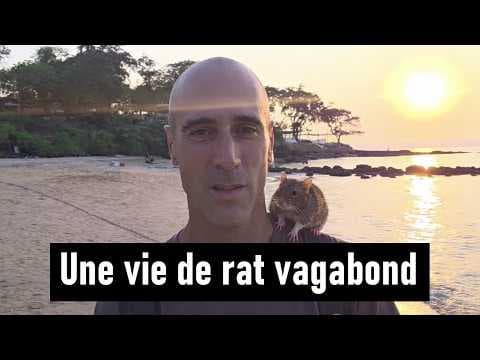
Peut-on vivre une vie de rat vagabond en Asie du Sud-Est ?
Audio Summary
AI Summary
The speaker addresses a question from Cyril Benet3086 about living a vagabond life in Southeast Asia, specifically mentioning Laos, Thailand, and Vietnam, without spending unnecessarily. The speaker identifies with Cyril as a "big rat" who seeks to live happily and frugally, and confirms that Southeast Asia is an ideal destination for such a lifestyle. Having lived this life himself in the past, the speaker expresses nostalgia for his vagabond days, describing it as "the most beautiful life" he has experienced. He notes that he is currently "too rich and too installed," struggling with "temptations of sedentarization," and actively trying to return to a more nomadic existence.
The speaker explains his past vagabond life was sustained by passive income from investments, such as rent from an apartment in France, dividends, and bond coupons, without engaging in online business or work. He contrasts this with his current situation, where he is "falling into this business online" and finding it difficult to disengage. He recounts his extensive travels as a vagabond throughout Southeast Asia, including Laos, Myanmar, Sri Lanka, Thailand, Vietnam, and Cambodia, expressing deep regret that he no longer lives this way, despite finding some interest in his current life.
He then elaborates on the joys of a vagabond lifestyle, particularly the satisfaction of spending very little and negotiating everything. He mentions having used free online training to hone his negotiation skills, even for trivial items like water bottles or laundry. The speaker highlights the pleasure of making small economies, such as eating for €1.50 a day and maintaining good health through minimal eating and constant movement, often by bike.
The essence of this life, according to the speaker, is constant discovery and not planning destinations. He recalls a personal rule during his vagabond period: never reserving accommodation until 4 PM, allowing complete freedom to go wherever he desired. This approach often led him to less conventional, non-online places where he could directly negotiate room prices, resulting in significant savings and more authentic experiences away from tourist traps. He advises against popular, expensive tourist destinations like Phuket or Dubai, suggesting instead exploring the heart of countries like Thailand.
The speaker illustrates the prevalence of inflated prices in tourist areas with an anecdote about buying 1 kg of longan fruit, where prices varied drastically within a short distance, from 250 baht to 60 baht. He uses this to emphasize that "everything is like that," citing omelets as another example where prices range from 40 to 200 baht for the same basic ingredients. For a "rat vagabond," life revolves around optimization and finding "incredible joy" in not spending money.
He describes this life as a journey where "the path is the destination," constantly seeking to revert to his "rat vagabond" identity by exploring intermediate regions rather than fixed destinations. The speaker acknowledges that money, while a powerful substance, has somewhat "disenchanted" his life by demanding constant attention to investments and business. He feels trapped by his online business, viewing it as his "baby" that he cannot abandon, which prevents him from living the carefree vagabond life he once enjoyed.
The speaker also touches upon the challenges of this lifestyle, particularly for men seeking romantic relationships without spending money, even for a simple drink. He admits it would be "complicated for the women" but excellent for those seeking abstinence or a spiritual journey, though he concedes that the "quantity and quality" of available women might not meet expectations.
Regarding visas, the speaker assures that it is "very easy" for French or European citizens to continuously travel between countries like Malaysia, Thailand, Laos, Cambodia, and Indonesia, staying for months at a time without issues, effectively living "ad vitam aeternam." He notes that many people have been doing this for years. For him, this nomadic, simple life of beaches, t-shirts, and minimal expenses is the true essence of Asia and Southeast Asia.
Fiscality, he explains, is less of a concern for a non-rich vagabond. One can remain a French resident and pay a flat tax of 30% on capital, dividends, and interest, without the complexities of establishing residency in another country.
Finally, the speaker highlights the introspective nature of the vagabond life. As one constantly moves, deep friendships are difficult to form, leading to a "spiritual journey with yourself." This allows for significant time for self-reflection and connection with one's inner thoughts, a stark contrast to the often "tired" and "less magic" sedentary lifestyle that requires vacations to compensate for its monotony. He concludes by expressing his intention to amplify his own travels and accelerate this mode of life, inviting listeners to share their experiences or questions about this "not very known" and "not standard" lifestyle.