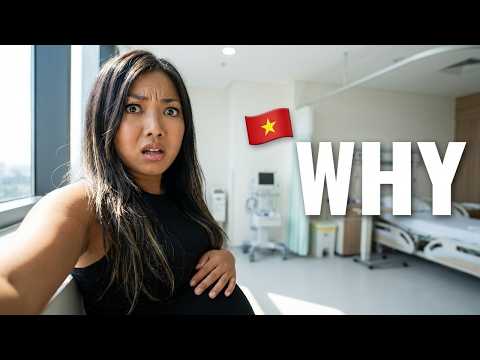
I Got Pregnant in Vietnam… Here’s What It Cost Me 🇻🇳
Audio Summary
AI Summary
The speaker announces her pregnancy, sharing the positive results of a home test with two lines. She expresses her happiness and simultaneous fear about how a new baby will impact her two daughters, hoping to give all her children enough attention. The speaker plans to surprise her husband and children with the news. She notes that this pregnancy will be different because they are living abroad in Vietnam and intends to document her experience of being pregnant overseas. The speaker mentions that they had previously planned to return to Canada if she became pregnant. She becomes emotional, crying happy tears while expressing her joy and the realization that this decision could be either the best for their lives or a very expensive mistake, especially since it involves health, the baby, and the feeling of support in a foreign country.
The speaker, a Canadian who moved to Vietnam with her family, aims to share the realities of living abroad, including the good, the hard, and the unexpected. She emphasizes that decisions like raising a family overseas cannot be guessed through, and the video will detail the actual costs of pregnancy in Vietnam, available options, and how to approach this decision without future complications. She also promises to reveal the moment she had to decide between giving birth in Vietnam or leaving, noting that the most surprising aspect wasn't the price but an unforeseen factor.
The primary misconception about pregnancy abroad, according to the speaker, is that it solely comes down to price. Instead, she argues it's about safety, comfort, and trust. While a fully local experience in Vietnam can be very cheap, it might not meet emotional or medical expectations accustomed to in Western countries. International hospitals offer standards closer to Western ones but come with increased costs. The speaker highlights that people aren't just paying for medical care but for peace of mind, especially during pregnancy when everything feels more intense. Communication, cleanliness, and doctor treatment become crucial, and trust in the system is essential for unexpected situations. She found that the decision quickly shifted from being about money to being about feelings.
Regarding the real costs in Vietnam, prenatal checkups at local clinics are affordable, ranging from 250,000 VND to 750,000 VND (approximately $10 to $30 USD). International hospital visits are more expensive, from 1.2 million to 3.5 million VND (about $50 to $150 USD). The speaker, accustomed to free healthcare in Canada, was surprised by the efficiency and speed of service in Vietnam, despite paying out of pocket. She noted much shorter waiting times for an OB here compared to Canada.
She shares her actual costs for early appointments: her first ultrasound was 500,000 VND ($20 USD), an NIPT test was 2.8 million VND ($110-$115 USD), a doctor exam was 250,000 VND ($10 USD), and vitamins/medicine were 225,000 VND ($9 USD), totaling 3,775,000 VND ($150-$160 USD) for the first visit. Her second visit included an ultrasound for 580,000 VND ($23-$25 USD), an exam for 250,000 VND ($10 USD), and medicine for 465,000 VND ($18-$20 USD), totaling 1,295,000 VND ($50-$55 USD). She also shows the calcium and vitamin D3 supplements recommended by her doctor, noting they are from a European brand.
The speaker explains that local options are very affordable, often under 500,000 VND, while international hospitals cost more but offer more clarity and reassurance. She emphasizes that international or luxury hospitals in Vietnam are of high quality, with clean, modern facilities and attentive aftercare, which she finds amazing. Delivery costs vary significantly: a local hospital birth can range from 7 million to 25 million VND ($200 to $1,000 USD), while an international hospital birth can be 50 million to 120 million VND ($2,000 to $5,000 USD), especially for a C-section. Hidden costs like extra tests, private rooms, and unexpected situations can quickly increase the total, especially without international insurance.
The trade-off between local and international options is personal. Local hospitals are experienced but have a fast-paced environment and limited communication if one doesn't speak the language. International hospitals offer English-speaking staff, more time with doctors, and a calmer environment aligned with Western expectations. The choice is between adaptation and comfort.
The speaker then addresses the difficult decision of whether to stay in Vietnam or leave to give birth. Staying offers routine, home comfort, and potential cost savings compared to Western countries. Leaving provides familiarity with systems in places like Canada but involves travel, timing complexities, and potentially higher costs. The crucial question is where one feels most supported if things don't go as planned, as pregnancy is unpredictable.
She recounts a moment after an appointment where, despite everything appearing fine, she felt an inner tension about being between two choices. One side favored staying in Vietnam due to their established life, routines, and the excellent aftercare and postpartum support available, including the option to hire a nanny. The other side considered returning to Canada to be with family and simplify paperwork, especially since she planned to visit her parents anyway. This became an emotional decision about what mattered more in that season of life, rather than a purely practical one based on costs or healthcare systems. The speaker concludes that it's about choosing where one feels most supported, grounded, and at peace to bring a baby into the world.