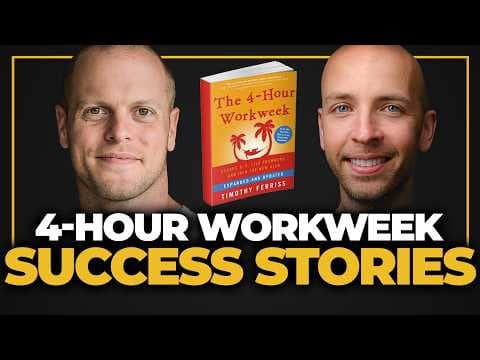
From Dad’s Basement to Selling Two Companies — 4-Hour Workweek Success Story
Audio Summary
AI Summary
The speaker, Brian Dean, shares his entrepreneurial journey, heavily influenced by Tim Ferriss's "The 4-Hour Workweek." His story begins in 2008, feeling lost after a negative PhD experience and struggling to find a job during the financial crisis, leading him to his father's basement.
Inspired by "The 4-Hour Workweek," he decided to start a business, initially an ebook on nutrition and back pain. This first venture failed to gain traction due to difficulties in acquiring traffic without a budget for paid ads. This led him to discover and delve into Search Engine Optimization (SEO).
Initially, Brian adopted a "wild west" approach to SEO, building a portfolio of around 200 exact-match domain websites. The strategy was to rank these sites and monetize them with AdSense ads. This model proved successful, generating around $3,000 per month, which was his target for living a comfortable life while backpacking in Asia.
However, this model was disrupted by Google's Panda and other algorithm updates, which penalized low-quality and thin content. He experienced two significant "slaps" from Google, first in Thailand and then in Spain, leading him to re-evaluate his strategy.
This led to a shift towards building a "real" website in the personal finance space, focusing on genuine content and white-hat SEO practices. This experience paved the way for Backlinko, his prominent SEO blog. Brian realized that existing SEO advice was often vague, prompting him to create the content he wished he had when starting out.
A key turning point for Backlinko was the creation of a comprehensive post detailing "Google's 200 Ranking Factors." To research this, Brian dug into Google patents and engineer statements, an effort that took 20-25 hours. This in-depth, data-driven approach, which he described as "10x" content, brought massive traffic and established Backlinko as a valuable resource. He abandoned his previous "publish and pray" consistency model in favor of creating high-quality, in-depth content less frequently.
Backlinko eventually attracted the attention of Semrush, a marketing platform, which acquired the company. The acquisition process involved a significant amount of due diligence, particularly concerning independent contractors. Brian learned the critical importance of meticulously documenting all contractor agreements to ensure a clean sale. He also emphasized the need to have finances in order, with proper profit and loss statements.
Following the acquisition of Backlinko, Brian was tempted to immediately start another venture. However, he heeded advice from studies on founders who had exited, which highlighted the psychological dangers of losing structure, purpose, and team connection. He learned the importance of "filling the void" and took a year off, during which he found fulfillment in playing tennis and joining a tennis club, which provided community and a sense of purpose without the immediate pressure of building a new company.
His next venture, Exploding Topics, was born out of a desire for something new and an identified market gap for a tool that could curate emerging trends across various niches. His initial monetization strategy for Exploding Topics was a paid newsletter, which proved to be a mistake. He realized that a Software as a Service (SaaS) model, offering a premium version of the trend data, was the more logical and ultimately successful approach.
A significant positive decision for Exploding Topics was its early focus on publishing data and becoming a source of trend-related information. He found that creating specific, data-driven content, such as statistics on user growth for emerging technologies like ChatGPT, yielded high returns and backlinks from journalists and bloggers. This strategy, he noted, had a "nuts" effort-to-reward ratio.
Reflecting on his journey, Brian emphasized the advice to "double down on what works," stressing that finding something that works is rare and should be aggressively scaled. He also recommended Michael Masterson's "Ready, Fire, Aim" for aspiring entrepreneurs, advocating for an action-oriented mindset over excessive analysis.
Regarding startup costs, Backlinko was incredibly lean, costing only a few hundred dollars initially for domain and hosting. Exploding Topics, however, involved a more significant investment of around $90,000 due to acquiring a prototype and bringing on the original developer.
Finally, Brian touched upon the enduring relevance of "The 4-Hour Workweek" principles, particularly geo-arbitrage, while cautioning that specific tech tools and cost examples might be outdated and require fact-checking. He concluded by stressing the importance of "filling the void" not just after selling a company, but also when a business becomes highly automated, to maintain psychological well-being and purpose.