I Just Invested $160,000 In This Stock
AI Summary
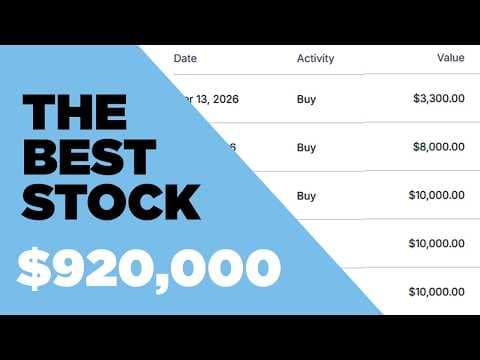
The speaker discusses their investment strategy, emphasizing the importance of buying into strong companies during dips, a practice they believe many investors fail to follow. They highlight Meta Platforms as a current example, where they have invested significantly despite the stock being in a dip, resulting in a $16,000 loss so far. The speaker details a series of purchases of Meta stock between January 29th and March 13th, ranging from $3,300 to $45,000 at various price points, continually buying as the stock price dropped.
A recent 4% drop in Meta's stock price is attributed to a New York Times article reporting a delay in the rollout of Meta's new AI model, "Avocado." The article suggests Wall Street is pricing in pessimism, viewing Meta as unable to create a competitive AI model, delaying plans, and wasting billions on capital expenditure. The speaker strongly disagrees, believing the market is "clearly wrong" about Meta. They note that Meta is already their third-largest holding and could become their largest if the stock recovers slightly.
The speaker critically analyzes the New York Times article, arguing it misrepresents facts and fuels investor concerns. For instance, the article claims Mark Zuckerberg missed a deadline for AI model development, but the speaker points out Zuckerberg's original statement was "in the next year or so," not an exact 12-month deadline. The article also cites anonymous sources claiming Meta's "Avocado" model falls short of leading AI models from rivals like Google, OpenAI, and Anthropic in internal tests. The speaker finds this reasonable, given Meta started working on this "months ago" while competitors have been developing their models for years.
The article further states that "Avocado" outperformed Meta's previous AI model and Google's Gemini 2.5 but not Gemini 3.0. The speaker interprets this positively, noting Meta, a recent entrant, has already surpassed older industry-leading models, though not yet Google's newest and most advanced Gemini 3.0. The decision to delay "Avocado's" release by two months, from March to May, is presented as the primary reason for investor concern and the subsequent 5% stock drop. The article also mentions Meta's discussions about temporarily licensing Gemini to power its AI products, which the speaker believes adds to the negative sentiment.
The speaker summarizes the news as Meta starting AI development a few months ago, surpassing many previous industry-leading models, but not yet catching up to the current flagship models of top tech companies. They criticize the market's "myopic" reaction, highlighting that most investors were unaware of the original release schedule for "Avocado" before the delay.
To illustrate the market's irrationality, the speaker compares Meta to Tesla. Meta has a market cap of $1.57 trillion, similar to Tesla's $1.5 trillion. However, Tesla's revenue has been shrinking for two years, and its net income ($3.79 billion) is significantly lower than Meta's ($60.46 billion). The speaker also points out Tesla's history of product delays, exemplified by Elon Musk's unfulfilled "robo taxi" predictions, yet Tesla trades at a 200 P/E ratio, while Meta's trailing P/E ratio is around 26 times. The speaker believes Tesla is overpriced and Meta is dramatically underpriced.
The speaker emphasizes Meta's strong fundamentals: rapid growth, reliance on ad revenue from millions of small businesses globally, and increasing sophistication in ad generation and optimization. They argue the market is fixated on short-term metrics like the "Avocado" release, which they believe will be forgotten, while overlooking Meta's sound long-term prospects. Meta trades at a low valuation (21 forward P/E, 18 times 2027 earnings), with healthy free cash flow despite significant capital expenditure.
Regarding Meta's capex, the speaker clarifies that it's not solely for AI training but also supports the entire platform used by half the world's population daily. They argue that even if Meta's AI models aren't "bleeding edge," the capex investments will still be essential for the company's platform needs, server capacity, and computing power. The speaker concludes by reiterating their confidence in Meta as a unique investment opportunity with a wide moat and low valuation, believing all their purchases will eventually be profitable.