I Studied 500+ Gamified Apps (Here's What Actually Works)
AI Summary
Many mobile apps initially implement gamification elements like points, badges, and leaderboards (PBL), which are frequently documented failures. In contrast, Strava amassed 180 million users without traditional badges, and Apple Watch achieved a 49.5% behavior change in 160,000 people through completion drive.
The "PBL fallacy" highlights how these common mechanics often fail. For instance, LinkedIn retired its "top voice" badges because they incentivized quantity over quality. Foursquare and Google News also abandoned badge systems after realizing they drove superficial engagement rather than desired behaviors. As gamification expert Yukai Shao notes, PBL represents a scoreboard, not the game itself.
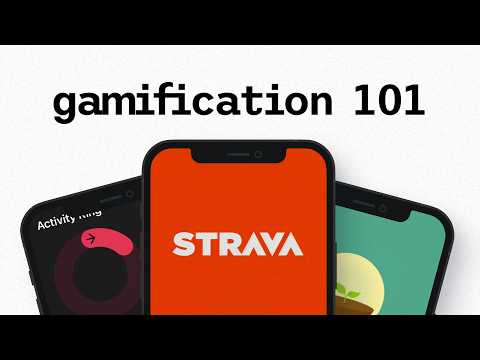
Strava offers a counter-example. Users average one hour of real-world activity for every two minutes in the app, driven largely by "segments"—user-defined stretches of road. Instead of global leaderboards, Strava creates thousands of hyper-local micro-competitions that are winnable, a strong predictor of competitive motivation. Social acknowledgements like "kudos" also increase future run frequency, with Strava clubs growing significantly. The lesson is to enable local competition and engineer the size of the competition rather than inflating empty metrics.
Another crucial concept is the "S-curve problem": adding too many gamification features can reverse engagement. Habitica, a heavily gamified productivity app, saw users become so absorbed in managing the game layer that actual productivity suffered, illustrating cognitive overload disguised as engagement. Stacking multiple mechanics like streaks, points, and badges can push an app past the peak of this curve.
"Streaks" are a particularly dangerous mechanic. Research shows they shift from motivational to obligatory over time, correlating with problematic smartphone use and reduced self-control, leading to regulatory scrutiny. While Duolingo successfully uses streaks, they offer user control like goal levels and streak freezes. Streaks that are unpausable and inescapable are problematic.
Instead, "variable reward magnitude" based on anticipation, not loss aversion, is highly effective. Games like Gameblazers use a three-stage process—anticipation, reveal, celebration—to create multiple dopamine events from a single data point, continually recharging engagement.
The Apple Watch's success lies in "completion drive," leveraging the Gestalt principle of closure. The activity rings create an open loop that the brain instinctively wants to close, leading to significant behavior change and positive real-world outcomes like improved sleep. Great gamification produces tangible benefits, not just "engagement theater."
Finally, "competence versus badge theater" emphasizes building mechanics that signal skill development rather than just app usage. Peloton, for example, provides real-time competence feedback and personal records, making its 100-ride badge a meaningful representation of actual achievement, unlike superficial badges.