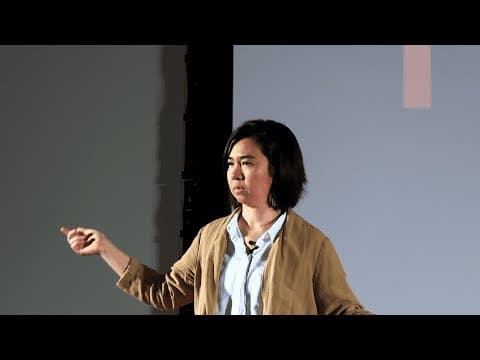
My journey recovering from trauma | Linda Holyoke | TEDxSLU
Audio Summary
AI Summary
The speaker begins by quoting John O'Donohue, a famous Irish poet and philosopher, from his work "Anamara," which translates to "soul friend." The quote reflects on humanity's place between the vastness of galaxies and the ancient earth, highlighting our connection to both the universe and the physical world.
The speaker shares their background in science and a upbringing where spirituality was not emphasized, which allowed them to freely explore their beliefs. It wasn't until their early 30s, after becoming very ill with chronic conditions that caused sensitivity to light, sound, vibrations, and sunlight, that they were pushed to explore alternative healing methods. These conditions severely impacted their daily life, preventing them from watching movies, cooking full meals, or driving on highways.
While Western medicine and various medications helped stabilize their health by about 20%, the speaker credits "energy medicine" with an exponential improvement in their well-being. Despite their scientific background, they were willing to try anything. They mention two modalities of energy medicine recognized by the National Institute of Health: Reiki, a Japanese tradition from the 1920s, and Healing Touch, which is used in hospitals nationwide and is an evidence-based practice shown to reduce pain, anxiety, and depression.
The speaker then describes their personal practice, which they admit might sound "woowoo" to some. This practice involves focusing attention inward, visualizing energy rising from the earth to root oneself, and light flowing down from above to connect with this root energy. From this state, one can set intentions. The speaker used this practice for clearing and healing, and eventually for various other aspects of their life, including healing relationships, addressing emotional traumas, and even for manifestations. They recount an anecdote of setting an intention for more personal space while shopping, and experiencing people instinctively giving them extra room. These "coincidences" led them to believe in the reality of the practice's effects.
From a scientific perspective, the speaker acknowledges that the nature of this energy is tricky to define. Spiritually, it's often referred to as God, pure consciousness, life force, or "chi" (from Tai Chi/Qigong) or "prana" (in Sanskrit). Scientifically, the short answer is "we don't know yet." However, they point to several related concepts: humans as "walking organic conductive beings" with an electromagnetic energy field, the brain's ability to create hormones in response to thoughts, and the many mysteries science still grapples with, such as the nature of consciousness and modern physics theories about quantum fields. The speaker was willing to accept the mystery and suspend disbelief.
They then guide the audience through a brief example of their practice. This involves deep breathing to relax and activate the parasympathetic nervous system. Participants are instructed to imagine an anchor or golden thread of light rooting them to the earth's core, drawing up loving kindness and energy. Simultaneously, they imagine a beam of liquid light flowing down from above, entering through the head. Both energies are envisioned meeting and expanding from the heart, around the body, to an infinite extent, reflecting the idea of humans as infinite beings with no edges. In this state, intentions can be set, whether silly or serious, as long as they are felt in the body. An example given is setting an intention to ace an exam, clearing any obstacles. The practice can be done for any length of time, from minutes to hours, daily.
The speaker shares their personal results: within two months of daily practice, they were able to stand, cook, drive on the highway, and socialize again. In six months, they could take one-hour road trips and watch movies in theaters. They emphasize that this is not the only tool for healing and that Western medicine played a crucial role, possibly saving their life. Their hope is for more people to be open to trying energy medicine, recognizing that no single approach is a complete solution on its own.