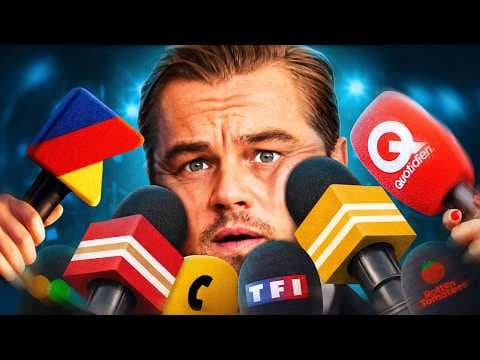
Leonardo DiCaprio ne sera jamais heureux.
Audio Summary
AI Summary
Leonardo DiCaprio, known for his roles as Jack, Romeo, Billy Costigan, Jay Gatsby, Jordan Belfort, Rick Dalton, and Bob Ferguson, is arguably the most recognized actor of the 21st century. With billions in box office revenue and millions of Instagram followers, his public image is often seen as perfect, yet it is incomplete, a result of his masterful manipulation of the media. This video offers an unprecedented deep dive into DiCaprio's life and mind, revealing aspects far removed from his polished persona, such as his involvement in a major embezzlement case, throwing horse manure at paparazzi, or being part of a group called "The Pussy Posse."
DiCaprio's journey began with a challenging childhood. His mother, an artist, was a significant influence, while his father, a "giga hippie," introduced him to counterculture figures. His parents separated when he was one, and he grew up in a place called Sering Alley. Despite his father being a "catastrophic" parent, he was a "hot-blooded" agent, securing Leo's first role at age five. DiCaprio's early career involved numerous castings, commercials, and even an educational film, "Mickey Against Drugs." His desire for cinema was clear, leading him to issue an ultimatum to pursue film roles over television. He spent his childhood frequenting a cinema next to his home with his father, discovering classics like "Star Wars" and "King Kong," which fueled his passion for acting. Recognizing a gap in his formal acting training, he immersed himself in films and performances, accumulating "1500 stories in his head" to inspire his own acting style.
At 16, DiCaprio landed a role in "Critters 3," a B-movie. However, his big break came when he auditioned for "This Boy's Life" alongside Robert De Niro, a revered figure in cinema. While 400 other hopefuls were stressed and serious, DiCaprio chose to be the "clown," improvising by sitting on a table and yelling at De Niro, an act not in the script. This audacious move impressed De Niro, who chose to work with him. In "This Boy's Life," DiCaprio played De Niro's violent stepson, a role that was pivotal to the film's success. The challenge was immense, as the entire film hinged on the audience's empathy for his character. His performance was so impactful that De Niro, without explicitly saying anything, recognized DiCaprio's immense potential. This led to DiCaprio receiving a New Generation Award, an early sign of his rising star.
The same year, for "What's Eating Gilbert Grape," DiCaprio immersed himself in the role of a mentally challenged child, even attending a special education facility to understand and authentically represent the children, rather than imitate them. This dedication earned him Oscar and Golden Globe nominations for Best Supporting Actor, marking his entry into an elite circle of actors.
DiCaprio's career continued to gain momentum, with Sharon Stone personally paying half his salary to secure him for "The Quick and the Dead." Though the film was a flop, DiCaprio extracted valuable experience, particularly in portraying a character's death, an early precursor to his most famous cinematic demise. He reunited with De Niro for "Marvin's Room," a complex film with a stellar cast including Diane Keaton and Meryl Streep. This period further honed DiCaprio's ability to express a wide range of emotions. He expressed a desire for "longevity" in his career, viewing it as a "marathon, not a sprint," leading him to meticulously choose his roles.
Then came "Titanic," a film that would cement his legendary status. As Jack, he became a global sensation, the "little fiancé of America." The film, a love story set against the backdrop of the unsinkable ship, became a monumental success, grossing over a billion dollars and being seen by 128 million viewers in its first year. Despite the film's unprecedented success and 11 Oscar wins, DiCaprio was not even nominated for Best Actor, a recurring theme in his early career with awards.
Post-"Titanic," DiCaprio, at 23, found himself thrust into immense fame and wealth. This period saw the rise of "The Pussy Posse," a group of actors including Tobey Maguire and Kevin Connolly, led by DiCaprio, known for their wild nights in New York. One notable incident involved the band assaulting the husband of actress Elizabeth Berkley after DiCaprio attempted to flirt with her. This behavior, far from his public image, highlighted the struggles of navigating sudden superstardom.
His career trajectory continued to be marked by thoughtful choices. After "Titanic," his salary multiplied tenfold for "The Beach." He turned down roles in "Star Wars," "Spider-Man," and "American Psycho," opting for roles that offered complexity. He explained that his early struggles with auditions and "absurd criteria" instilled in him the belief that "nothing is done," a sentiment that continues to drive him.
A pivotal moment arrived with Martin Scorsese. Robert De Niro, having recognized DiCaprio's talent years earlier, had advised Scorsese to "keep an eye on this young comedian." This led to DiCaprio being cast in "Gangs of New York," a passion project Scorsese had envisioned for 30 years. When the film faced financial difficulties, DiCaprio co-financed it, demonstrating his commitment not only as an actor but also as a producer. He underwent rigorous physical training for the role, performing opposite Daniel Day-Lewis, a celebrated actor who emerged from retirement for the film. Despite the intense performances, DiCaprio again did not win an Oscar, though Scorsese received his first Golden Globe.
Their collaboration continued with "The Aviator," where DiCaprio portrayed Howard Hughes, a complex billionaire. His immersion in the role was so profound that he reportedly developed some of Hughes's tics, suggesting a blurring of lines between actor and character. This role finally earned him a Golden Globe, breaking a long streak of nominations without wins. Two years later, he starred in Scorsese's "The Departed," alongside Jack Nicholson, Matt Damon, and Mark Wahlberg. The film earned Scorsese his first Oscar, but DiCaprio again missed out.
DiCaprio also collaborated with Steven Spielberg in "Catch Me If You Can," playing the real-life imposter Frank Abagnale Jr. He spent three days with the real Abagnale, noting their shared ability to seduce effortlessly. This film explored the theme of identity, a recurring motif in DiCaprio's later work, including "Aviator," "The Departed," and "Shutter Island." He seemingly divorced himself from the "little fiancé of America" image, seeking more complex, often troubled characters. This was further evidenced in "Revolutionary Road," where he reunited with Kate Winslet to portray a disintegrating marriage, deliberately shattering their iconic "Jack and Rose" image from "Titanic."
In "Shutter Island," DiCaprio delivered a powerful performance as a character grappling with a dead wife, showcasing an impressive emotional range. Scorsese noted DiCaprio's ability to access any emotion, even those "no one else would have."
His personal life, particularly his preference for much younger women, has drawn criticism. However, his professional life continued to soar. He collaborated with Christopher Nolan on "Inception," a complex dream-heist film. DiCaprio spent a year dissecting the script, immersing himself in Freud and psychoanalysis. His performance, particularly in scenes involving complex visual effects, demonstrated his ability to convey deep emotion even in abstract settings.
DiCaprio's commitment to his craft led him to take on a rare supporting role in Quentin Tarantino's "Django Unchained," playing a cruel and racist villain, Calvin Candie. This marked his first unambiguous villain role. The film's production was marred by financial controversy, with the production company, Red Granite Pictures, being linked to a major Malaysian embezzlement scandal. Despite DiCaprio's long-standing environmental activism and role as a UN Messenger of Peace, his association with the scandal raised questions. However, he received his second Golden Globe for the role.
Finally, after 24 years, 28 films, and numerous nominations, DiCaprio won the Oscar for Best Actor for "The Revenant." He played Hugh Glass, a 19th-century frontiersman fighting for survival after being attacked by a bear and left for dead. The film's extreme shooting conditions, including constant -30-degree temperatures and limited "golden hour" daylight, demanded immense physical and emotional investment. For extended periods, his character was unable to speak, forcing DiCaprio to convey emotion solely through his face, a challenge he embraced. His reaction upon winning the Oscar was notably subdued, leading to speculation about whether the award was truly his ultimate goal or merely a byproduct of his relentless pursuit of challenging roles.
His most recent collaborations include "Once Upon a Time in Hollywood" with Tarantino, where he played a fading actor, Rick Dalton, confronting his fears of obsolescence. He also reunited with Scorsese and De Niro for "Killers of the Flower Moon," a highly anticipated film. This marked a full circle, bringing together the three legends. Despite initial studio reluctance regarding DiCaprio's tendency to suggest script changes, he delivered a nuanced performance, portraying a complex character driven by desire rather than pure villainy.
DiCaprio's career is a testament to his unwavering dedication to his craft. He has consistently chosen challenging roles, immersing himself completely in each character, often at a personal cost. He embodies the idea that "nothing is done," constantly striving for excellence. His personal life remains private, a stark contrast to the myriad of personalities he embodies on screen. He has sacrificed aspects of his personal life, perhaps even happiness, in his pursuit of cinematic greatness, leaving audiences with a legacy of unforgettable characters and stories.