Paco Rabanne - Le créateur qui a choqué le monde entier
AI Summary
Francisco Rabaneda y Cuervo, later known as Paco Rabanne, was born on February 18, 1934, in Pasaya, a Spanish Basque fishing village. His early life was marked by the Spanish Civil War, during which his father, a Republican colonel, was executed by Franco's troops. This forced his family into exile in France, where they endured difficult conditions in refugee camps before settling in Brittany. This traumatic childhood instilled in Rabanne a humble view of life and a deep understanding of the true cost of things.
Rabanne displayed exceptional artistic talent from a young age, leading him to enroll in the École des Beaux-Arts in Paris in 1951, where he studied architecture for 12 years. This period was crucial for his personal and artistic development, fostering his critical thinking about materials and the relationship between form and function. To support his family, he sold fashion and accessory sketches under the name Franck Rabanne, distinguishing himself with an architectural rigor and an engineer-like approach to design, particularly in shoes, where he focused on walking mechanics and technical audacity. His designs aimed to influence posture and behavior, showcasing an unconventional approach that would become a hallmark of his later work.
In the early 1960s, Rabanne entered the fashion world through accessories, designing costume jewelry from plastic, a material he considered "despicable" but also modern and aligned with pop art. He aimed to create jewelry that was authentically "fake," rather than a substitute for precious metals. A pivotal encounter with couturier Pierre Cardin in 1963 sparked Rabanne's vision for metal dresses, leading him to experiment with unconventional materials like metal and plastic, challenging the traditional textile-based approach to clothing.
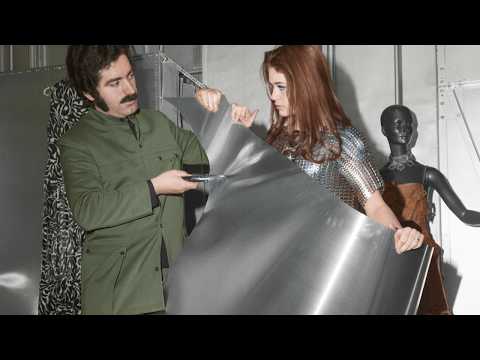
By the mid-1960s, French fashion had become somewhat stagnant and traditional, catering primarily to mature women. Rabanne, alongside other innovators like André Courrèges, sought to provoke change and introduce a new aesthetic for younger generations. He consciously rejected thread and needle, sourcing metal from factories around Paris, and aimed to question all fundamental aspects of fashion.
On February 1, 1966, Paco Rabanne presented his first haute couture collection, "12 Unwearable Dresses Made from Contemporary Materials," in Paris. This collection, a true artistic manifesto, utilized materials other than textiles and was accompanied by avant-garde music by Pierre Boulez. The presentation was considered scandalous, as it radically challenged established notions of clothing and fashion, but it firmly positioned Rabanne at the forefront of the cultural revolution of the 1960s. He sought to break women's traditional understanding of clothing, advocating for freedom and empowerment. His designs, often featuring metal shells, chainmail, and rhodoid discs, were perceived as a form of armor for a "warrior woman" or "superhero," transforming femininity into something bolder and more determined.
Rabanne's clothing went beyond aesthetics, creating a unique sensory experience. Dresses made of metal, for instance, produced sound with every movement, engaging multiple senses and altering the wearer's behavior. While acknowledging that such garments were not for everyday wear, he viewed them as expressions for special occasions, treating fashion as a celebration.
From 1966 onwards, Rabanne's experimental fashion gained recognition from international stars, allowing his avant-garde creations to penetrate popular culture. His collaboration with singer Françoise Hardy, who embodied the modern young woman of the 1960s, was particularly iconic. Hardy showcased his metal and plastic dresses, despite the practical challenges of their weight, further cementing Rabanne's image as a revolutionary designer.
In the mid-1960s, Rabanne also met Salvador Dalí, the surrealist artist, who recognized a shared non-conformist spirit. Though their meeting didn't lead to a direct artistic collaboration, it formed a legendary, improbable duo, with Dalí often inviting Rabanne to events to create a "buzz" with his stunning dresses. Rabanne, however, saw his artistic lineage more aligned with Marcel Duchamp's subversion than Dalí's surrealism.
Rabanne continuously explored new materials and production methods. In 1967, he designed a collection featuring molded vinyl elements. He also sought to democratize his art, creating dresses from metallic paper that could be glued together and sold affordably, to be discarded after use. This demonstrated his genuine obsession with material qualities and constraints, and his ability to find innovative solutions.
A significant turning point in Rabanne's career came in 1969 with the arrival of the Pucci family, Spanish perfumers seeking a French name to enhance their brand. This partnership marked the beginning of Paco Rabanne Parfums, one of the greatest success stories in perfumery history. Rabanne approached perfume with the same radical, disruptive vision as his fashion. Collaborating with designer Pierre Dinan, he created a men's fragrance inspired by a Rolls-Royce grille, encased in a technically challenging green metal bottle, which became a commercial success.
Despite his growing reputation and financial security from perfumes, Rabanne maintained an artisanal, pioneering spirit in his fashion house. He worked hands-on, designing and often personally producing his collections, rejecting the image of a deified couturier. He valued teamwork, a calm environment, and simplicity, famously taking public transport daily.
Throughout the 1990s, Rabanne continued to innovate, incorporating technological advancements from aerospace into his designs, exploring new materials and the effects of light on clothing. He treated his runway shows as dramatic, emotional works of art, carefully structuring them to evoke different sensations. In 1990, he received a prestigious French haute couture award, an emotional recognition of his craft that he had long awaited.
At the dawn of the year 2000, Paco Rabanne chose to retire from haute couture, feeling he had expressed all he needed to say. He retreated to Brittany, a region he held dear, in utmost discretion. Ironically, his perfumes have only grown in popularity since his retirement. Rabanne was a man of the present and future, rarely looking back.
The Paco Rabanne brand has been relaunched, embracing the founder's radical, innovative, and experimental principles. Contemporary collections continue to explore unconventional materials and forms, bringing Rabanne's iconic 1960s aesthetic into the present. Paco Rabanne's legacy lies in his multifaceted, unclassifiable body of work, his constant thirst for innovation, and his timeless vision, which remains relevant and influential in fashion history. His minimalist approach, particularly in experimental yet refined pieces like Françoise Hardy's dress, contributes to its enduring appeal. He is remembered as an artist who pushed boundaries, experimented with materials and shapes, and challenged conventional notions of clothing.