How K-Pop Demon Hunters' Audrey Nuna Wrote The Playbook For Creative And Cultural Disruption
Audio Summary
AI Summary
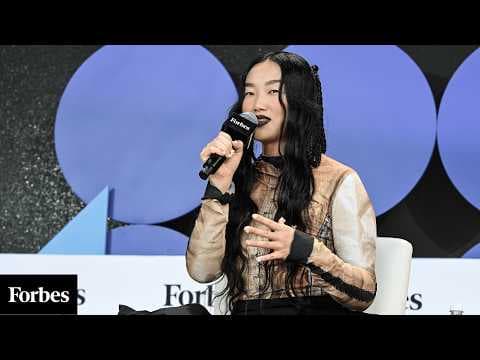
The speaker expressed excitement about the conversation and thanked the host for having her, acknowledging the hot Phoenix weather. The host immediately highlighted the speaker's recent success in the award season, noting that "K-Pop Demon Hunters" won two Academy Awards, two Golden Globe Awards, and two Critics' Choice Awards. Additionally, her song "Golden" was the first K-Pop song to win a Grammy, which she described as "pretty crazy" and something she is still processing. She mentioned her appearances on various talk shows, calling the past seven months "surreal" and "transformative."
The host pointed out that while many know her from "K-Pop Demon Hunters," she has been in the music scene for a long time, releasing albums and "hustling." The speaker confirmed her long journey in music, stating she just turned 27 and has been professional since around 19 or 20. She shared that she initially wanted to be a Broadway singer but was inspired to pursue pop music after watching Beyoncé's Super Bowl halftime show in 2012 or 2013. With immigrant parents and no direct connections to the industry, she started by posting Instagram and YouTube covers, even recording in her bathroom. This led to her meeting Anwar Sawyer, her first producer and manager, who contacted her via direct message when she was 17. Despite initial apprehension, their collaboration quickly developed, marking the beginning of her music career.
She also briefly attended NYU, commuting long hours to Orangeburg, New York, to work on music until the early morning before returning for classes. This period was described as "crazy" and "transformative," where she learned much about music creation. Regarding her discovery for "K-Pop Demon Hunters," she called it a "glitch in the matrix" and "serendipitous." She recalled performing at South by Southwest in 2024, feeling she had done poorly. However, Jojo from Sony Animation approached her afterward, suggesting she would be perfect for "K-Pop Demon Hunters." Though initially dismissive due to her self-criticism, the idea was planted. Weeks later, her team connected her with Ian Eisendrath, the executive music producer for the soundtrack. She pursued the opportunity primarily because she felt a deep connection to the film's characters, especially as a first-generation Korean American, appreciating the rare chance to see her story represented. She emphasized that alignment with the stories one wants to tell can lead to "magical things."
The conversation shifted to representation in the entertainment industry. The speaker acknowledged that strides are being made, viewing art as a powerful tool for initiating representation in media. She stressed the continuous need to "do better" but expressed immense pride in being part of a project that made children, particularly those of Korean or Asian heritage, feel proud to share their culture—an experience she lacked growing up. While appreciative of awards, she found the genuine pride of children to be the most heartfelt reward. She advocated for following up media representation with action in "multi-disciplinary spaces," such as increasing diversity in C-suites and among founders, referencing initiatives like Forbes' "30 under 30."
Addressing the founders in the audience, she offered advice centered on "hijacking." First, she urged them to "care about humanity" and focus on making a positive impact, believing that following this "North Star" would lead to other things falling into place. Second, she encouraged them to "hijack" the current era, where rules are changing. She distinguished this from merely rebelling, advocating instead for building, collaborating with diverse perspectives, and challenging ingrained beliefs about right and wrong. "Hijacking," she explained, requires humility, the willingness to unlearn, and the ability to find people who not only align with one's vision but also challenge it. She underscored the importance of viewing everything as a creative act.
When asked how she personally "hijacks," she elaborated on the idea of "tools are tools." She admitted to disliking social media and even pop music at times, but stressed the importance of not equating tools with their traditional uses. Citing a Jenny Holzer quote from the Guggenheim, "use what's dominant in culture to change it quickly," she defined hijacking as respecting and observing what works, even within systems one might not initially love. For artists, this means humbling oneself to understand the "machines that are in place," not necessarily bowing to them but learning from their effectiveness. She applied this to her realization that pop music is not merely a genre but a "design philosophy" or a tool.
She then praised Saran Mumdani as an inspiration for his "genre bending" and cross-disciplinary approach, citing his collaboration with Cardi B on a jingles contest for free education as an example of finding alignment with different people. This, she said, represents a new era of "true alchemy" and "fusion," where simply combining ingredients isn't enough; one must "simmer" and "try new things."
The discussion moved to her philanthropic work. With a shout-out to her manager Paula, she emphasized her belief in education as "our biggest hope" in a world that often feels hopeless. She described her "Baby OG visionary scholarship" for BIPOC women in STEM pursuing higher education, mentioning a winner from Pakistan, Fatima, and expressing pride in providing resources for talented women globally. She also supports the Luminos Fund, which helps children in sub-Saharan Africa get a second chance at school. Her goal is to integrate education and access initiatives into all her endeavors, rejecting binary thinking and embracing her full self, rather than being confined to a single role like "singer."
Finally, she confirmed she is working on new music, expressing joy in "falling back in love with music" and learning about life in the studio. For a final action item, she advised the audience to reflect on the people in their lives who challenge them and to continue spending time with them, or to actively seek such mentors if they don't have one. She emphasized the value of "soundboarding" and having someone who will say "no" when necessary, highlighting the Under 30 Summit as an ideal place to find such individuals.