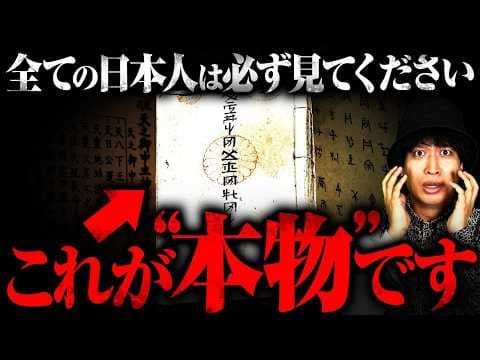
【完全保存版】本当の歴史が書かれた〝竹内文書〟をすべて解読しました。
Audio Summary
AI Summary
The transcript discusses the "Takeuchi Documents," a collection of ancient Japanese writings claimed to predate the Kojiki and Nihon Shoki. These documents are presented as a comprehensive history from the creation of the universe to later imperial eras, with a standard text compiled by Takeuchi Yoshimi. The video highlights that these documents were taken seriously by some military figures in 1935, who saw them as supporting a grand historical narrative of Japan ruling the world. However, the documents were later suppressed by the government, not because they were factually incorrect, but because they were deemed dangerous due to their potential influence on military personnel and internationalists.
The Takeuchi Documents reportedly divide history into four eras, starting with a divine age where a supreme god shaped the universe. A key concept is "Sumerami-koto," translated as "ruler of 16 states," implying a global dominion originating from Japan. The text describes a massive, luminous stone falling from the sky in Toyama Prefecture, interpreted as a meteorite and a divine message. This event led to the construction of a grand shrine, establishing the region as a sacred center alongside another in Gifu.
The documents also mention the "Sumerami-koto" using a 16-petal chrysanthemum crest, which inspired rulers worldwide to adopt similar symbols. This suggests an effort to unify the world through land, civilization, thought, and symbols, all under a "Shirasu" (governance) ideology. The existence of shrines venerating "Goshiki-shin" (Five-Colored Gods) in Kumamoto is cited as supporting evidence.
Furthermore, the Takeuchi Documents recount catastrophic events, including three global destructions, leading to the demise of the "Goshiki-shin." A prophecy from the sun indicates the approach of a final era. The documents also detail Qin Shi Huang's emissary, Jofu, visiting Japan to collect elixirs of immortality. However, his true purpose was to study ancient Japanese script and history, suggesting he was a spy. The text posits that the Chinese imperial lineage was appointed by Japan, with Qin Shi Huang being the 113th appointed king, implying a deep-rooted connection and hierarchy.
The narrative then shifts to the story of Mukatsu-hime's remains, which were enshrined in the imperial palace, leading to a devastating plague. Emperor Sujin relocated these remains, and later, Empress Yamato-hime was tasked with finding a more suitable location, eventually leading to the Ise Grand Shrine. The documents also suggest Jesus Christ survived his crucifixion and came to Japan, settling in Aomori Prefecture, with the local "Hirai" area possibly deriving its name from "Hebrew."
The text further claims that during a period of historical revision, five ministers requested a summarized version of the Takeuchi Documents. This led to the expansion of the Takashiro Kotai Jingu shrine and the exclusion of earlier historical periods, effectively altering the historical record. The narrative suggests that the power of certain clans, like the Katsuragi, influenced these decisions, possibly due to the high cost of generating sacred materials. The completion of the Kojiki is described as a process where ancient script was read aloud and transcribed into kanji, implying it's a redacted version of the Takeuchi Documents, omitting divine eras. The video concludes by stating that the following video will visit the Kotai Jingu shrine and feature an interview with a descendant of Takeuchi Kiyomaro.