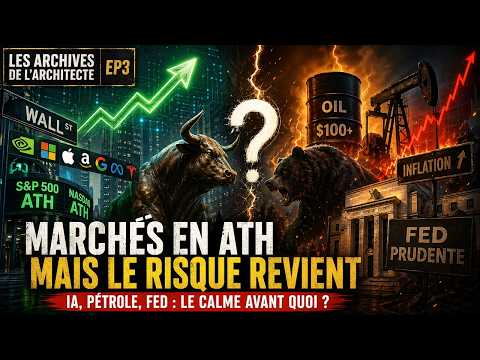
Tout monte mais jusqu'à quand ? Le vrai danger des marchés en 2026
AI Summary
Welcome to the show for Saturday, April 25, 2026, featuring "Architect's Archives" episode 3. Wall Street is experiencing a surge of euphoria, with the S&P 500 and Nasdaq closing at new record highs. This coincides with rising oil prices, with Brent crude surpassing $100 a barrel, a crucial piece of information given the ongoing tensions around the Strait of Hormuz and the conflict involving the United States and Iran.
The stock market is largely driven by the semiconductor industry, a vast sector encompassing numerous layers, sub-layers, and suppliers for hardware, photonics, and data centers. There's much to explore in this particular domain. Several new all-time highs (ATHs) have been noted, particularly for Nvidia and Intel. Intel, which had been sidelined for several months during the Trump presidency's bear market, has seen a resurgence following the Trump family's and the US's participation, reportedly around 10-15%. Today, this asset has appreciated significantly, perhaps by a factor of three or even four from its low point. Amazon has also reached a new high. Similarly, social media stocks, which were viewed pessimistically in recent weeks, have shown positive results. AMD is following Nvidia's lead, and TSMC in semiconductors, along with Sandisk, which manufactures RAM and SSD chips, are experiencing high demand.
Nvidia's performance fully validates the AI theme. We don't seem to be at the peak of this particular bubble yet. Nvidia closed at a record 28.27, with a market capitalization of 5 trillion, indicating strong ongoing investments and significant CAPEX. This circular economy model, while displeasing to some, is expected to eventually lead to the "mother of all bubbles" centered around AI. However, for now, investment continues, borrowing persists, and the future vision for AI remains bright. Amidst this, there have been recent reports of cloud security breaches via a Discord vulnerability. The question remains whether these major companies will eventually fall victim to their own game.
Attention is drawn to the upcoming earnings reports from the "magnificent seven" companies, starting next week with Microsoft, Alphabet (Google), Amazon, Meta, and Apple. This week could be critical.
On the US macro front, the job market remains resilient, adding over 214,000 jobs by April 18. Inflation risks are primarily from energy, with Brent crude exceeding $105 per barrel. The Federal Reserve is in a wait-and-see mode, awaiting further data on inflation, oil, and the PCE, as well as employment figures, though the latter is not currently a primary concern.
In commodities, oil prices are rising, creating underlying tension. However, the stock market appears completely decoupled from global events, driven by the AI euphoria. Gold, notably, recorded its first weekly decline in five weeks. The semiconductor, photonics, hardware supplier, and data center industries are booming. Investors should assess their risk tolerance, similar to how some allocate risk in cryptocurrencies, balancing foundational assets like Bitcoin with higher-risk startups. This higher risk, however, carries a significant potential for total loss.
In the crypto market, Bitcoin is holding strong, attempting to break out of a difficult zone. Bitcoin ETFs have seen several days of positive inflows. Ethereum, however, experienced notable outflows despite its price remaining attractive around the $2300 mark. The broader crypto market is awaiting more favorable conditions, particularly regarding liquidity, as much of the available liquidity is currently concentrated in the AI sector, a trend observed over the past two years.
Decentralized finance news includes the Kelp and AAV situation, with the #DeFiUnited hashtag trending on social media. AAV is attempting to cover a $290 million deficit. Pledges currently stand at $73,700 against an estimated need of $163,200, approaching the halfway mark. Public commitments for donations total $43,500, demonstrating strong multi-community mobilization. It's noteworthy that during a bear market, everyone contributes. Some view this as ill-advised bailout, while others commend the initiative for strengthening the decentralized finance community, despite ongoing discussions about AAV's future direction.
Technical analysis reveals the Nasdaq printing approximately 20% performance in just one month. If one had entered the Nasdaq around 22,860 points four weeks ago, below the 50-day moving average and near the 100-day moving average, they would have achieved a remarkable year's performance. The US M2 money supply continues to grow, but this short-term liquidity is being absorbed by the AI sector like a black hole, making it uncertain when a rotation might occur. The Eurostoxx 50 is oscillating around its 20-day moving average but closed in the green. The S&P 500 is also progressing, albeit less frenetically than the Nasdaq, with a 13-13.5% gain over the past month. For those with strong performances, especially nearing summer, it might be prudent to consider lightening positions, particularly for short-term speculative holdings. Wall Street's euphoria is undeniable, and while the "sell in May" adage has been disproven in recent years, traditional market wisdom often holds true over longer periods.
The US Dollar remains stable around the 98.5-99.5 zone, hovering near its 50 and 20-day moving averages. The range median is around 100, with the bottom of the large range (since Trump's presidency) at 102-103, and the top at 110 points, where Donald Trump began his presidency. Under Biden, the dollar had weakened to 89 points before rising to 115 points for the DXY in September 2022 during a prolonged bear market. Today, the dollar is returning to a certain normalcy under the Trump era, and a Trump presidency would likely aim to keep the dollar relatively weak.
In precious metals, gold is at 4709, while silver is around 76 and encountering resistance at its 20-day moving average.
The total crypto market capitalization stands at 2560 billion, forming a double bottom pattern. Resistance is at the 20-day moving average of 2600 billion. If this level isn't breached, consolidation between the 200-day moving average (2110 billion) and 2600 billion is expected. A breakthrough could quickly lead to 2900-3000 billion. Bitcoin dominance has been attempting a breakout for four weeks, rising from 58.4 towards 60.6, indicating Bitcoin continues to attract attention in the crypto market. Bitcoin is also encountering resistance around 778. A breach could target 84 initially, with the 100-week moving average at 87.8 and the 50-week moving average at 96.2. Oscillator readings are decent, and volumes are healthy, but the euphoria seen in Nvidia or other companies with 5-15% daily gains on multi-trillion dollar valuations is not yet present. Ethereum hit resistance at the 200 and 20-day moving average combo, around 2400-2450 billion, and also at its weekly RSI median around 43. A period of consolidation might build momentum for the second-largest cryptocurrency.
Regarding Treasury, mining companies, and Coinbase, a pool of these stocks shows CLSK (Clean Spark) performing well, rising from $8 to nearly $13 in four weeks, with a breakout zone just above $14. Coinbase, however, is stagnating around its 20-day moving average and the significant $200 long-term polarity zone. It's showing a somewhat weak double bottom, a subdued RSI, and declining volumes as the price tries to escape. This mirrors Bitcoin and the broader industry, where a transfer of wealth and control from retail investors (who built the market from 2013-2021) to ETFs and institutions is occurring, leading to increased banking of the sector. However, this domain still carries significant risk. Diversification is key in 2026 to avoid surprises.
Diversification has proven profitable, as AMD, priced at 76.62 in April 2025 during the Trump tariffs, would now represent a 340% gain (a 4.5x return) if bought around $80. More recently, for those who missed the 2025 entry, a recent entry point around the support and 50-day moving average at $193-194 has yielded an impressive 82% gain in four weeks, almost doubling the investment.
Amazon continues its steady ascent, a "quiet force" that, while not as explosive as some tech stocks, consistently progresses and remains a solid long-term investment. The "pick and shovel" sellers, which offer a piece of the American stock market (like ICE), saw a contraction around $81 and are now back to $90, touching the 50 and 20-day moving averages. While not generating thousands of percent, this offers stable and consistent growth, similar to French stocks like Air Liquide.
Microsoft is currently at its 20-day moving average, lagging behind other stocks, but has seen significant volume over the past two months. Apple is preparing for a CEO transition, with John Ternus replacing Tim Cook after 15 years. Ternus, a loyal Apple employee since 2000, previously served as VP of hardware engineering. Under Tim Cook, Apple's capitalization grew roughly 10-15x from the Steve Jobs era. Hopes are high for Apple under Ternus.
French stocks offer little short-term excitement. We continue to hold solid, long-term investments. Thales and similar systems were battered when tensions in the Strait of Hormuz seemed to calm, but the situation remains volatile. It's important to distinguish between Dassault Systèmes (ticker DSY) and Dassault Aviation (ticker AM), with the latter showing much better performance. Dassault Aviation has been in an ascending parallel channel since 2020, rising from $62 to $364. While impressive, such rapid growth in five years suggests waiting for more attractive entry points. Air Liquide has also reached a new ATH, exhibiting slow but steady growth, consistently bouncing off its 200-day moving average. For long-term holders, bonuses are offered every two years for accumulating sufficient shares. This highlights a debate: are slow, safe, dividend-paying stocks like Air Liquide dinosaurs in today's fast-paced AI market, or do you prefer the "slow and steady wins the race" approach?
In altcoins, there's no significant movement. Solana continues to consolidate near support between $78 and $97-100, with all moving averages above it. AAV, which was severely degraded short-term, tried to break out to $118 before recent events but was pushed back to $90 last week. Hyperliquid remains stable around $40. BNB, against both the dollar and Bitcoin, is not as degraded, although against Bitcoin, it has seen a degradation from a ratio of 0.019 in November 2022 to 0.008 today. More recently, since October 2025, BNB has been significantly bearish against BTC, even though it's known to perform well against Bitcoin during bear markets.
Finally, in Asia, Alibaba has rebounded over the past two to three weeks, finding support at its 100-day moving average around $120 on the NYSE. The Nikkei in Japan is also holding high, but has been blocked twice around the same zone, while its RSI is weakening. This raises the question of whether the market, particularly the US market, is moving too fast and will need a period of digestion this summer. A cautious approach until autumn 2026 seems prudent, especially after a strong April with 15% gains for the S&P and 20% for the Nasdaq. This suggests a likely return to averages and profit-taking in areas that typically see such activity. Historically, summers often see slower markets with less speculation and reduced flows, although exceptions like last summer's crypto pump exist. Over decades, however, summers tend to be periods of calm or slight market decline.
I wish you an excellent day, and I'll see you next week.