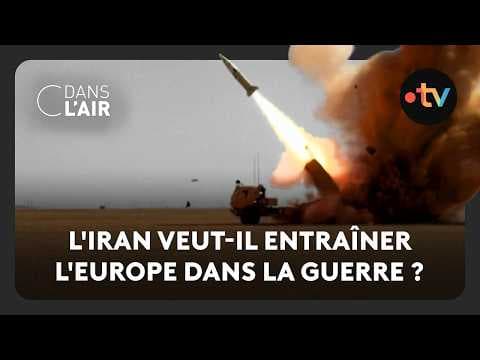
L'Iran veut-il entraîner l'Europe dans la guerre ? - C dans l’air - 06.03.2026
Audio Summary
AI Summary
Seven days into the conflict in the Middle East, initially marked by surgical strikes that decapitated the Iranian regime and eliminated its Supreme Leader, the war has expanded, drawing in Lebanon and Europe. Britain, France, Italy, Spain, and Greece are deploying military forces to the Mediterranean. The central question is whether Iran intends to involve Europe in this war.
Donald Trump's war aims remain unclear, shifting with his social media posts. While official White House documents initially clarified the American objectives as targeting missiles, the navy, and terrorism, with no mention of regime change or nuclear issues (presumed annihilated), Trump's recent statements suggest a desire for a new Iranian leader "who would please him." This ambiguity leaves observers uncertain whether the goal is a complete regime overhaul or merely a change in leadership. Some suggest Trump's rhetoric, comparing a desired Iranian leader to Venezuela's president, indicates a total war aim and a desire to hand-pick Iran's leadership. However, the Iranian regime, despite being weakened, is far from destroyed. Its command structures, particularly within the Revolutionary Guards, remain intact and largely support the Supreme Leader's son, signaling continuity.
The U.S. and Israeli communication strategies differ starkly. While Israel's military provides clear, concise updates, the American approach, led by politicians, is characterized by hyperbole and a "superhero" narrative. This approach is seen as risky, potentially backfiring if significant casualties occur. Critics view the White House's propaganda videos, which intersperse war footage with movie clips and AI-generated images, as obscene, trivializing, and dangerous. They argue that such content normalizes violence, misrepresents the brutal reality of war, and creates a false perception of a quick resolution, potentially leading to public impatience when the conflict inevitably bogs down. Military experts emphasize the importance of humility in warfare and respect for the adversary, warning that underestimating an opponent can lead to serious problems. The use of such clips also risks alienating some Republicans in Congress, who find the theatricality unsettling.
The war has already caused significant casualties in Iran and Lebanon, with Israeli deaths also reported. In Lebanon, Israeli bombardments have devastated southern Beirut and other localities, displacing 95,000 people. Israel has explicitly threatened Lebanon with a fate similar to Gaza.
European countries, including France, are deploying defensive military assets to the region. French President Emmanuel Macron has assured citizens that France is not part of this war and will not engage in combat. However, the deployment of the aircraft carrier Charles de Gaulle and the amphibious helicopter carrier Tonnerre to the Mediterranean is seen as a demonstration of French and European power, providing reassurance and protection for the hundreds of thousands of French citizens in the region, particularly in Lebanon. These deployments are primarily defensive and symbolic, not an act of war. France also has defense agreements with Gulf countries like the UAE, Qatar, and Kuwait, which could necessitate French intervention if their territories are directly attacked, though France retains its freedom of action.
On the seventh day of the war, the resilience of the Iranian regime has surprised some, but not those who understood its deeply entrenched and multi-layered security, military, police, and prison institutions. The concept of "enlisement" (bogging down) is a constant in modern military operations, reflecting Western impatience with the slower pace of military time. Iran's strategy appears to be regional conflagration, targeting oil refineries and terminals in the Strait of Hormuz to drive up prices and disrupt global trade. This aims to increase the cost of the war and provoke a reaction from Gulf countries, playing a long game that Trump may not fully grasp. Iran has been preparing for such a conflict for decades, establishing a decentralized command structure to ensure continuity even if its leadership is decapitated. They possess a significant arsenal of missiles and drones, and have yet to activate their maritime assets, including an estimated 1,000 to 1,500 "suicide speedboats" capable of disrupting shipping in the Strait of Hormuz. This protracted conflict could turn the tide against the U.S. as global oil prices rise and international pressure mounts.
In Israel, residents are accustomed to air raid alerts and taking shelter in bunkers. While there is broad support for the war against Iran, which many see as an existential threat, there is also growing fatigue and anxiety, particularly about how long the conflict will last and whether Trump will abandon them. The Iron Dome defense system provides a sense of security, but the threat of missile debris and direct hits remains.
The motivations of Trump and Israeli Prime Minister Benjamin Netanyahu are distinct. Netanyahu has built his political career on the Iranian threat, viewing this as an existential war for Israel, possibly aiming to secure his place in history and distract from domestic legal troubles. Trump's initial objective was simpler: to end the Iranian nuclear threat. However, his shifting statements suggest he might declare victory and withdraw at any moment, potentially leaving Israel in a difficult position. Factors that could lead Trump to declare victory include domestic political pressure (his base is not keen on military interventions or unconditional support for Israel), economic concerns (rising oil prices, disrupted trade), and military considerations (the high cost of intercepting missiles).
The succession of the Supreme Leader in Iran is a critical issue. Mojtaba Khamenei, the deceased leader's son, is a conservative figure close to the Revolutionary Guards and is seen as a frontrunner, despite lacking broad religious legitimacy and facing public opposition. His potential appointment is viewed by some as a military coup by the Revolutionary Guards, installing a figurehead to maintain a religious facade without effective power. The destruction of the building housing the institution responsible for electing the Supreme Leader by Israeli strikes further complicates the succession process. Another influential figure, Ali Larijani, known to Western powers for his negotiation skills, has appeared calm and reassuring, suggesting he might be a transitional figure or a potential interlocutor for the U.S.
The Iranian regime, despite losing 48 leaders and strategic infrastructure, maintains a strong propaganda campaign, using AI-generated videos to falsely claim military successes and reassure its population. They emphasize that they are winning the war, blaming the U.S. and Israel for civilian casualties, and asserting that they have sufficient munitions. They also aim to reassure neighboring countries that their targets are American bases, not their territories. The delay of the Supreme Leader's funeral due to security risks highlights the regime's vulnerability to Israeli and American strikes.
The idea of the Iranian regime cracking is being discussed, with reports of police and Revolutionary Guard members deserting their posts. However, experts warn that regime collapse can be abrupt and unpredictable. The Iranian system, deeply entrenched for 47 years and fueled by a culture of martyrdom, has established a chain of command and replacements, making it resilient. Dissolving such a structure without a clear post-collapse plan, as seen in Iraq in 2003, could lead to chaos.
The conflict's impact on civilians is severe, as seen in the Israeli kibbutz near the Lebanese border, where families live under constant threat of rocket fire and drones. Despite the hardships, residents express resilience and support for the war, viewing Iran as an existential threat, yet many also call for Netanyahu's resignation due to the events of October 7th. The scale of the Israeli response against Hezbollah in Lebanon, following rocket attacks, raises concerns about a potentially devastating ground offensive.
The potential for Iranian-backed terrorism in Europe, particularly France, is a concern. While ballistic missiles from Iran are unlikely to reach France, asymmetric threats, such as proxy attacks or terrorist cells, are a possibility. French intelligence services are vigilant, and security measures have been heightened, but the risk of attacks, though not as severe as during the ISIS/Al Qaeda period, remains. Iran's arsenal includes drones and asymmetric naval tactics, such as the "swarm of mosquitoes" in the Strait of Hormuz, which could be used once their missile capabilities are exhausted.
A quick surrender by Iran is deemed unlikely due to the absence of a clear authority to make such a decision and the regime's deep-seated opposition to the U.S. The UNIFIL peacekeeping force in Lebanon remains in place but is not expected to defend Lebanese civilians, a task primarily for the Lebanese army. The Hezbollah, with its 7,000 seasoned fighters, poses a formidable military force. While Arab countries with defense agreements with France could request assistance, France maintains its discretion in responding.