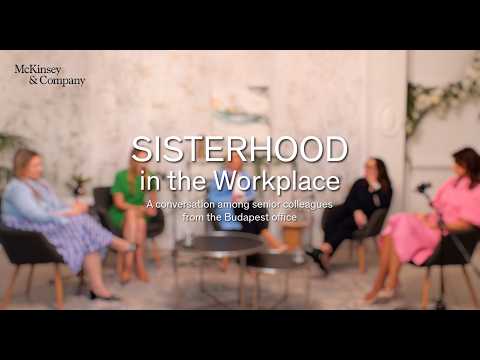
What happens when women truly support each other in the workplace?
AI Summary
Martha, a partner at McKinsey in Budapest, highlights a concerning statistic: women's representation in tech in Europe has dropped from 22% to 19%, with the biggest decline occurring early in careers, from entry-level to the first step into leadership. However, the discussion centers on a different narrative: five women partners and associate partners in Budapest who not only stayed but thrived, building a supportive "circle" where motherhood and leadership coexist, and sponsorship is actively practiced. This group exemplifies what happens when women collaborate to expand opportunities rather than competing for a single seat at the table.
One participant mentions a McKinsey report that painted a "scary future for women in the age of AI," suggesting AI creates structural imbalances by automating jobs where women are overrepresented and underrepresenting women in growing roles. To combat this fear, she references the "broken rung" concept, emphasizing two key strategies: choosing companies that invest in development and create opportunities, and consciously pursuing future-proof skills and opportunities by following trends. While choosing the right company seems almost too easy within their supportive circle, she finds the focus on future skills more crucial, advocating for fundamental, "eternal" skills alongside trend-following.
The discussion then shifts to "creating opportunities," which at McKinsey is termed "sponsorship"—going beyond mentorship to actively bring colleagues to opportunities. One participant recalls realizing their group was a community during her maternity leave when a colleague, Ynca, proactively found an opportunity for her return. Three years later, she reciprocated, finding opportunities for Ynca. This systematic, rotating handover of roles among returning mothers demonstrates a conscious effort to pay it forward. Marta recounts her own experience with a colleague who was assigned as her mentor during her McKinsey interview in 2014, highlighting the strong bond that formed from this initial act of support.
When asked what they can say in this circle that they can't say elsewhere, one participant emphasizes the feeling of not being judged, describing it as a "safe space" akin to therapy. Another finds it liberating to express equal passion for work, family, and personal growth, a sentiment not easily shared universally but deeply understood within their group. They also note a tendency to seek each other out at events, valuing the immediate connection and shared understanding.
Regarding the "loneliness in the room" feeling often experienced by women, one participant states she rarely feels it, partly due to luck in early projects where she was surrounded by strong female leaders. This positive initial experience helped her feel comfortable and present in boardrooms. She also mentions developing a solution for awkward handshakes with men in professional settings: simply offering her hand confidently. Another participant dismisses the "only woman in the room" thought, noting that she only considers it when she's the only one wearing color, a non-factor after that initial observation. She believes dwelling on it limits self-expression. She recalls a very early project where a client asked her to make coffee, and her male manager immediately intervened, telling her she "can never be the person who makes the coffee," reinforcing her different role in the room.
The report also highlights the tension women face: speaking up too often makes them seem "difficult," but not speaking up makes them "invisible." One participant expresses frustration with this, stating she never cared about it, prioritizing authenticity. She believes constantly masking her true, outspoken self would be unsustainable. Another shares feedback from early in her career that she was "too soft" with clients, despite her collaborative approach leading to over-delivery. This reinforced that being herself, even with a compassionate style, was effective. The consensus is that finding one's authentic self and a "sweet spot" for performance is crucial, regardless of gender. It's about empowering individuals to act in their own style, providing encouragement to experiment.
The most rewarding conversations, they agree, come from diverse perspectives. Working with people who think differently genuinely improves solutions, making time spent with each other valuable for new insights.
The discussion then turns to "drop-off" from entry to first leadership positions and "fragile moments" in their careers. Many cite becoming mothers as the most fragile time, requiring reinvention of operating models and support networks. One participant, as the "most junior mom" with the youngest daughter, felt fortunate to learn from the "menu card" of experiences provided by the others who had "paved the way." Another's most fragile moment occurred before motherhood, due to a lack of role models, which made her career path unclear until she found them.
The concept of an "operating model" for returning mothers, especially those working part-time, is explored. One participant recalls a conversation where a colleague, Brigy, stopped discussing her part-time operating model because it invited too many comments. Brigy confidently asserted that her model worked "fantastically," a stance admired for its self-assurance in a typically anxiety-inducing area. While acknowledging it's not easy, she explains that taking it out of the narrative prevents it from overshadowing performance. Realizing "you can't do it all and you should not do it all" and being comfortable letting go was a fragile moment for her. The group emphasizes the value of having multiple role models, as they offer diverse "operating models" and choices, which is crucial for inspiring many women.
Regarding a perceived "hidden tradeoff between flexibility and being a mother," they largely disagree. They view it as a matter of creating one's own operating model, accepting help, and having a strong support network in both work and personal life. Guilt, such as leaving work early for childcare, is often self-imposed, as others rarely raise it as a problem. However, they acknowledge a bias where "mom with small kids" is assumed to be less flexible, a bias they actively work to break by encouraging direct communication rather than assumptions.
When provocatively asked if AI can help close the gender gap, one believes it can, but only if women consciously move into growing areas, requiring a structural shift in industries, roles, and skill sets. Another argues that intentionality is key, regardless of AI. In every era, there's an equivalent of AI, and success hinges on having a clear view of what one wants to do and being intentional about it, making up one's own mind rather than seeking external validation. No company or system will solve it for you; self-care and self-direction are paramount. The community, however, provides encouragement and support, not by dictating actions, but by fostering individual growth.
The importance of not doing it alone is stressed, with the hope that their community continues to grow. A strong culture where women stay is characterized by effective sponsorship—people actively creating opportunities, listening, guiding, and "opening the door." One participant was surprised to learn that their advanced, practical approach to sponsorship was a revelation to others, highlighting how genuinely living these values can be uncommon. Another marker of a positive culture is honest feedback and empowerment, allowing individuals to "make my own McKinsey" rather than being confined to a box or prescribed how to act as a female leader or mother.
In a lighthearted moment, they share what their children think they do. One daughter finds her mother's job "boring" and primarily sees her as a mom. Another's daughter thinks her job is "glamorous" because she speaks English, meets new people, and travels to "nice places." Marta's children, across different ages, are aware she enjoys her work but have no clear idea of what she actually does.
They hope younger women looking at their group see the possibility of succeeding authentically, finding a supportive group of friends, feeling encouraged to network, and realizing they can forge their own unique paths without conforming to traditional expectations.