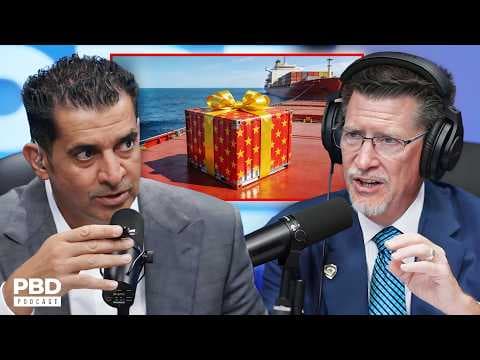
“A Gift From China” - Trump WARNS Xi Over Secret Missile Chemicals Given to Iran
Audio Summary
AI Summary
The discussion begins with President Trump's statement regarding the seizure of a Chinese ship carrying a "gift" to Iran, which he implied was not "very nice." This incident occurred amidst ongoing military actions where U.S. forces have reportedly "obliterated most of their missiles" and are actively restocking their own ammunition. Trump suggested this "gift" could be a form of assistance from China to Iran, despite his good relationship with President Xi.
An analyst speculates that the "gift" from China was rocket fuel, noting that China has previously shared satellite coordinates of U.S. bases in the Middle East, indicating a pattern of enabling Iran. The analyst interprets Trump's public mention of the "gift" as a subtle message to Xi, letting him know the U.S. is aware of China's activities without direct confrontation.
Another speaker highlights the current "age of misinformation" and the influence of powerful countries like Russia and China, which have a vested interest in prolonging the conflict and increasing costs for America. The removal of Maduro in Venezuela is cited as an example, as Venezuela was selling sanctioned oil at a discount to China, which was a significant financial benefit for China. China has a long history of supplying armaments to Iran, even during the current conflict.
The military capacity of Iran is discussed, with sources indicating that while it has been "seriously impaired," it has not been "obliterated." Approximately 50% of Iran's drone and bombing capacity remains intact. The Iranians are believed to be attempting to "outlast Trump," especially if their military capabilities are impaired but not fully disabled. This strategy is also influenced by U.S. internal politics, including upcoming elections and shifting public opinion polls which suggest a potential Democratic sweep in November.
Speculation arises that the "gift" contained "missile-related chemicals." The Supreme Court's decision on tariffs is brought up, with the argument that it may have emboldened China, removing a significant leverage point Trump had against them. The U.S. military's current state of readiness is questioned, with a report suggesting the U.S. could run out of weapons within two weeks if a conflict were to erupt in the South China Sea. Furthermore, 40% of THAAD missiles were used in the first 16 days of the Iran conflict, with restocking not expected until the end of 2027. This suggests China might be "testing" U.S. capabilities.
The seizure of the Chinese ship carrying missile chemicals in Hormuz is presented as China "seeing what they can get away with." While China is stronger now than 20 years ago, the U.S. has also taken actions that have impacted China, such as cutting off discounted oil from Venezuela and Iran, and losing control of the Panama Canal. These actions could be seen as cornering China, compelling them to support Iran. China's reliance on minerals and the U.S. lack of refineries are also mentioned as points of leverage.
The strategic importance of the Strait of Hormuz and Karg Island is discussed. If the U.S. controls these, it would significantly impact China's ability to control Iran and, by extension, challenge America.
Regarding "staying power," China is noted to have stockpiled significant oil reserves, suggesting preparedness for both a tariff war and the Iranian conflict. China's aggressive pursuit of clean energy, which now accounts for half of its energy needs, also provides a buffer against oil chokeholds. While a prolonged closure of the Strait of Hormuz could cripple China's economy, it would likely take at least three months, a timeframe that might be challenging for the U.S. given its political calendar and upcoming midterms.
The U.S.'s "higher threshold for pain" in an election year is questioned, particularly concerning public opinion and economic indicators beyond the stock market. The recent increase in tax refunds temporarily boosted retail sales, but this effect is expected to wane. The core question remains: who has more staying power, the U.S., Iran, or China? Some believe Iran and China have longer staying power than the U.S.
The financial strain on Iran is highlighted, with reports suggesting they are spending $400-500 million daily on oil, equating to $12-13 billion monthly. Some estimates suggest they can only sustain this for another two to six weeks before facing significant internal struggles and public frustration. The upcoming World Cup, starting June 11th, is mentioned as a potential factor, as Iran's participation could influence public sentiment or necessitate a ceasefire.
The lack of military defection against the Iranian regime is observed, despite hopes for internal uprising. It's argued that the army would only turn when its "own survival is at stake," likely spurred by a general population uprising, similar to what was seen in January. The U.S. political calendar and domestic pressures are seen as significant constraints for Trump, whereas the Iranian regime does not face similar concerns.
The idea of incentivizing the Iranian population to rise up is explored through the "Rewards for Justice" program. It's suggested that instead of massive military spending, a fraction of that, perhaps $1 billion, could be used to offer $5 million rewards to 200 top Iranian military leaders to defect. This approach, leveraging a quiet, underground CIA-type program, could potentially lead to a quicker end to the conflict by causing internal collapse within the Iranian military. A CIA commercial in Mandarin, aimed at recruiting Chinese spies, is cited as an example of such unconventional recruitment methods.
The counter-argument to this "utopian" idea is that Iran's leadership is driven by "radical Islam ideology" and "fanaticism," making financial incentives less effective. The IRGC (Islamic Revolutionary Guard Corps) numbers over 200,000 and is in control, making a few hundred defections insufficient to spark a widespread military revolt. While the idea of fostering internal insurrection is appealing, its practicality against a fanatical theocracy is doubted.
The discussion shifts to a promotional segment for the "Vault Conference," an event for entrepreneurs, CEOs, and business leaders. The conference's growth from 420 attendees in 2019 to an expected 12,000 in 2026 is highlighted. The event, taking place at the MGM Grand in Las Vegas, attracts decision-makers from companies with revenues ranging from $25 million to over $500 million. Sponsorship opportunities are available, offering brand visibility on the Las Vegas Strip, on-stage moments, and direct connections with attendees through a dedicated event app. Past sponsors include industry leaders like PayPal and Tony Robbins.