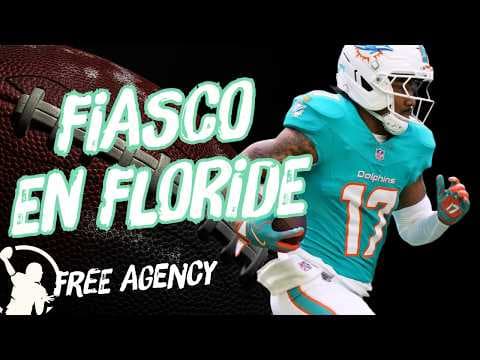
FREE AGENCY : FIASCO EN FLORIDE
AI Summary
Welcome to episode 998 of the Touchdown Actu podcast. This episode, hosted by Raoul Villeroi and Grégory Richard, offers an early assessment of the NFL offseason, specifically focusing on free agency. The hosts will discuss three teams considered "winners" and three teams considered "losers" of the free agency period. To end on a positive note, they begin with the winners.
The first team highlighted as a winner is the Denver Broncos. Their significant move was acquiring wide receiver Jaylen Waddle from Miami in exchange for a 2026 first-round pick, a third-round pick, and a fourth-round pick. This trade, while not strictly free agency, is considered a key offseason transaction. Waddle is seen as a crucial weapon for quarterback Bo Nix, addressing Denver's struggles to finish drives, especially given their 29th ranking in third-and-out conversions in 2025. Richard believes this trade is beneficial, particularly for a relatively young Broncos team that could benefit from experienced players rather than just accumulating draft picks. He points out that Denver was a top contender in the 2025 season, and Waddle's addition strengthens their receiving corps, especially in the red zone, complementing Courtland Sutton.
The Broncos also retained 17 out of 21 of their own free agents, bringing in only one outside free agent, safety Tyson Anderson, primarily a special teams player. Key re-signings include Singleton and JK Dobbins. Villeroi questions if a largely identical roster can win a Super Bowl, suggesting they might have missed opportunities to strengthen other positions. Richard, however, argues that with Bo Nix on a rookie contract, this was an opportune time to secure key players for the future, including a potential extension for Nix. He emphasizes that the Broncos, who had the best record in the AFC last season, have maintained their core, with only rotational defensive players departing. The team's sustained strength, especially with the potential for further development from players like Jadae Baron, makes their offseason moves commendable.
Next, the Pittsburgh Steelers are discussed. A major acquisition for them was wide receiver Michael Pittman Jr. from the Colts, who has 65 receptions over the last five seasons. Pittman is expected to provide a strong complement to Dick Metcalf, who was previously somewhat isolated on offense. Richard sees this as a significant upgrade, replacing Calvin Austin III and offering more versatility. He also highlights other key improvements: Ricole, who McCarty coached in Dallas, and Kenneth Gainwell, who had over a billion yards in the last two seasons and is familiar with the new coach's offensive system, are seen as upgrades at running back. On defense, the signing of Jamel Dean from Tampa Bay for three years and $36.75 million, the second-largest free agent contract in Steelers history, is a significant boost to the defensive backfield, replacing Darius Slay. The Steelers also signed safety Jaquan Brisker to a one-year deal, a local player from Penn State, which is viewed as an improvement over previous options.
Despite these positive moves, the main "elephant in the room" for the Steelers is the quarterback situation, with Aaron Rodgers potentially returning but no official signing yet, leaving Mason Rudolph as the current QB1. Richard acknowledges this uncertainty but believes that if Rodgers joins and the team addresses their interior offensive line needs in the draft (they have the 21st pick), the Steelers could be a formidable force in the competitive AFC North. Given that they made the playoffs in 2025, maintaining or improving their performance makes their free agency a success.
The final "winning" team is the Carolina Panthers, who narrowly made the playoffs. The arrivals of edge rusher Jaylen Phillips and linebacker Devin Lloyd are key. Villeroi raises concerns about the left tackle position, particularly Iken Equon's uncertainty, and whether the 19th draft pick can address this. Richard admits initial apprehension about general manager Dan Morgan's early moves, especially the departure of Brian Burns. However, he notes a positive shift, especially in strengthening the trenches. The Panthers are seen as building on their unexpected NFC South win, capitalizing on Bryce Young's rookie contract to become more credible playoff contenders.
Defensively, Devin Lloyd is considered the best linebacker on the market, and Jaylen Phillips's signing is a substantial investment: $120 million over four years, with $80 million guaranteed, despite his injury history. Richard acknowledges the risk but notes Phillips's potential when healthy and his ability to mentor younger players like Nick Curton and Prince Leoman-Mielen. The expectation is that Bryce Young will need to elevate his offensive play to match the defensive investments. Overall, the Panthers are seen as having a strong free agency by adding experience and talent to a young roster.
Moving on to the "losers" of free agency, the first team discussed is the Miami Dolphins. Villeroi describes their actions as a "panic move," noting the departure of key players like Tua Tagovailoa, Tyreek Hill, and Jaylen Waddle. While they gained significant draft capital, the loss of almost all their star players raises concerns about a clear long-term strategy. Richard agrees, suggesting the Dolphins are clearly aiming for the first pick in the 2027 draft. He finds the complete dismantling of the roster problematic, particularly the trade of Jaylen Waddle.
The Dolphins signed around 36 players, most of whom are rotational players from other NFL teams, with their current receivers being Jalen Tolbert and Malik Washington. The signing of Malik Willis for $67.5 million despite only six career starts is heavily criticized, especially given the lack of talent around him. Richard fears this move could derail Willis's development and set the team back significantly, potentially judging him prematurely in a "disastrous" situation. He contrasts Miami's approach with that of the Cardinals, who, despite also being in a rebuilding phase, made more sensible decisions, particularly at quarterback, acknowledging a transition year. Richard also points out the ongoing issues with Miami's offensive line, particularly the interior, which further compounds the problem. He views this "tanking" strategy as historically ineffective for teams like the Jets, Browns, and Raiders, questioning the value of accumulating draft picks without a clear plan for player development in a league with increasingly homogeneous draft classes.
The second "losing" team is another Florida franchise, the Jacksonville Jaguars. Villeroi immediately notes their cap space issues, arguing that this is not an excuse for losing key players like Travis Etienne and Devin Lloyd without adequate replacements. He views their offseason as poor. Richard concurs, highlighting the loss of important players and the questionable replacements. He acknowledges their strong finish to the 2025 season with eight consecutive wins, but worries this might have been an overperformance.
The Jaguars' offensive backfield now relies on Bal Tuton, Liquint Allen, and Chris Rodriguez, none of whom are seen as significant upgrades. Combined with Trevor Lawrence's inconsistent performance and the underutilization of Ban Thomas, the team appears weakened. Richard compares them to the 2023 Giants, who also had an impressive initial season under a new coach but saw their success crumble due to poor management. He believes the Jaguars are now "tributary" to their financial constraints, losing ground to teams like the Texans, who, despite winning the AFC South, have shown more proactive efforts to improve. The decision to have Travis Hunter play solely as a cornerback, rather than both offense and defense, is also seen as a signal of lowered expectations and a lack of control.
Finally, the Tampa Bay Buccaneers are named as the third "losing" team. Villeroi highlights the depletion of their defense and, more painfully for him, the departure of Mike Evans, a franchise icon. He suggests Evans's departure might indicate a belief that he couldn't win with Tampa Bay, or it could be poor contract management. Richard views the Buccaneers' situation as more nuanced but still negative. He notes that the team collapsed mentally at the end of the 2025 season, giving the playoffs to Carolina. While acknowledging cap management challenges, he points out the significant loss of veteran leaders and core players.
The Buccaneers did try to anticipate some departures by bringing in cornerbacks Morrison and Parish and drafting Mec Booka and Jalen McMillan to fill Evans's void. They also signed Alex Anzalone and Christian Rosboom, but the potential departures of key figures like Lavonte David further weaken the team. Richard questions if the team can maintain or improve its level of play, especially with internal issues like Todd Bowles's coaching record and Baker Mayfield's inconsistent performance. He believes Bowles is on the hot seat, pointing to the team's collapses against weaker opponents in 2025 as evidence of underlying problems. The overall sentiment is that the Buccaneers are sending signals of decline rather than resurgence, unlike teams that successfully rebuilt after similar setbacks.
In conclusion, the podcast identifies the Denver Broncos, Pittsburgh Steelers, and Carolina Panthers as the winners of the 2026 free agency, while the Miami Dolphins, Jacksonville Jaguars, and Tampa Bay Buccaneers are named as the losers.