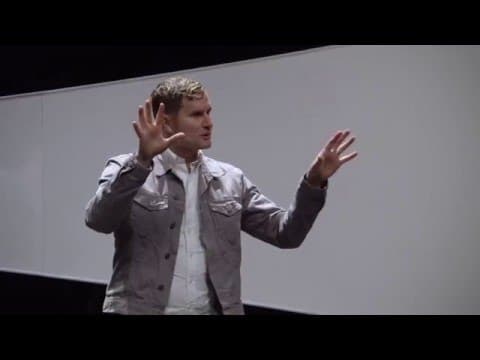
Rob Bell / Everything is Spiritual (2016 Tour Film)
AI Summary
The speaker explores the concept that "everything is spiritual" by examining stories humanity tells itself, the scientific understanding of the universe, and the nature of human experience. He begins by contrasting the triviality of modern "tribal fires" like the Super Bowl with the ancient human need for stories that provide meaning and coherence.
He identifies three dominant narratives that have shaped human understanding. The first, thousands of years old, asserts the superiority of "our tribe, our God, our way," often leading to conflict and accumulation of power. The second, about 300 years old, champions human intellect and scientific progress, believing that given enough time, humanity will solve all problems. However, this story has been challenged by the immense loss of life in modern wars, suggesting its limitations. The third, a more recent narrative, posits that there is no larger meaning, only the physical existence of cells and synapses, and that ancient stories are part of the problem. This view emphasizes survival of the fittest and the finality of death. The speaker argues that none of these stories adequately provide the "glue" or "narrative" needed to live with hope and courage today.
He proposes a new story, integrating modern scientific understanding with timeless wisdom, to explain who we are, what we're doing here, and what it all means. This new narrative begins with the universe itself. Scientific consensus suggests the universe originated from a single, infinitely dense point 13.8 billion years ago, expanding ever since. This "sextillion-ton pinprick" of energy, an "ineffable singularity of stupendous fecundity," has been in a state of ongoing creation.
The universe’s evolution began with particles bonding to form atoms, then atoms forming molecules. These molecules eventually led to the creation of stars through thermonuclear fusion, producing heavier elements like carbon, oxygen, and nitrogen—elements essential for life. Later, planets formed, and around 10 billion years in, molecules bonded to create the first cells and organic life. Human beings arrived very late in this cosmic timeline, just in the last second of a 24-hour day representing the solar system's age. Despite our late arrival, humanity rapidly developed fire, tools, language, and complex societies.
The speaker then turns to the human body, a complex system of billions of cells constantly dying and being reborn. He uses the metaphor of a boat whose parts are entirely replaced over time, yet it remains "the same boat," to illustrate that our identity lies more in our pattern than in our physical components. We are "cellular patterns" moving through time.
Delving into the subatomic level, he notes that atoms are made of particles, which are further composed of at least 150 subatomic particles. At this quantum level, reality becomes "very, very, very weird very fast." Particles appear and disappear, travel without traversing intermediate space, and take all possible routes simultaneously until observed. This leads to the conclusion that at its smallest level, reality is energy in relationship. This fundamental interconnectedness explains intuitive knowing, like sensing when someone is lying or when one is unsafe. We are literally made of "stardust"—the same carbon, oxygen, and nitrogen created in stars.
The universe is a "self-transcending reality" that has been increasing in complexity, depth, and unity for 13 billion years. Atoms are more complex than particles, molecules more complex than atoms, and so on. This movement towards greater complexity is less probable, like paint cans spontaneously forming a mural. Each new layer of existence adds depth, and the bonding of earlier components creates something new with emergent properties not present at the lower level—an "epiphenomenon." The example of a flock of birds, where a communal mind emerges without being traceable to any single bird, illustrates this. Similarly, human attributes like hope, dreams, fear, and joy, which define our unique personhood, cannot be located in our physical cells.
The universe also moves towards unity, with things bonding with others of similar essence to form something bigger. This explains the deep human longing to be part of something greater than oneself, and why loneliness and racism are so destructive—they go against the universe's inherent drive towards connection and unity. Fundamentalism, which seeks to return to a "pristine past," also runs counter to the universe's forward momentum.
Human beings, arriving late in this unfolding, developed "consciousness"—the ability to reflect on our own existence, ponder meaning, and discern progress. This capacity to recognize what is "worse" and what is "better," and to strive for further improvement, suggests that "progress is the soul of the universe," as Teilhard de Chardin said. This inherent drive to self-transcend, to move forward in complexity, depth, and unity, is what the speaker calls "love." He connects this to ancient teachings, noting that the idea of "God is love" is not new.
He illustrates the nature of love through human relationships: true love involves understanding others' perspectives, leading to personal growth and wisdom. It creates something bigger than the sum of its parts, a "depth" and "unity" where individuals participate in something larger than themselves.
The speaker then explores Jesus' teachings about the "Kingdom of God," which he describes as an "expanding reality of the divine" that is both "among you," "upon you," "at hand," and "within you." Jesus used parables because literal language was insufficient to describe this ever-expanding, ever-growing realm of spirit. The question then becomes: is the universe done unfolding? Or are there new layers yet to emerge, particularly when people bond with each other in similar essence and substance? This implies a "new humanity" where collective action creates something never before seen.
He connects this idea to ancient mystics' concept of "Christ consciousness" as a universal animating energy that holds everything together and pulls it forward. They believed humanity forms "one body," a "new humanity" transcending divisions, where each person has a role. Rituals like the Eucharist symbolized this unity, emphasizing shared humanity and mutual care.
Further supporting this, research by Kate Pickett and Richard Wilkinson in "The Spirit Level" demonstrates a direct correlation between the gap between rich and poor in developed nations and various societal health indicators (life expectancy, crime, mental illness, literacy). A wider gap consistently correlates with worse outcomes, even for the wealthy. This suggests a profound interconnectedness, demonstrating that "we are all way more connected than any of us first realized."
Finally, the speaker offers three practical applications for this new story:
1. **Your Past (Dark Matter):** He notes that 96% of the universe is unknown "dark matter" and "dark energy," which scientists believe is vital for the universe's existence. Similarly, our personal pasts contain "dark matter"—experiences of pain, failure, loss, and suffering that, while awful at the time, are often what shape us and lead to gratitude. Embracing this "dark matter" rather than denying it allows for unexpected, redemptive life to emerge. By entering into our own and others' suffering, we tap into a universal force that carries us forward.
2. **Your Present (Love's Direction):** In moments of criticism, misunderstanding, or slander, our natural inclination is to shrink back. However, the universe's fundamental direction is forward, expanding and self-transcending in love. Love, in this context, means moving beyond oneself for the well-being of the world. The "art of being alive" is to recognize these moments and choose to align with the universe's forward movement, even if it requires temporary rest or healing.
3. **Your Future (Omnicentricity):** The expanding universe is "omnicentric," meaning every point is its center. We are each a center of the universe. Our greatest moments of love, joy, and connection originate from a grounded center and move outwards, overflowing and generative. The question then becomes: what potential, what "pre-life embryo genetic form," resides within us, waiting to explode into the universe? What new life can emerge through us if we open ourselves up and allow it, transcending our perceived limits and boundaries?
He concludes with a benediction, urging the audience to embrace their dark matter, align with the universe's forward-moving love, and see themselves as grounded centers from which new life is waiting to explode, recognizing that "everything is spiritual."