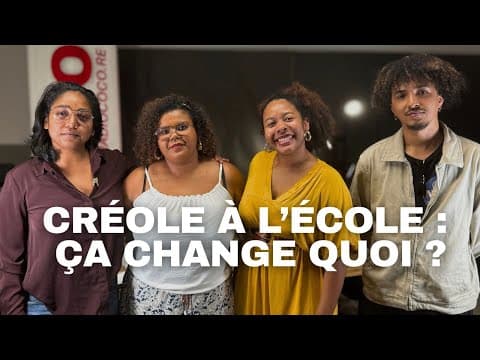
Grandir avec ou sans le créole réunionnais à l’école, ça change quoi ? | REPLAY LIVE @RadioCoco974
Audio Summary
AI Summary
This YouTube live session, hosted by Émilie, explores the place of Creole in education and Reunion society. Joined by Soun, Walid, and Alicia, the discussion begins with a reflection on their personal connections to the Creole language. For some, it's a daily presence, a constant companion, while for others, it represents culture and a way to assert their Reunionese identity. Early memories of Creole range from a traumatic primary school experience where a child was corrected for using a Creole word, to arriving in Reunion as an 8-year-old and being immediately immersed in the language by family. Another participant recalls visiting a museum where the history was presented in Creole, highlighting initial difficulties in full comprehension despite a Creole-speaking environment.
The conversation then shifts to the educational experience with Creole. While Creole became officially recognized as a regional language of France and began to be taught in the early 2000s, many participants had limited or no formal Creole classes during their schooling. One guest had only one Creole class in primary school, while another, Alicia, discovered the language later, choosing it as an option for her baccalaureate. Initially, Alicia viewed Creole as something learned naturally within the family, not something taught in school. However, taking the Creole option in her final year of high school revealed a deeper understanding of the language, its grammar, vocabulary, and its cultural significance. She discovered words like "bardo" (sunrise) and realized Creole was more than just a spoken language; it was a rich cultural expression. This led her to pursue higher education in Creole studies.
Walid, who moved to Reunion at age 8, had a different experience. His parents, who communicated with him in French, spoke Creole amongst themselves. He learned Creole through family immersion and found it easy to master. However, he notes a lack of formal Creole education in his schooling, contrasting it with the teaching of foreign languages like English and Spanish. He believes learning one's own language should precede learning others. The discussion highlights a common perception among parents that Creole was not a language to be formally taught but rather learned organically. This perception, unfortunately, led to a lack of Creole options in schools for a long time.
Alicia recounts her parents' initial hesitation towards her taking Creole classes, driven by the idea that it was not a "real" subject. However, with the goal of obtaining her baccalaureate, she pursued the option, which later transformed her perspective. She emphasizes that learning Creole in school went beyond mere language acquisition; it involved understanding its cultural context, history, and nuances. She also shared a personal struggle with French during her studies, feeling a disconnect despite it being her primary language of instruction. This experience, she explains, made her feel more at ease and confident when speaking Creole, highlighting the language's role in personal empowerment.
The participants discuss the devaluation or valorization of Creole in schools. While no one recalled instances of Creole being explicitly devalued, there were also few instances of it being actively valorized beyond cultural events like Fête Kaf. The absence of consistent valorization meant that for many, Creole remained an informal part of their lives, separate from their academic journey.
The conversation then moves to higher education. Alicia pursued a Bachelor's degree in French Literature and later added a Creole degree, recognizing the complementary nature of both languages. She is now pursuing a Master's in teaching (MEF) with a specialization in Creole language, aiming to become a Creole teacher and prevent the language from fading. Walid has also recently started a Master's in MEF focusing on Creole language. Both express a desire to contribute to the preservation and transmission of Creole.
The discussion touches upon the challenges in teaching Creole, including a lack of resources and lingering prejudices. Alicia's master's research on the place of Creole in secondary schools revealed that some parents and educators still hold outdated perceptions about the language. The need for more developed resources for teachers is also highlighted.
The potential impact of strengthening Creole education is explored. It is suggested that increased Creole instruction would foster a stronger sense of identity and cohesion among Reunionese people, creating a more inclusive environment where everyone feels at home. The idea of a "paradise" in schools, where Creole is fully integrated, is proposed as a way to combat discrimination and promote cultural understanding.
The debate about the perception of Creole versus French in professional settings is also brought up. While French is often seen as the language of opportunity and success, there's a growing recognition of the value of Creole. Participants share experiences of feeling more confident and less stressed when they can use Creole in professional contexts. The challenge of speaking French in official settings, even when advocating for Creole, is highlighted as a frustrating paradox.
In their personal lives, while some participants speak Creole daily with family and friends, others are actively working to re-appropriate the language, sometimes facing self-consciousness or fear of judgment. The influence of music in learning Creole is emphasized, with many artists like Daniel Warot and Maya Kamati cited as inspirations. The poetic and imaginative qualities of Creole are celebrated, with participants sharing how music has helped them discover new words and understand cultural nuances.
The live session concludes with an invitation to listen to a song by Léa Noël, an artist who embraces multilingualism in her art. Léa shares her journey of learning Creole and how it naturally integrates into her music, emphasizing its poetic and expressive power. She highlights the importance of music as a vehicle for language and cultural transmission, drawing parallels to the historical oral traditions of Reunion. The discussion also touches upon the challenges of translating and transcribing Creole lyrics, underscoring the language's unique nuances. Léa announces upcoming performances, encouraging the audience to experience her music live. The session ends with a Maloya song by Léa Noël, chosen to represent the diverse identity of Reunion.