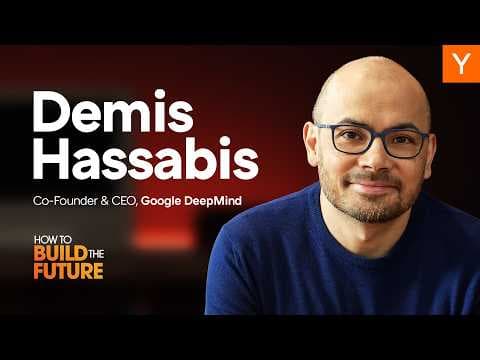
How to Build the Future: Demis Hassabis
Audio Summary
AI Summary
Demis Hassabis, co-founder of DeepMind and now head of Google DeepMind, shared insights into the current state and future of artificial general intelligence (AGI), emphasizing the foundational role of large-scale pre-training, RLHF (Reinforcement Learning from Human Feedback), and chain of thought in the final AGI architecture. While acknowledging these components as crucial, he highlighted several unsolved challenges, including continual learning, long-term reasoning, and specific aspects of memory, which he believes are essential for achieving AGI. He also stressed the need for systems to be more consistent across tasks.
Hassabis drew parallels between the brain's memory consolidation during sleep and DeepMind's early work with "experience replay" in DQN, which allowed the system to master Atari games by replaying successful trajectories. He noted that current approaches, like shoving all information into a large context window, are "brute force" and inefficient, even with context windows reaching millions of tokens. He believes there's significant room for innovation in memory systems, as the cost of looking up and retrieving relevant information remains non-trivial. While a million-token context window might seem large, it's quickly consumed by live video processing, underscoring the need for more efficient and selective memory mechanisms.
Discussing DeepMind's historical emphasis on reinforcement learning (RL) and search, evident in projects like AlphaGo and AlphaZero, Hassabis confirmed that this philosophy is deeply embedded in the development of Gemini. He suggested that RL might still be "underrated" and that many of the pioneering ideas from AlphaGo, such as thinking modes and chain-of-thought reasoning, are now resurfacing in current foundation models. He anticipates significant advancements in the coming years by re-exploring and scaling these older RL ideas, including Monte Carlo tree search.
Hassabis also addressed the trend of model distillation, where the power of large frontier models is packed into smaller, more efficient versions. He stated that DeepMind excels in this area, having a significant need to serve billions of users across Google's products with low latency and cost. He expressed optimism that there's no inherent "informational limit" to how smart smaller models can become, predicting that today's frontier capabilities will eventually be available in tiny, even edge, models within a year. These smaller, faster models, like the Gemma series, are crucial for rapid iteration in applications like coding and for running AI on edge devices for efficiency, privacy, and security, especially in robotics and personal assistants.
On the topic of reasoning, Hassabis acknowledged the impressive chain-of-thought capabilities of current models but pointed out their failures on tasks that a "smart undergrad wouldn't." He suggested that current thinking paradigms are "simplistic" and "brute force." He imagined improvements such as monitoring and interjecting midway through a thought process, noting that models sometimes "overthink" or get into loops. He cited playing chess against Gemini as an example, where the model might identify a blunder but, unable to find a better move, still executes it. This "jagged intelligence"—solving complex problems like IMO gold medals while making elementary math errors—suggests a missing "introspection about its own thought process."
Regarding AI agents, Hassabis agreed that they are "just getting started" and are a necessary path to AGI because AGI requires an "active system" that can actively solve problems. He believes the industry is still in an experimentation phase, learning how to best integrate agents into workflows to provide fundamental value beyond mere demonstrations. He observed that while agents can accelerate prototyping, they still lack the "craft," "human soul," and "taste" needed for truly groundbreaking creative work, citing the absence of a "hit game" entirely "vibe coded" by AI.
Hassabis pondered the concept of creativity in AI, referencing AlphaGo's famous "move 37." While impressive, he questioned whether current systems could "invent Go" if given a high-level description of a beautiful, complex game with simple rules. He believes something is still missing to enable this level of generative creativity. However, he also entertained the possibility that existing systems might be capable of such feats if combined with a "brilliant enough creative person" who is "at one with the tools."
On open source, DeepMind's release of Gemma models reflects their commitment to open science and the belief that highly capable, accessible models should be in the hands of users. He highlighted the strategic advantage of making edge models open, as they are inherently vulnerable once deployed on devices.
Discussing multimodality, Hassabis emphasized that Gemini was built with this capability from the start, a decision that initially made development harder but is now yielding long-term benefits, particularly for world model building and robotics. He foresees multimodal foundation models becoming essential for robotics and digital assistants that interact with the physical world, understanding intuitive physics and context.
Regarding the cost of inference, Hassabis doubted it would ever be "essentially free," citing Jevons paradox. He predicted that users would consume any available inference capacity, whether through swarms of agents or single agents exploring multiple directions. Even if energy costs drop to near zero due to scientific breakthroughs, he expects physical bottlenecks in chip production to maintain some rationing of inference for decades.
In the realm of science, beyond proteins, DeepMind's spin-out, Isomorphic Labs, is focused on drug discovery, aiming to design compounds with desired properties. Hassabis envisioned a "virtual cell" simulation within about 10 years, allowing researchers to perturb and analyze cellular systems. He noted the challenge of insufficient data, particularly the inability to image a live cell at nanometer resolution without destroying it, which would otherwise transform it into a solvable vision problem.
Hassabis believes AI will revolutionize all scientific and engineering fields. He recalled DeepMind's original two-step mission: "solve intelligence" (build AGI) and "use it to solve everything else." He clarified that "everything else" referred to "root node problems" in science that unlock new branches of discovery, with AlphaFold serving as a prime example of this impact. He sees many current scientific endeavors as being at an "AlphaFold one moment," with promising results but not yet having fully solved grand challenges.
For startups aiming to advance the scientific frontier, Hassabis recommended combining AI with another deep technology area, especially those involving the "world of atoms" like materials science or medicine. He believes these interdisciplinary efforts are more "defensible" against rapid changes in foundation models and offer long-lasting value, albeit being inherently difficult. He stressed the importance of passion and conviction in pursuing such deep tech problems.
Hassabis identified a pattern for AlphaFold-style breakthroughs: a massive combinatorial search space, a clear objective function (like minimizing free energy or winning a game), and sufficient data or a simulator to generate synthetic data. He believes these conditions allow current AI methods to effectively find "needles in a haystack," like optimal drug compounds or Go moves.
On the meta-level of AI doing genuine scientific reasoning beyond pattern matching, Hassabis thinks we are "close." He described systems like "co-scientist" and "alpha evolve" that push these boundaries. However, he hasn't yet seen a "true genuine massive discovery" from AI. He attributes this to a missing element related to creativity and going "beyond the bounds of what's known," which requires analogical reasoning rather than mere extrapolation. He proposed an "Einstein test": training a system with 1901 knowledge and seeing if it can deduce Einstein's 1905 discoveries, including special relativity.
Finally, for aspiring technical pioneers, Hassabis advised tackling hard, deep problems, as they are "no more difficult" than shallower ones, just differently challenging, and offer a greater chance to "make a difference." He reiterated the value of interdisciplinary work, especially with AI, and urged founders to consider the implications of AGI appearing mid-journey in their deep tech ventures, planning for how their systems might leverage or interact with AGI. He suggested that AGI systems might use specialized AI tools like AlphaFold as separate, efficient components rather than trying to integrate all knowledge into one giant, less efficient brain.